
A few Christmases ago, my stocking was bulked out by a copy of Doris Kearns Goodwin’s biography of Abraham Lincoln, Team of Rivals. There wasn’t much mirth in Lincoln’s story. When he was nine, his mother died, and his father set off in search of a new wife, leaving Abe and his sister Sarah to fend for themselves through a winter in which, as Lincoln later put it, “the panther’s scream filled the night with fear and bears preyed on the swine.”
For festive fortitude, we are better off turning to another story of a great son of Illinois left to fend for himself: the events of Christmas 1990 at 671 Lincoln Avenue, Winnetka. Abraham had to survive panthers and bears in his lonely winter; Home Alone’s Kevin McAllister only has to worry about the Wet Bandits.
You already know the story. Kevin is the black sheep in a wealthy, inattentive family. But when disaster strikes, Kevin’s strength and moral example save not only him, but all the McAllisters.
It’s not just the size of 671 Lincoln Court that reminds you you’re watching a film from an altogether different era. When released in 1990, the film cost just $18m to make but grossed nearly half a billion at the box office. That’s a Marvel-esque figure at a time when tickets cost a tenth of what they do at your nearest Everyman. It remained the highest-grossing live-action comedy for more than two decades.

That acclaim, and the film’s present yuletide ubiquity, are justly deserved. With John Hughes writing, Chris Columbus directing and John Williams providing the music, the whole production has a sense of the A-Team getting together for one last job. You can glimpse the commitment in how diligently potential plot holes are tracked down, isolated and exterminated. Would the parents not notice Kevin’s unused plane ticket? No, because it was swept into the bin accidentally with some spilled milk the night before. It’s full commitment from an all-star squad.
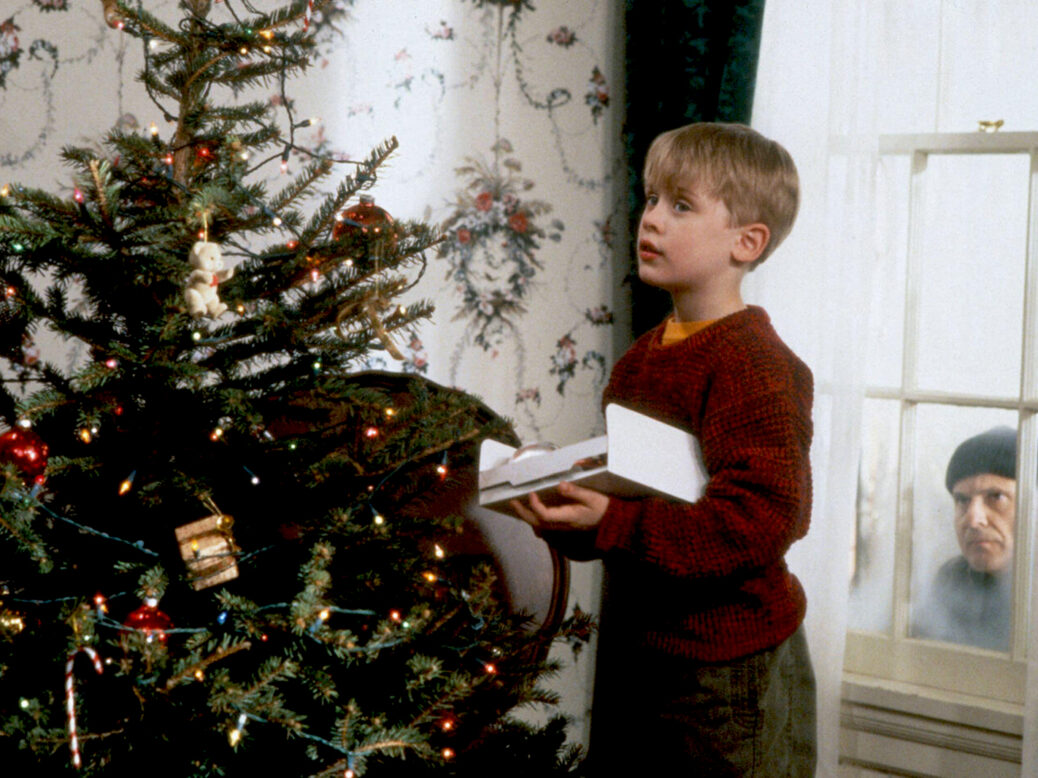
Today, Home Alone sits firmly atop the pantheon of Christmas favourites. But I wonder if we take the right lessons from it. The most famous and remembered scenes are the parts where Kevin outwits the two criminals attempting to rob the house. The film’s iconic cover shows Macaulay Culkin in faux-existential panic, Munch’s Scream with a bowl cut, while Joe Pesci and Daniel Stern loom at the windows. But fairly little time is actually devoted to this confrontation — just the closing 20 minutes.
The rest of the film is a much longer set of meditations on solitude and survival. It put me in mind of Jane Austen’s Mansfield Park: not, I think, an unfair comparison. Kevin has a touch of the Fanny Price about him. They are both mansion-dwellers confined to the attic, blamed for things beyond their control, declared early on as “les incompétents” by those most worthy of the epithet, both have families who think they can do without them but who, in the end, all come crawling back.
What unites Kevin and Fanny above all, though, is their competence. The enduring conceit of Home Alone is a simple one: it’s set in a world in which the children are adults, and the adults are children.
8-year-old Kevin is eternally useful, a font of embodied capability and practical knowledge. He chops trees, lays traps and prioritises dental hygiene (“Is this toothbrush approved by the American Dental Association?”). His last meaningful line in the film, “I got some milk, eggs, and fabric softener”, is decidedly logistical. When he realises the burglars are coming, he stiffens his sinews like one of Kipling’s boy-men: “I can’t be a wimp. I’m the man of the house.”
Whilst Kevin, the Robinson Crusoe of the Midwest, carries on in splendid isolation, the adults are utterly helpless. The McAllister family make a woeful attempt to get Kevin back before swiftly resigning themselves to the tacky Montmartre bolthole they inexplicably chose over their Christmas snow-covered mega-mansion. The police, led by the aptly named Sergeant Balzac – specialist in family crisis intervention – are lazy and ineffectual. The Parisian customer service representative at Charles de Gaulle airport is roughly what you’d expect. When the pizza delivery man hears the sound of gunfire playing from a television indoors, he runs for cover like he’s an extra in Band of Brothers. And then there’s Frank, Kevin’s uncle and freeloader extraordinaire, the ultimate man-child, robbed of the ability to pay for anything, resorting to the insults of a pre-teen (“Look what ya did, ya little jerk!”), and eyeing any object of value with the intensity of a greedy child racing to the Christmas tree.
The villains, of course, are the most juvenile of all. The “Wet Bandits” are so named because they flood every house they rob. Kevin’s Pepsi-addicted young cousin, Fuller, is chastised throughout the film for wetting the bed. The Wet Bandits revel in wetting entire homes. A child’s shame becomes a criminal’s calling card.
Since it is the adults of Home Alone who have all the growing up to do, it would be wrong to look to Kevin for a bildungsroman plot. But the film does have one. Kevin’s mother is first alerted to Kevin’s loss by a sudden, metaphysical pang, hearing his voice as their plane flies across the Atlantic — as Jane Eyre hears Rochester across the ether. Her consequent scream is followed up, for once, by some actual agency: she resolves to stay at the airport, and barter and beg her way back around the world to her son. This she manages, thanks to the (often reluctant) kindness of strangers, most famously from a folksy polka band who offer her a ride in the back of their van.
It is Kate McAllister, not Kevin, who changes the most. Kevin’s lesson is – and I suppose should be – simply to be more Kevin. Kate comes of age. When reunited, it’s no longer a tale of Kevin longing for his mother’s approval, but she longing for his: “Oh Kevin, I’m so sorry,” she atones. His reply is characteristically practical: “Where’s everybody else?”
Now, I think we get to the real reason the film endures. Seen from the angle of a parent, the story of the McCallister clan is much more reflective of what life actually looks like than we care to admit. Throughout the film, adults keep coming to Kevin for guidance: most notably Old Man Marley, the recluse next door, who via some wise counsel from Kevin in a nearby church, is convinced to reconcile with his estranged son. ‘Aren’t you a little old to be afraid?’ Kevin asks. ‘You’re never too old to be afraid,’ comes the reply.
One of my favourite books about parenting is J.G. Ballard’s memoir, Miracles of Life, which details his life as a single father after the untimely death of his wife whilst on holiday in Spain. Written near the end of his life, it rapidly becomes clear that parenting, for Ballard, was much closer to a two-way street than most of us usually admit. As he puts it, “I still think that my children brought me up, perhaps as an incidental activity to rearing themselves.”
The lesson, I think, applies to all of us, child, parent, or whatever. We are all fallible, and we all need innocence. But of course we can never say that out loud. So we all pretend the McAllisters are hopeless: an anomaly, an exception, rather than the rule. Or that Kevin is a brat. That’s what Christmas films do best: remind us that wisdom often runs backwards. It’s why Arnold Schwarzenegger’s painful odyssey in Jingle All the Way is all in search of a plastic action figure. Or why Hugh Grant’s Prime Minister in Love Actually can only declare his love at a children’s nativity play. The Grinch had Cindy Lou. Scrooge had Tiny Tim. We have Kevin McAllister, the eight-year-old competence machine, to remind us how much we will always have left to learn.
[Further reading: Richard Curtis’s Christmas carol]
Content from our partners



Related

Join the debate
Subscribe here to comment