
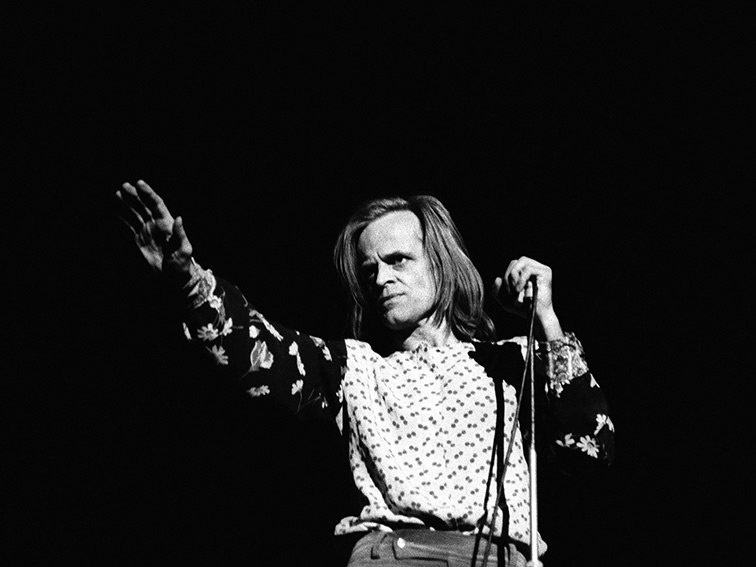
When film directors talk about shooting, they tend to mean with a camera. When the actor Klaus Kinski was on set, they often meant with a gun. Kinski would start fights, ignore instructions, make absurd demands and, on occasion, turn a gun on cast members for being too noisy – he blew off an extra’s fingertip during the filming of Aguirre, the Wrath of God (1972). So violent and destabilising was he that, during the filming of Crawlspace (1986), the entire crew begged the director David Schmoeller to “please kill Mr Kinski”. The film’s producer was way ahead of them, telling Schmoeller that it was worth shooting Kinski dead to get the insurance pay-out and be rid of him. Kinski’s children may well have agreed. His daughter Pola alleges he sexually abused her for more than a decade. Of his three children, only one attended his funeral in 1991.
Kinski is not, then, an obvious pick for ventriloquising the saviour of mankind. And yet, on one night in 1971, he did just that, taking to a Berlin stage to give a furious one-man show about Jesus Christ. It collapsed into anarchy, as Kinski harangued the audience and they hurled “fascist” back at him like rocks at a stoning. It was to be his last performance on the German stage – a performance that Benjamin Myers’s latest novel, Jesus Christ Kinski, brilliantly recreates.
Myers’s previous books can broadly be split into two camps: a warm, sometimes visionary pastoral (Rare Singles, The Perfect Golden Circle, parts of Cuddy), and a hard, vernacular lyricism, full of blood and spit (Pig Iron, The Gallows Pole). Jesus Christ Kinski straddles both, and showcases Myers’s animating interest in male misfits, as well as extending his formal range.
The novel is written in alternating voices: the manic screed of Kinski, and that of the Myers-surrogate, simply called “the writer”, who tells how during Covid “the writer” became obsessed with footage of the one-off Jesus Christus Erlöser performance.

Narrated largely in the second-person, Kinski stalks himself. His principal enemy is one Klaus Kinski, with dishonourable mentions for his agent, critics, journalists, Jews, women, doctors, audience members, the soft-headed liberals of the new Germany and, of course, Werner Herzog. He may have directed the films on which Kinski’s artistic reputation rests, but according to Kinski, Herzog is a “worthless, simpering piece of rat shit”, and a “cretinous… Bavarian hick”. Those are the gentler quotes.
Myers’s title speaks to the various echoes at play in the book: in Jesus Christ Kinski we hear Kinski berating himself and others berating Kinski; we hear, too, a hint of reluctant awe in the face of a monstrous man with monstrous talent. It also captures Kinski’s fantasy: that in his one-man performance he resurrects Christ, such that Jesus Christ Kinski becomes one person, ready to preach at the flock and bed their wives.
The writer’s sections are quieter, telling a story of the novel and offering up some fairly bland cultural diagnosis about the puritanism of youth, the collapse in “trusted narratives”, and the idiocies of cancel culture.
The two narrators are given distinct shape on the page: the writer’s words are always in two narrow columns running down the page like newspaper print, while Kinski’s sections jump between internal monologue, dialogue, script lines and stage directions, with words scattered about like shrapnel. Interspersed are black and white photographs of the show, with ever-closer crops of his wild stares and gestures. This gives Kinski a terrific immediacy. But where the actor is full of destructive energy, swinging between the narcissist’s poles of self-pity and self-aggrandisement, the writer is flat, defensive about his “widely disliked” subject, and rather too keen to congratulate himself for writing about him anyway. It can feel at times like a PR covering for their client’s self-inflicted injury.
Much in these sections is superfluous. For example, having clearly shown the violent charisma of Kinski and suggested his sympathy for Hitler, nothing is added by the writer telling us that “Kinski raged with the hysterical conviction of the totalitarian egoist, [which] reminded him of Adolf Hitler”.
The book’s achievement lies in the throbbing life force of Kinski himself. His is a dark star, close to collapse. It offers no guiding light but continues to burn five decades on from that winter evening in Berlin.
Jesus Christ Kinski
Benjamin Myers
Bloomsbury Circus, 208pp, £18.99
Purchasing a book may earn the NS a commission from Bookshop.org, who support independent bookshops
[Further reading: On the front line in the Battle of Ideas]
Content from our partners



Related

This article appears in the 23 Oct 2025 issue of the New Statesman, Doom Loop
Join the debate
Subscribe here to comment