
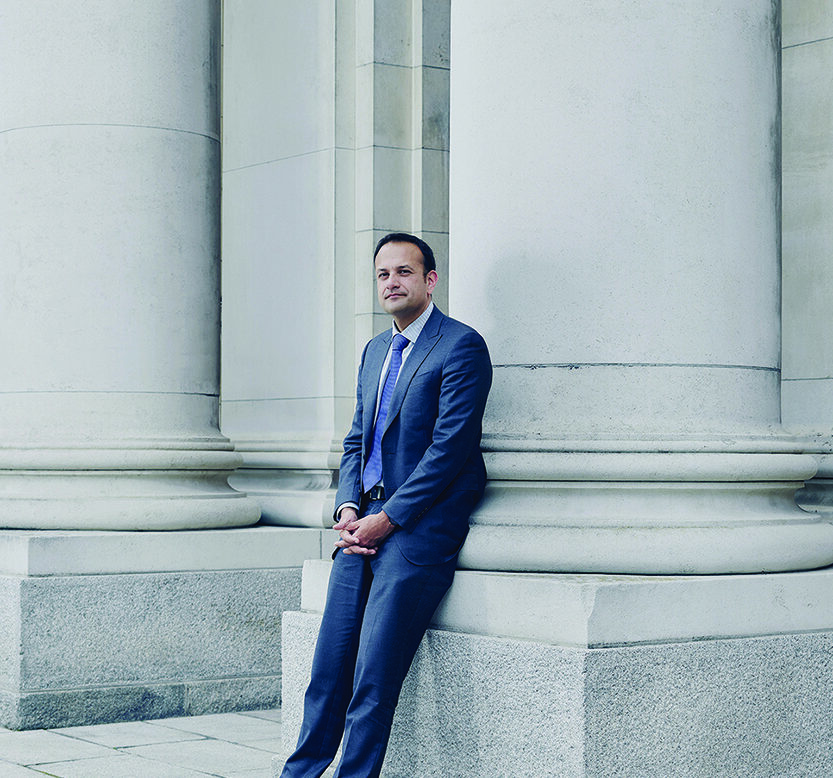
No Irishman since Éamon de Valera has confounded the British more than the former taoiseach, Leo Varadkar. Young, gay, half Indian – the Westminster establishment could not comprehend this in an Irish leader. Where did the buckled shoes and peat-worn hands go? Didn’t Rome – the real governing force of that island – take issue with the homosexuality? Could that man in a well-cut suit really be the chosen patron of all those saints and scholars? And why – thank you to Boris Johnson for asking, in 2019, the critical question – “isn’t he called Murphy like the rest of them?”
Until Varadkar took office in 2017, there existed a small stock of Hiberno-characters in the British political imagination. His predecessor Enda Kenny, also of the centre-right Fine Gael, was a West-of-Ireland rogue with a lilting accent. Before him? Brian Cowen (Fianna Fáil – ever-so-slightly-less centre-right than Fine Gael), a man from central Ireland who enjoyed a pint, or seven. And then there was Bertie Ahern (Fianna Fáil), the wily Dublin fixer and good-craic radical. These three were recognisable to the English.
Along comes Varadkar – 38 years old when he first assumed the title of taoiseach, the youngest to have ever done so – with no melodic brogue or even much of a public sense of fun. He spoke with a clipped Dublin accent and lacked the genial charm of Kenny or the rakish allure of Ahern. Friends, allies, enemies and opponents suggest to me he might be “on the spectrum”. When he arrived in Downing Street for the first time, five days after his elevation to high office, he looked less like a friendly lackey and more like a foot soldier for EY, there to tell everyone their job was being outsourced to a robot.
What emerges from Speaking My Mind, Varadkar’s new memoir, is a politician of staggering ambition casting around for a legacy – and in Brexit he hoped to find one. He is keen to situate himself within the technocrat class: he likes Germany’s Angela Merkel and Luxembourg’s Xavier Bettel; he has a latent fondness for Rishi Sunak (absent from his more negative discussion of other senior Brits). In 2016, as a minister in Kenny’s cabinet, he recalls a moment in Paris on St Patrick’s Day: “[The ambassador] arranged for me to have a quick handshake with Emmanuel Macron, who was likely to become president of France later that year. It made a great photo – two young men for the future.” Britain’s Tories looked on, confused: when did Ireland become so managerial, corporate, European?

Willingly or not, Varadkar came to represent a new Ireland as it emerged finally from the strictures of Catholicism and underwent a decade of rapid and vertiginous liberalisation. As a senior minister he came out as gay live on air a few months before the same-sex marriage referendum of 2015 (passed by 62 per cent). And he was taoiseach when the country most drastically unshackled itself from Rome – when the abortion referendum passed with 66.4 per cent in 2018.
And so, at the same time, Ireland was hardening its fiscal model around a rapaciously capitalist low-tax FDI (foreign direct investment) system, while also fashioning itself as the cosy good-vibes liberal nation. And much to the distaste of Brexit ultras, Varadkar also appeared to be calling the shots in Brussels, while drumming up support in Washington (there will be no US-UK trade deal if the UK tries to put a hard border on the island of Ireland, Nancy Pelosi warned in 2019).
He was fated to be loathed in Britain. In 2019, Anglo-Irish relations had reached their lowest point since the IRA ceasefire in 1994. Theresa May’s plan to avoid a hard border on the island of Ireland had failed; Johnson was creeping closer to a no-deal exit; the UK’s smooth withdrawal from the EU was being thwarted by the Irish at every step. That was the mood in the Conservative Party. All eyes turned to Varadkar. In advocating for Ireland’s interests, he became the great saboteur of Britain’s much-feted destiny outside the bloc. Insults ranged from “naive” to “arrogant” to “useful idiot” – did Varadkar not know he was becoming a patsy of Europe?
Their confusion at a new state of global affairs oxidised into contempt. But I do also wonder whether Varadkar was trying to be dislikeable too. The ambition, and preference, to act as a statesman on the world stage rather than as a domestic politician came with insecurity and pride. He is defensively anxious not to be misunderstood: “I have often been accused of being cold – even lacking in empathy – but that’s not true: I’m just understated and reserved.” But he is also boastful: in 2018 he addressed the European Parliament “in four languages – English, German, French and Irish” (and, presumably, he knows the word for self-regarding in every single one).
For all the talk of a new Ireland, Varadkar does not want to be seen as a half-Indian or gay politician (though he is insistent on being remembered as a “young” one: “Youngest Taoiseach ever” one chapter is prosaically titled). And, curiously absent from the memoir, is much reflection at all on his stint as public enemy number one to the Brexit ultras. As it tracks Varadkar’s early interest in politics – eyes set since age eight on the top job in Dublin’s Government Buildings – followed by his rapid rise through Fine Gael’s ranks, his five years as taoiseach across two stints and the denouement of his career in electoral politics, Speaking My Mind reads more like what lawyers call a Res gestae, a list of “things done”, than anything like a memoir with a personal arc. For a man whose life came to mean so much, he has terribly little to say about it.
It’s also a book unencumbered by literary flair (“Angela [Merkel] smiled her kind smile. Her blue eyes, very like my mum’s, sparkled”) and heavy on millennial cringe: “For seven years, I’d had the hopes, fears and worries of five million people on my shoulders. As with Tolkien’s ring of power, the burden was getting heavier.” Sprinkled among the book’s otherwise spartan language – befitting such a spartan politician – are some disarming semantic choices. A corridor in Government Buildings is “malodorous”; Donald Trump “loomed like an affable bear”.
Meanwhile, on this journey through Varadkar’s career – which is at its most interesting when Brexit thrums in the background – we learn of his powers of observation: Liz Truss is eccentric, Michael Gove is odd; Johnson is at once more flexible and less principled than May. We skip through similar insights that might bore an infant at school. But then again, he admits to “finding the 1992 debate about the Maastricht Treaty exciting” (he would have been 13); bragging to his friends at school that he was allowed to stay up as late as 10pm to watch the news (this is exactly what you would expect young Leo to brag about at school); and that in his teens he hardened his faith in “the idea of a responsible government that didn’t spend money we didn’t have”. Whatever else they may be, these aren’t the instincts of a good-craic radical.
Varadkar is a politician constituted of ironies: reluctant to indulge in identity politics when identity politics was at its peak; an instinctive social conservative who oversaw the great liberalising decade; the engine of the Irish woke-capitalist model. He seemed uninterested in the constitutional question of Northern Ireland. But thanks in part to the political logic he inherited from Brexit, he is now the most vocal Irish politician on the question of reunification outside of Sinn Féin. His distance from the worst of the Troubles somehow allowed him to speak more candidly to both the North’s republicans and small-u unionists. And, for a nationalist Irish politician with an Indian father he seems curiously unburdened by the sharper edges of all that colonial legacy.
But the greatest irony of the Varadkar universe lies with the Tory Brexit class itself: the Telegraph, the Spectator, Johnson, Mark Francois and all their fellow travellers. By turning Varadkar into a bogeyman of the British state and British ambitions, they created a unicause in the Republic. Ireland united behind a leader subject to their vicious mudslinging, and he only grew in popularity and rhetorical clarity because of it. By articulating the stakes for Ireland and bringing Europe and Washington along with him, Varadkar became a standard-bearer for a much more worrying condition in Westminster.
He reinforced a subliminal fear in Tory Britain: Ireland had undergone a quiet psychological revolution out of their view. The outburst in front-page hostility emerged from a realisation that not only was the Ireland they knew lost to them, but that the former colony was central to the greatest constitutional upheaval modern Britain had ever faced. And Varadkar was not there simply to sweep it all under the friendly rug of post-Good Friday Agreement history.
There are few now in the British establishment who deny that this prickly Irish taoiseach won the argument and got what he wanted out of it all: no hard border on the island, despite Johnson’s efforts. Detractors claim that the EU would have cleaved to Ireland’s interests anyway, with an Irish ambassador in Brussels explaining the Good Friday Agreement to confused Slovenians. And, politically, that might be true-ish.
But this underrates Varadkar as the metaphor of a new era in the Anglo-Irish story. Whatever his personal foibles, he looms in Brexit Britain’s psyche not as a bogeyman, but as the symbol for a world they no longer understood.
Speaking My Mind
Leo Varadkar
Sandycove, 368pp, £25
Purchasing a book may earn the NS a commission from Bookshop.org, who support independent bookshops
[See also: Dr AI will see you now]
Content from our partners


Related

This article appears in the 17 Sep 2025 issue of the New Statesman, Can Zohran Mamdani save the left?
Join the debate
Subscribe here to comment