
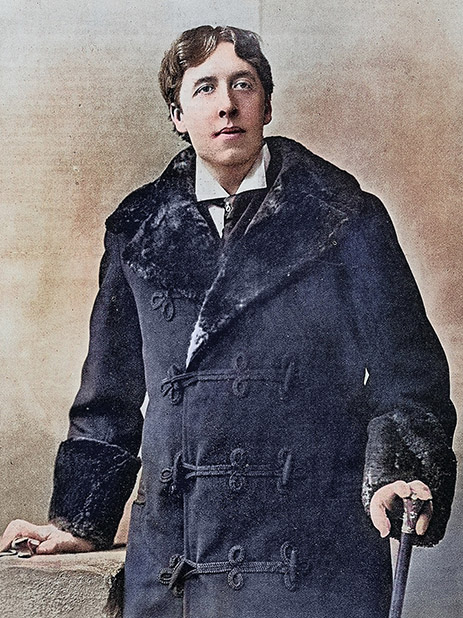
“Between 1910 and 1960,” Melanie McDonagh observes, “well over half a million people in England and Wales became Catholics.” Most of them never set down their reasons, leaving the historical record to be dominated by the literary folk who wrote about it all the time: Oscar Wilde (an honorary member of the club, as an Irishman who finally converted on his Paris deathbed in 1900), GK Chesterton, Evelyn Waugh, Graham Greene, and a few dozen others. McDonagh’s book does not reverse this imbalance – notwithstanding some tantalising sociological digressions – but it does justice to its cast of characters.
As a group, they resist generalisation. Some were hard not to love, like the First World War veteran David Jones, a damaged but childlike visionary who produced modernist masterpieces in watercolour and book-length poems which astonished TS Eliot and WH Auden. Some made enemies everywhere, such as Wilde’s one-time lover Lord Alfred Douglas, an admirer of Mussolini who once explained to George Bernard Shaw that “my views… are right, being founded on humility and the love of God, and yours are hideously wrong, as you will find out when you come to die”. There were shrinking violets such as the reclusive painter Gwen John, and outrageous troublemakers like the Oxford philosopher Elizabeth Anscombe, who launched a protest at the award of an honorary degree to Harry Truman (“What Nero, what Genghis Khan, what Hitler or what Stalin will not be honoured in the future?”) and who, when told by a waiter that women in trousers were not permitted in the restaurant, announced that in that case she would take them off.
Chesterton, the era’s wittiest and most fluent spokesman for conversion, glowed with benevolence towards his fellow man; the waspish Muriel Spark, by contrast, clarified to a priest that “I don’t at all feel it my duty as a Christian to go about liking everybody regardless”. A Catholic convert could be a self-parodying reactionary like Waugh or an earnest liberal like his friend Greene; as relentlessly proselytising as RH Benson – despite being the son of an archbishop of Canterbury, he informed his family that “I belong to a Church that happens to know” – or as discreet as the now-forgotten man of letters Maurice Baring, whose advice was to “never, never, never talk theology or discuss the Church with those outside it. People simply do not understand what you are talking about.”
Baring called his conversion the one action of his life that he never regretted. McDonagh’s converts tended to say things like that, which does not mean they relished every aspect of Catholic life. Baring’s novel of conversion, Passing By, was so melancholy in tone that a friend quipped it should be put on the Vatican’s Index of Prohibited Books. Gwen John’s brother noted her discovery “that pious people can be just as stupid, insensitive and vulgar as anyone else”. Few of these converts, even in an age when respect for the papacy was at its height, felt the need to defend the Vatican on all counts; some were borderline anticlerical in their disdain for the clergy, while others raised an ironic eyebrow. On the eve of the 67-year-old Edith Sitwell’s conversion, Waugh wrote to her: “I heard a rousing sermon on Sunday against the dangers of immodest bathing dresses and thought that you and I were innocent of that offence at least.” Catholic heroism does feature in Waugh’s novels, but in considerably smaller quantities than Catholic ennui.

According to one conventional opinion, people get religious for the emotional consolation it provides. McDonagh has a knack for querying such stereotypes. Douglas felt nothing when he converted – it was something of a “tiresome necessity” to belong to what was, in the last analysis, the Church which spoke with divine authority. In Spark’s The Comforters, two characters agree that “the True Church was awful, though unfortunately, one couldn’t deny, true”.
That kind of language evokes another era, in which the average person had at least an Anglican upbringing, and might be persuaded that Catholicism was the original tune and the Church of England the bad cover version. Eric Gill – the great engraver and incestuous paedophile whose story tends to get a rather hasty treatment in Catholic accounts of this era – persuaded Jones into the Church by drawing three shapes: a perfect triangle, and two three-sided bodges in which the lines didn’t meet. Pick a triangle, he told Jones. Jones said he preferred the neater one. Gill: “I didn’t ask you which one you preferred. One isn’t a better triangle than the others. The others are not triangles at all.” In other words, there is only one actual Church, one community that could claim to be founded by Jesus Christ.
In today’s very different landscape, when according to one survey there are twice as many Catholic Zoomers as Anglicans, does McDonagh’s story have the slightest relevance? Do her converts have much to do with the young people who – according to both anecdotal and (possibly overstated) statistical evidence – are increasingly filling up the pews that their parents’ generation vacated?
Well, perhaps there is a common thread. As she observes, the point the converts kept returning to, when justifying their decision, was that Catholicism was “real”; not just in the Anglican-bashing sense, but in that the Church seemed part of the fabric of the universe, beyond time and change and untouchable by any human whim. John Gray, the poet and briefly another of Wilde’s lovers, was in Brittany when he stumbled on a run-down chapel in which a dishevelled priest was babbling through a Mass attended by “half a dozen peasant women”. It was then, Gray recounted, “that it came to me. I said to myself, John Gray, this is the real thing.”
It is not an accident that so many of today’s young converts are also attracted by traditional liturgy and doctrine. The psychological explanation is that these poor bewildered souls are clinging to a nostalgic illusion. The more sympathetic version is that if there is an ultimate meaning to life, it will probably have a timeless aura about it. The 20th-century converts felt that – Baring, at a Mass behind the lines on the Western Front in 1914, was transported by the thought that it was the same Mass the troops would have heard at Agincourt – and the current crop seems to intuit the same thing.
As McDonagh’s vivid, engaging narrative implies, a traditional faith does not automatically give rise to a rigid and authoritarian culture. It can, but at its best 20th-century Catholicism gave birth to social and political experiments as daring as the Catholic Worker movement and the Spanish Mondragon cooperative, popular art as successful as Lord of the Rings and the Sagrada Família, and a subculture healthy enough that by 1960 annual conversions in England and Wales reached 14,483. (The numbers, for much-contested reasons, collapsed over the next decade.) It also, not coincidentally, stimulated fiction of the calibre of the Sword of Honour trilogy and visual art as beautiful as Jones’s paintings, in both of which Catholic dogma is a stimulus to, rather than an obstacle to, the close observation of life.
On the battlefields of the First World War, the Catholic chaplains were said to be especially popular because they offered two things: the sacraments if the soldiers wanted them, and an easy-going companionship if they didn’t. When they weren’t praying in Latin, the padres shared the soldiers’ – sometimes foul-mouthed – language, could hold their own when the whisky bottle went round and would hurl themselves into the crossfire if they saw a dying tommy in need of the last rites. “They have got a perfectly firm creedal faith – pragmatic, dogmatic, supernatural,” goes one account quoted by McDonagh. “Round these fixed points everything is allowed to be in a state of flux.” That trick – knowing when to be inflexibly dogmatic, and when to chill out – is a hard one to pull off. But sometimes Catholicism gets it right.
Much of the converts’ stories is pretty familiar – especially to converts like me – and I wondered whether McDonagh’s book would feel like a mere rerun. In fact she is the ideal author for the subject, being simultaneously a serious Catholic, a history PhD, and a seasoned Fleet Street journalist who takes as her 11th commandment that the reader should never be allowed to get bored. The book is just pious enough to take its subjects’ inner lives seriously, but not so much so as to slip into a churchy hush. McDonagh describes Aubrey Beardsley’s conversion movingly, while expressing satisfaction that his dying request – for his more obscene drawings to be destroyed – was not fulfilled.
Occasionally there could be a firmer editorial hand: the word “remarkable” appears three times in the space of seven lines on page two, and the chapter on Siegfried Sassoon devolves into a series of letters, reproduced without comment, whose appeal is not obvious. But the book, in its cheerfully unsentimental way, does demonstrate not only why the floodgates opened for a few decades, but also why the stream has never quite dried up.
Converts: From Oscar Wilde to Muriel Spark, Why So Many Became Catholic in the 20th Century
Melanie McDonagh
Yale University Press, 368pp, £25
Purchasing a book may earn the NS a commission from Bookshop.org, who support independent bookshops
[Further reading: Jeanette Winterson’s thousand and one yawns]
Content from our partners


Related

This article appears in the 26 Nov 2025 issue of the New Statesman, The Last Stand
Join the debate
Subscribe here to comment