
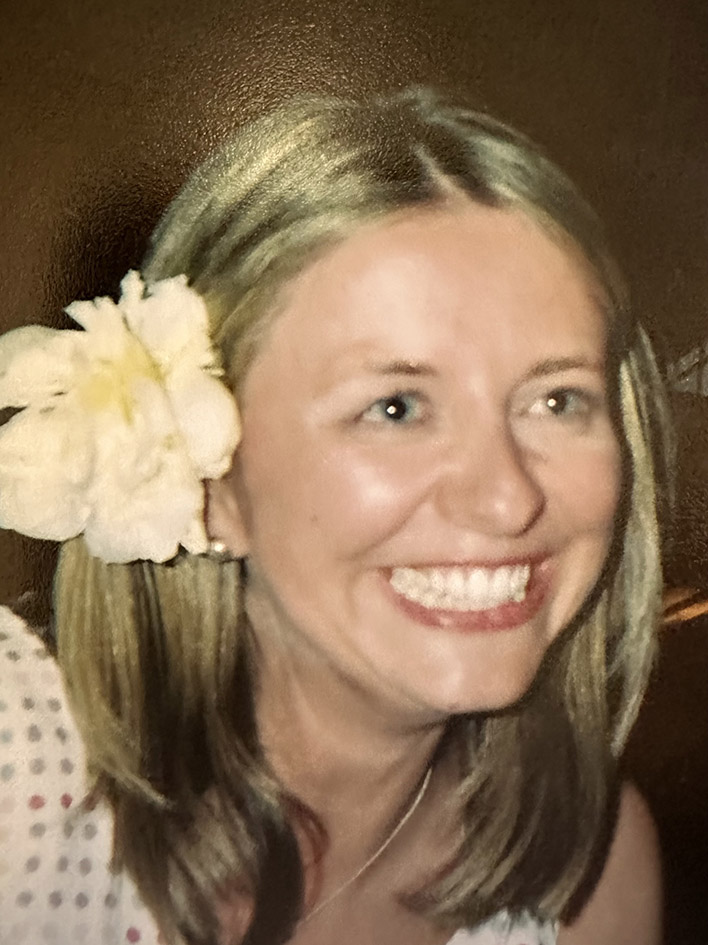
My closest friend from college days – we’ve known each other for more than 30 years now – appeared in a doorway in the middle of my first term at university. She was holding a clipboard, and announced she was casting a play. I had no ambitions to be an actor, but I recall her officious manner very well and have teased her regularly about it in the decades since. I didn’t know she would be my friend then, but I wanted her to be, I resolved somehow to inch inside her glamourous orbit.
(From The Virago Book Of Friendship, edited by Rachel Cooke.)
The girl with the clipboard was me. Rachel Cooke wrote these words. Rachel died last Friday, 14 November; she was just 56 years old. As a writer, she was the New Statesman’s brilliant television critic. Her journalism at the Observer earned her the reputation of “backbone” of the paper. But crucially to me, Rachel was my friend for almost four decades.
I first met Rachel at Oxford in it the autumn of 1988. We were both 19 and somewhat overwhelmed by Keble College. Re-reading her words, I realised that I had been as fascinated with Rachel as she was with me. In those first few weeks of term, I had clocked her walking around the quad in her neat uniform of Levi 501s, Doc Martens, and a printed shirt. She was a slight, beautiful young woman, with a tote bag always slung over one shoulder, sometimes a raincoat. The look was English, bookish chic. She was unfeasibly well put-together (professional, even) for someone who had just done their A Levels.

I found her intriguing and a bit scary. I made the excuse of casting a play to seem more serious in her eye. She declined, and I immediately abandoned the idea of a theatre production and doubled down on making her my friend instead.
Though she was my peer, her influence on me was as strong as any teacher or role model. As a girl she had cultivated a deep interest in feminism. In time, I understood this arose from Rachel’s feeling that her mother’s career had taken a second place to her father’s (she was a research assistant; he was a successful academic). Rachel’s proto-feminism came from a sense of injustice.
As a young teenager, she was already reading feminist writing widely – If Women Counted by Marilyn Waring as well as Simone de Beauvoir and Marilyn French were on her shelves. We were surrounded by clever contemporaries but Rachel stood out. No-one else listened to Radio 4 or read the Guardian cover to cover.
When I think about Rachel at 19 even then she embodied a fight for equality. Her political thinking was vividly preoccupied by second- versus third-wave feminism. But back then and ever since, Rachel judged other women by what they did, rather than what they said. When a man exposed himself and masturbated in front of my ground floor college window, Rachel was furious on my behalf and mobilised us both. She confronted The College Authorities, demanding to know why they were prepared to put women at risk.
This was the birth of her activism. She led – and sometimes pulled – me and others along with her. Thanks to Rachel, a sexual harassment code was pushed through the college (one of the first in the university). Free rape alarms were issued to women students. Our campaign for No VAT on tampons was hustled through too. Rachel was on fire. We wore matching dungarees and went on Reclaim the Night marches. We laughed about the dungarees, but Rachel’s stridency was everything. Rachel marched then and, really, continued to march all her life. Thirty years later, she was appalled by the culture wars and continually spoke out when others did not. She loved other women but would happily take down a “silly” one – see her writing on Megan Markle. She wasn’t afraid to challenge a kind of feminism she didn’t accept as real.
Her beliefs underpinned Rachel’s deep curiosity in women and men’s behaviour. Why were people like they were? Decades later, I had become a psychoanalyst and our intense conversations continued and deepened: on email, by text and in person. She called me her “free analyst”. In truth, she was contemptuous of most therapy, but I recognised that her interviews often used complex theories of a dynamic unconscious. You see it in her interviews, most notably with difficult people. The tributes to the brilliance of her writing see this too.
Really, I want to record here her brilliance in friendship. When my own husband suddenly died young, Rachel stood guard at my front door, to protect me. A woman I did not know well arrived on her cycle “as if she was out for a bloody bike ride!” said Rachel. The woman dared to try and get past Rachel with a pot plant and a letter. Rachel took the letter, thanked her and shut the door. She came back upstairs and laid on the bed with me. In different ways, this care continued over the days and weeks and months – Rachel’s constancy. She understood what feeling broken meant. She knew grief and picked it up in others. She was the best of friends.
Our friendship was intense. I can smell her still. It was the sort of intimacy one rarely. experiences with another woman. When, in her early thirties, she met Anthony Quinn, who would become her adored husband of more than 20 years, I was so pleased. Her equal in so many ways, he was a perfect match for her. He understood her need for independence, the frequent suppers with her own friends. My friends saw Rachel as formidable. The truth was that, if she loved you, she gave you everything. She offered complete freedom to trust that your confidences would remain between you and her. Equally, if she was angry with you, you knew it.
At our regular suppers she was always affectionate, grabbing my arm when we walked to the Tube. She was tactile and observant – anxious if you looked tired or under strain. She encouraged openness and telling the truth about feelings. I think about her attitude to her body and mine – not of what we looked like, but how we felt, what ached, how age was changing us.
I will miss her for an eternity. I have kept all her letters and cards. A note from 1995 mentions a boyfriend whose name I had forgotten, a deadline she was up against and also, “But I mustn’t complain, life is good.”
In Freud’s 1915 paper, “On Transience”, he writes: “A flower that blooms only for a single night does not seem to us on that account less lovely.” I fully expected to have Rachel’s fascinating and passionate take on life for at least another three decades. What I understand Freud to be saying here is that the short-lived nature of someone as valued and beloved as Rachel Cooke never diminishes their exquisite worth.
[Further reading: Re-reading the utterly original Rachel Cooke]
Content from our partners



Related

Join the debate
Subscribe here to comment