
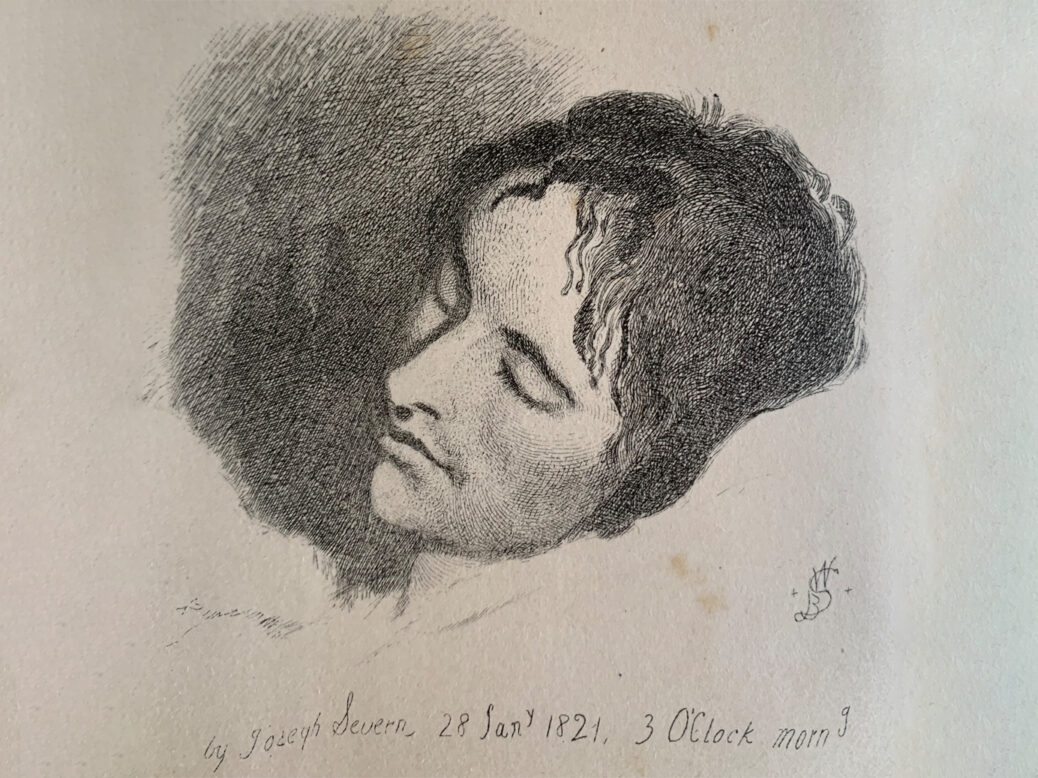
Last week, New York District Attorney Alvin Bragg, best known for prosecuting Donald Trump on the charge of falsifying business records to cover up payments of hush money to Stormy Daniels, had an easier task: handing back 17 stolen books to the Whitney family. Among them was a beautifully bound collection of eight manuscript letters. Pasted as frontispiece was a silhouette of a slender woman holding a fan.
As the New York Times was the first to report, it was recovered last year by a sharp-eyed bibliophile, Joshua Mann, co-owner of B & B Rare Books on Madison Avenue. A young man had come in, attempting to sell the volume. Immediately suspicious, Mann persuaded the customer to let him retain it so that he could establish its authenticity and set a price. Having consulted Professor Susan Wolfson, a Keats expert at Princeton, and contacted the Art Loss Register in London, he was in a position to inform the police. He had in his hands some of the most precious and controversial letters in English literary history, filched from a shelf in the Whitney mansion on Long Island many decades ago.
Superscribed “Shanklin, Isle of Wight, Thursday,” the first of them begins:
My dearest Lady,

I am glad I had not an opportunity of sending off a Letter which I wrote for you on Tuesday night—’twas too much like one out of Rousseau’s Heloise.
The allusion is to Jean-Jacques Rousseau’s passionate epistolary novel Julie; ou La Nouvelle Héloïse, one of the foundation texts of Romanticism. This was the beginning of the correspondence between John Keats and the girl with whom he became obsessed in the final years of his brief life. The woman holding the fan in the silhouette: Fanny Brawne.
Keats met her in the autumn of 1818, around the time of his 23rd birthday. He spent Christmas with her family. He was not in a good way. He had nursed his brother Tom who was dying of tuberculosis, and was beginning to cough himself. The reviews of his long poem Endymion had been so savage that fellow poet Percy Shelley later suggested that they, not the consumption, were what killed him. Brawne was 18, quick-witted and fashionable in a way that suggested she had read widely enough to see through fashion; she was possessed of an ease in conversation that Keats found both alluring and unsettling.
The correspondence began the following summer, when Keats was enjoying the sea air of the Isle of Wight. The letters he wrote from there are among the most extraordinary in the language, unique in their mixture of lyrical intensity and raw emotional exposure. Here is a characteristic passage from that first one:
Ask yourself my love whether you are not very cruel to have so entrammelled me, so destroyed my freedom. Will you confess this in the Letter you must write immediately and do all you can to console me in it – make it rich as a draught of poppies to intoxicate me – write the softest words and kiss them that I may at least touch my lips where yours have been. For myself I know not how to express my devotion to so fair a form: I want a brighter word than bright, a fairer word than fair. I almost wish we were butterflies and liv’d but three summer days – three such days with you I could fill with more delight than fifty common years could ever contain.
The love was unconsummated, the parting unbearable when Keats sailed for Italy in the forlorn hope that the warmer climate would ease his tuberculosis. He died in Rome on the 23 February 1821, aged 25, having asked his friend Joseph Severn not to show him Brawne’s last letters because of the distress they would cause him.
Brawne married ten years later and lived until 1865. She kept Keats’s letters throughout, saying almost nothing about him publicly. But in 1878 her children allowed the editor Harry Buxton Forman to publish them. Charles Dilke, grandson of one of Keats’s closest friends, was furious: to have exposed such intimacy to the gaze of the vulgar public was “the greatest impeachment of a woman’s sense of womanly delicacy to be found in the history of literature”. As for “Mr Forman’s extraordinary preface,” it was “no less notable as a sign of the degradation to which the bookmaker has sunk”. Even Algernon Charles Swinburne, the Victorian poet most influenced by Keats, complained that they should never have appeared, indeed “ought never to have been written” – not even an unmanly boy “in his love-making or in his suffering”, should “howl and snivel after such a lamentable fashion”.
The Victorian literary world had by that point established a version of Keats it found acceptable: the martyred genius, beautiful and doomed, destroyed by malicious reviewers, his sensuous verse a kind of approved indulgence available at a safe distance. The letters to Brawne disturbed this comfortable arrangement in ways that their readers found hard to articulate precisely and therefore attributed to a fault in Keats rather than a blind spot in themselves. Matthew Arnold, whose influential essay on Keats appeared in 1880, was representative in his discomfort. He admired the poetry enormously, finding in it evidence of a Shakespearean gift, but the personality revealed by the letters struck him as wanting in what he called character and self-command. The lover who wrote of jealousy with such naked frankness, who confessed to spending whole mornings at his window unable to write, who described himself as unmanned by a woman’s dress – this was a figure that Arnold’s high Victorian sensibility could not easily accommodate. There was something, he implied, insufficiently gentlemanly about it.
The love letters were sold at auction and dispersed. Some are held in the collections of Keatsiana at Harvard, the New York Public Library and the house in Hampstead where the poet wrote his great odes to a nightingale and a Grecian Urn. Now those that were lost and have been found will be auctioned again, this time in aid of the philanthropic foundation that now owns the Whitney estate from where they were stolen. They are anticipated to fetch up to $2 million. The identity of the young man who claimed that the 17 books came from his grandfather’s retirement home in South Carolina has not been revealed.
Meanwhile, the Romantic impulse to wear one’s heart on one’s sleeve endures two and a half centuries after the publication of Rousseau’s groundbreaking novel. Now Keats’s outpourings of emotion are no longer a source of embarrassment but rather the epitome of what love letters ought to be. Not that anybody handwrites exquisitely crafted love letters any more.
Jonathan Bate is the author of Bright Star, Green Light: The Beautiful Works and Damned Lives of John Keats and F. Scott Fitzgerald.
[Further reading: Ben Lerner has taken autofiction somewhere new]
Content from our partners


Related

Join the debate
Subscribe here to comment