
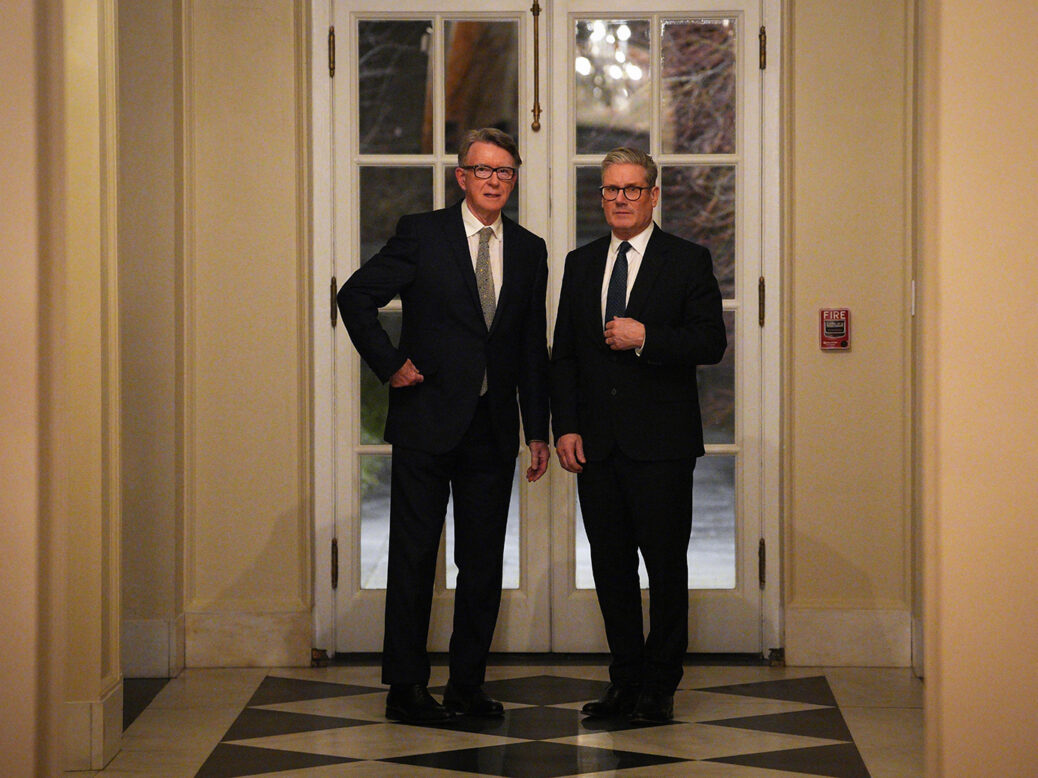
Keir Starmer has sacked the Foreign Office’s top civil servant, Olly Robbins. The senior mandarin has been made the fall guy after the extraordinary revelation that Peter Mandelson failed his security vetting ahead of being posted as ambassador to the US. The decision to fail his clearance was overruled by the Foreign Office.
The Prime Minister and the Foreign Secretary, Yvette Cooper, lost confidence in Robbins, the NS understands, after the Guardian‘s investigation revealed that Mandelson’s initial vetting failure was overruled by Robbins’ department. No 10 says the Foreign Office did not make it aware of this fact.
Starmer is now facing calls from opposition parties to resign amid questions over whether he misled parliament about the details of Mandelson’s appointment.
To remind you: there were two stages to the “vetting” of Mandelson before he was made US ambassador. As we detailed in our cover story in February, the Cabinet Office’s Propriety and Ethics Team conducted a due diligence report on Mandelson and the other candidates in December 2024. This highlighted the issues that already existed in the public domain, rather than involving a deeper vetting. The report flagged Mandelson’s relationship with Jeffrey Epstein, his business links with Russia and China, and his past resignations from cabinet.

Much of the scandal around the appointment has centred on this first stage of vetting: that Starmer was made aware of Mandelson’s relationship with a convicted sex offender and appointed him anyway. (Downing Street says Mandelson lied in his response to three follow-up questions to this report; Mandelson maintains he was truthful. Most people think that the facts presented to Starmer should have precluded the appointment whatever Mandelson said in those three further questions.)
But the second stage of Mandelson’s vetting has faced less scrutiny, quite simply because the government declared on the record last September that Mandelson passed it. This developed vetting for the Foreign Office – required for all diplomats – took place only after he was announced for the role, which was unusual. After Mandelson’s resignation last September, I was one of many journalists who heard suggestions from sources that something went awry somewhere in the Foreign Office vetting process, but government sources repeatedly and strenuously denied it. We have always been told by the government that “the processes were followed but Peter Mandelson deceived”.
Cooper, then Foreign Secretary, appeared to address all of the questions around Mandelson’s Foreign Office vetting in September. She wrote to the Foreign Affairs Select Committee and stated plainly: “Peter Mandelson’s security vetting was conducted to the usual standard set for developed vetting in line with established Cabinet Office policy.” The vetting process “concluded with DV clearance being granted by the FCDO in advance of Lord Mandelson taking up post in February”, she wrote, and later again: “The security clearance was granted prior to Peter Mandelson beginning his role as ambassador.”
For months, Starmer has insisted that the due process was followed. He said himself in February that there was “security vetting, carried out independently by the security services, which is an intensive exercise, that gave [Mandelson] clearance for the role” of ambassador. Indeed, McSweeney criticised the vetting process in his resignation over the Mandelson scandal.
After hours of silence, the government released a statement denying any knowledge of this decision on the part of Starmer or any other ministers, instead entirely blaming Foreign Office officials. Shortly before 11pm, Starmer sacked Robbins.
“Neither the Prime Minister, nor any government minister, was aware that Peter Mandelson was granted developed vetting against the advice of UK Security Vetting until earlier this week. Once the Prime Minister was informed, he immediately instructed officials to establish the facts about why the Developed Vetting was granted, in order to enact plans to update the House of Commons,” a government spokesperson said. One question that immediately springs to mind is whether any Labour advisers, who aren’t mentioned in the statement, had knowledge of the decision.
Team Starmer has chosen to deny any knowledge that Mandelson failed his vetting, washing their hands of responsibility and pinning the blame on Robbins. It may be a less damaging explanation than the alternative, but not by much. When taken at face value, it plumbs new depths in terms of Starmer’s extraordinary obliviousness to the workings of his own government.
Did Robbins – a highly respected civil servant – really take such a seismic decision on his own, without informing any minister? Some – including inside government – think the explanation strains credulity. “Olly is a professional and won’t have taken this decision without being forced,” a former No 10 official says.
Others struggle to believe that Starmer or No 10 would knowingly lie about something that has a paper trail, but are speculating as to whether, wordlessly, “with a nod and a wink”, it was communicated to Foreign Officials that the vetting decision would need to change.
What Robbins says will be instructive. He has so far not commented, but has been invited by the Foreign Affairs Committee to tell his account of events.
Despite Robbins’ sacking, Labour insiders are still directing fury and disbelief at No 10. One figure who is tempted to resign says they won’t go over the top now “because I have council candidates who need me knocking on doors”.
Even if Robbins alone is responsible for the decision to overrule the initial vetting decision, serious questions remain about Starmer’s grip, and about how the Prime Minister and his senior cabinet ministers have managed to mislead parliament and the country for months that Mandelson passed his vetting when he, quite extraordinarily, had not. Suddenly what happens after May has become a live question again in the Labour Party.
“It’s not looking good, is it?” one government adviser texts. It certainly isn’t.
[Further reading: Inside Zack Polanski’s inner circle]
Content from our partners



Related


Join the debate
Subscribe here to commentSeems ludicrous to believe that Robbins would not tell a Minister about Mandelson’s failed vetting. And if leant on by an adviser or someone, to turn a blind eye, then are we really expected to believe that no one informed the Prime Minister? You’d think, given Mandelson’s history, that a Prime Minister would be extra vigilant and want to be across everything.