
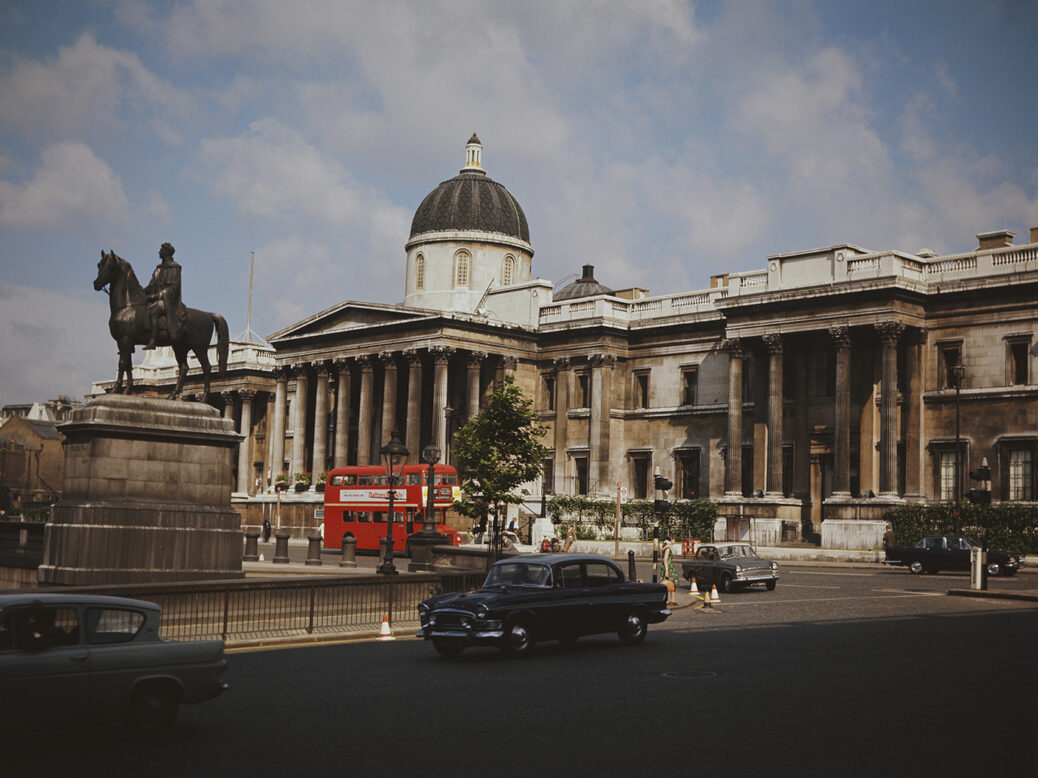
This changed my life. When I was young and spotty and impecunious, every weekend I would dart in and out of the National Gallery. Mostly it would be for less than half an hour and often just to look at a single picture – the great Leonardo cartoon, or the Seurat bathers, or a show-off, bravura Veronese. I’d always liked painting, but the Old Masters became a passion. Just down from Scotland, London felt cold, hard and unwelcoming. Except for the dear old National Gallery. In and out, I went, out and in.
Free entry, you see. I’d never have done that if I’d had to pay each time, or been stopped and asked for ID. Entry was easy enough to be habit forming. Now I am a trustee of the great institution, and the pressure from Whitehall to charge visitors has become intense. I get it. The financial pressures on us are brutal. Public money is short. Generous donors want to give for new galleries and famous purchases. Indeed, very soon we are going to unveil the architectural winner in a competition for a new building that will hugely revitalise the centre of London, linking Trafalgar Square and Leicester Square with a project of exceptional beauty. Good people have given a lot of money to make this happen and it will be a glory.
In general, however, donors don’t want to fund the electricity bill, or the staffing costs. So why not make visitors pay – particularly foreign visitors? Why should millions of taxpayers who don’t like art subsidise people who do? Here is why. The paintings don’t belong to the state or even, really, to the gallery; they belong to the British people. They are ours. For two centuries the National Gallery has existed to set on fire the imaginations of ordinary folk when confronted with genius; to make them more ambitious; to change their lives.
To do that, it has to be welcoming. It might seem an easy option to charge foreigners – but that means establishing who is, and who isn’t, and that means computer checks and queues and ticket barriers and so, for many people, the unmistakeable message: this isn’t for you. It also means that when you do go, you get your money’s worth until your feet are aching, and you don’t quickly go back again. So now I have to ask myself whether I think first about Treasury priorities and balance sheets, or about myself in my early twenties, lonely in the big city, stumbling nervously into glowing rooms that changed how I understand the world.

Venetian lacuna
One alternative that people talk about is a tourist tax. I was in Venice on Good Friday. My hotel room was hot and I’d open the window in the middle of the night to hear a quiet, determined swishing from the street. These were sweepers who keep this extraordinary place – where stone floats on water – almost clean enough to eat your pasta off. That is what the tourist tax here pays for and, coming from filthy London, this visitor thought it well worth a few euros. But – but – you have to pay for the big galleries. Compared with London, most were uncannily empty. I could stand alone and uninterrupted in front of world-famous art. Bully for me. This is not the kind of quietness a confident culture should celebrate.
Scot therapy
And then, by Easter weekend, thanks to the miracles of modern travel, I was with my sisters in Perthshire. “Home” is a smell – in my case, a mingling of soft rain, juicy woodland, distant smoke and, at the appropriate moment, a mutton pie. Sitting around, scanning the news, contemplating the likely disaster for Labour in May, contemplating a disarmed and increasingly humiliated Britain, with low productivity and lower self-esteem, I began to wonder about where the next big shock is coming from.
The answer may well be Scotland. The SNP seems close to being able to win an overall majority in next month’s Holyrood election. If so, John Swinney, the First Minister, says he would immediately try to trigger a second independence referendum. Will Keir Starmer’s voter-battered Labour administration have the authority and confidence to refuse? It’s hard to see how this plays out. But unless Scottish Labour can pull off a last-minute surge, we will be arguing about ethnic identity, hard borders, currency and UN status for the rest of the year.
Bill of health
Louis Mosley, Britain’s Palantir boss, has been hitting back at critics of the company’s involvement in the NHS. As one of them, I feel he avoids the central critique. It’s nothing to do with his grandfather; it’s about state subservience to US Big Tech, greased by political contact (Peter Mandelson, anyone?) and the way it crowds out British start-ups. Peter Thiel, Palantir’s leader, is part of the philosophical foundation of Trumpworld. Look out of the window, folks. These people are not our friends.
[Further reading: Thatcherism is still the problem]
Content from our partners


Related

This article appears in the 08 Apr 2026 issue of the New Statesman, The Fall
Join the debate
Subscribe here to commentIn my case, the National Museum of Scotland was my free playground. Mum worked on various job, including as a dinner lady, to pay the fees for my school which was a brief walk through Greyfriars graveyard, and past the statue of Bobby, and I would then waste an hour each day gainfully accumulating an appreciation of everything from prehistoric man to landing on the moon, until my mum got home from work and made my “Tea” (Scottish term for our evening meal rather than a mid-afternoon snack).
In the summer, I would walk home, and stop off at the National Portrait Gallery in Queen Street, which in those days (late 60’s) was also the Scottish Museum of Antiquities, and it housed such magnificent exhibits for a 13 year old boy, such as The Maiden, Scotland’s unique beheading machine. It was built in 1564—predating the French Guillotine by over 200 years—and was used for about 150 years. But also, a curious exhibit in a glass display of the sporran pistol which was a real 18th-century “security device.” It consisted of a small, hidden flintlock pistol built into the metal clasp of a sporran. If a pickpocket tried to open the clasp without knowing the “trick,” the gun would fire downwards. The display note recalled a story of the device “misfiring” and injuring the wearer’s anatomy – but I suspect this was poetic licence by museum guides to highlight the folly of the design.
I was a regular – and when the guides stopped following me around to ensure I did not make off with the exhibits – and I became a trusted visitor and occasional helper (unofficial).
Yes – Museums and Art Galleries must definitely remain free of charge, for ever.