
The Dutch writer Ian Buruma, now in his mid-seventies, is the author of some two dozen books, mostly about modern China, Japan and Europe. His latest book is inspired by his father, Leo, who spent the last three years of the Second World War as a forced labourer in Berlin. Leo left behind hundreds of letters he had written to his English-born wife back home, along with an album of photographs. Ian’s father told him many stories about his years in Berlin, but it was only after his death in 2020 that his son began to work through this material. The result, set in the broader context of Berlin’s history during the war, is Stay Alive.
What Leo was able to write was in many ways rather limited. But enough detail comes through to provide a vivid central thread to the narrative. As a law student in the German-occupied Netherlands, Leo was asked to sign an undertaking effectively accepting German authority, but like most of his fellow-students he refused and went into hiding. However, he was picked up by the German police and threatened with the arrest of his parents unless he agreed to go to Germany to work in the war economy. Buruma doesn’t say so, but a major reason for the acute shortage of labour in Nazi Germany was Hitler’s refusal to conscript women into the factories, because he thought that soldiers at the front would be more willing to fight if they were confident that their families were well fed and cared for at home. He believed women should raise children for the Reich, rather than go out to work.
Leo ended up in Berlin, where he stayed for the rest of the war. As an educated young man, he had the good fortune to be put to work in a factory accounts department, and so was spared the heavy manual labour that was the lot of most foreign workers. He was able to act as an interpreter because of his knowledge of French, German and English. And he was placed in a barracks reserved for western European workers, though he could see in the camp next door the appalling conditions in which eastern European forced labourers were made to live.
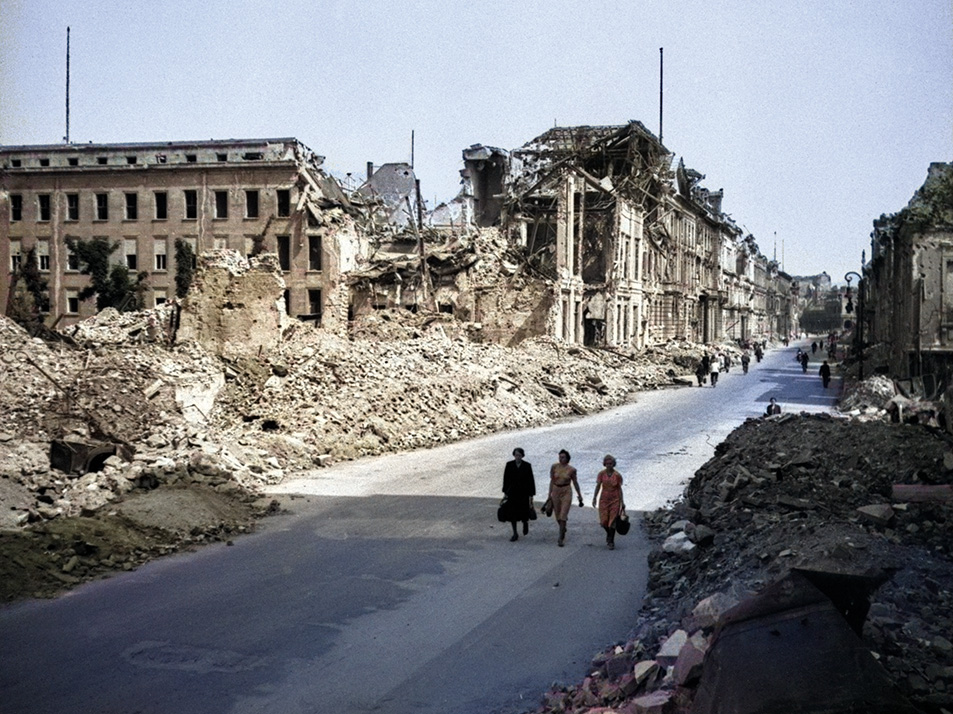
By 1943, Allied bombing raids on the German capital were quickly increasing in frequency and intensity. The Russian prisoners’ camp next to where Leo was living was destroyed by incendiary bombs. Observing a daytime raid by US bombers, Leo “felt keenly how narrow the margin is between life and death”. By 1944 Berlin was in ruins and people were struggling to survive. As the Reich collapsed in chaos, Leo was asked by an acquaintance to look after a villa in the plush western quarter of Dahlem. In April 1945, Red Army soldiers arrived and, discovering a hidden handgun, lined up Leo and the other residents in front of a wall, preparing to shoot them.

At this moment, an English-speaking Russian officer arrived, and the prisoners were able to save themselves by explaining that they weren’t Nazis. Leo managed to make his way to the city centre but collapsed from exhaustion. In another extraordinary piece of luck, he was picked up by another Dutchman and his girlfriend, a German sex worker, who let him stay at her apartment while he recovered. Eventually he got back to the Netherlands. Many others did not.
Ian Buruma knows how to tell a good story. He brings home in gripping detail the experiences not only of his father but also of a series of other people who lived through the war years in Berlin – years when people greeted each other not with the conventional “good morning” or the Nazis’ “Heil Hitler” but the phrase that gives the book its title: “Stay alive!” He makes it clear how unrealistic the Allies’ hopes were that the bombing of the city would lead to people rising up against the Nazis (though he does quote the popular joke: “Where would we be without Hitler?” one person in a bomb shelter asks, and a voice replies, “At home in our beds”).
Early in the war, life in the German capital, as in other parts of the country, had continued more or less as normal. Even the Nazis had not managed to suppress Berlin’s famous popular culture and nightlife entirely. Buruma’s chronological narrative, starting in 1939, gives a graphic sense of the deterioration of the quality of life as Allied bombing began to have its effect. Nazi propaganda minister Joseph Goebbels tried to counter this deterioration, at least symbolically, by offering distractions such as expensive films, concerts and other cultural offerings, though his tolerance did not extend to “un-German” offerings such as jazz and swing music.
Buruma writes in an enviably fluent and readable style. He has a keen eye for the telling anecdote and the illuminating quote. The personal touch supplied by stories of his father’s experiences is often moving. Still, I have some major reservations about this book. The first is that it is based on a quite narrow selection of source material – diaries and letters, augmented by interviews he has carried out with elderly Germans who lived in the city through the war years. Moreover, the small selection of narratives he uses – gripping and perceptive and well deployed though most of them are – will be familiar to anyone who has studied this period, even superficially. A good number of them have been translated into English. And they come from a very small section of society. Just to list their authors shows how misleading is the claim in the publisher’s blurb that “this book illuminates how ordinary people navigated the moral catastrophe of the Third Reich”: the German aristocrats Ursula von Kardorff and Helmuth James von Moltke, the Russian princess Marie Vassiltchikov, the Anglo-Irish writer Christabel Bielenberg (married to a German lawyer and niece of newspaper tycoon Alfred Harmsworth), the popular novelist Erich Kästner, the writer Ruth Andreas-Friedrich, and so on. Not much sign of “ordinary people” here. We learn next to nothing about the working-class inhabitants of proletarian precincts such as Wedding or Neukölln.
Buruma relies too much on sources that have been translated into English, for example the voluminous diaries of Goebbels (who had, incidentally, six children, not seven, as Buruma claims, all of them murdered by their parents at the end of the war to save them having to live in a postwar world made meaningless for them by the absence of Nazism). Considering Buruma reads German, there is very little excuse for using the English selection made by the American journalist Louis P Lochner, who found pages of the diary scattered around the ruins of the government quarter, or the more recent translation made by the British historian Fred Taylor, which was heavily criticised by the editors of the complete German diaries.
Finally – and this is a more delicate point – Buruma pays so much attention to the fate of Berlin’s Jews that one might think they formed a major part of the overall population of the city. There were 160,000 Jewish people living there, which did indeed amount to a third of all Jews in Germany at the time of the Nazi seizure of power. Berlin, however, was a city numbering 2.24 million people by 1933, so the Jewish population was only 7 per cent. There could have been greater coverage of other persecuted minorities, such as “gypsies” (Sinti and Roma) or homosexuals, or the very large number of people persecuted and murdered for their political beliefs, above all the city’s communists, who really were a major element in the capital’s population. It would have improved this book no end had the author managed to supply some statistics, for example the mortality figures you can find in Monica Black’s remarkable Death in Berlin: From Weimar to Divided Germany (2010), to put the stories and anecdotes he supplies into some kind of perspective. All that said, however, Buruma’s account of the sufferings of Berlin Jews is undeniably graphic and frequently very moving.
Stay Alive doesn’t make any fresh contribution to knowledge, or even amount to an adequate account of Berlin and Berliners during the war. But it is still a readable and engrossing narrative that can be recommended to those who want to know something of the lives of a sample of the most literate and articulate of the German capital’s people during the war.
Stay Alive: Berlin 1939-1945
Ian Buruma
Atlantic, 400pp, £22
Purchasing a book may earn the NS a commission from Bookshop.org, who support independent bookshops
[Further reading: Meet Pete Hegseth, boss of Operation Big Tough Men In Hot Places]
Content from our partners



Related
This article appears in the 18 Mar 2026 issue of the New Statesman, The new world war
Join the debate
Subscribe here to commentThe subject matter is covered in fiction very succinctly and with the imagination to portray it from the point of view of a German officer, in Martin Amis’s “The Zone of Interest”.