
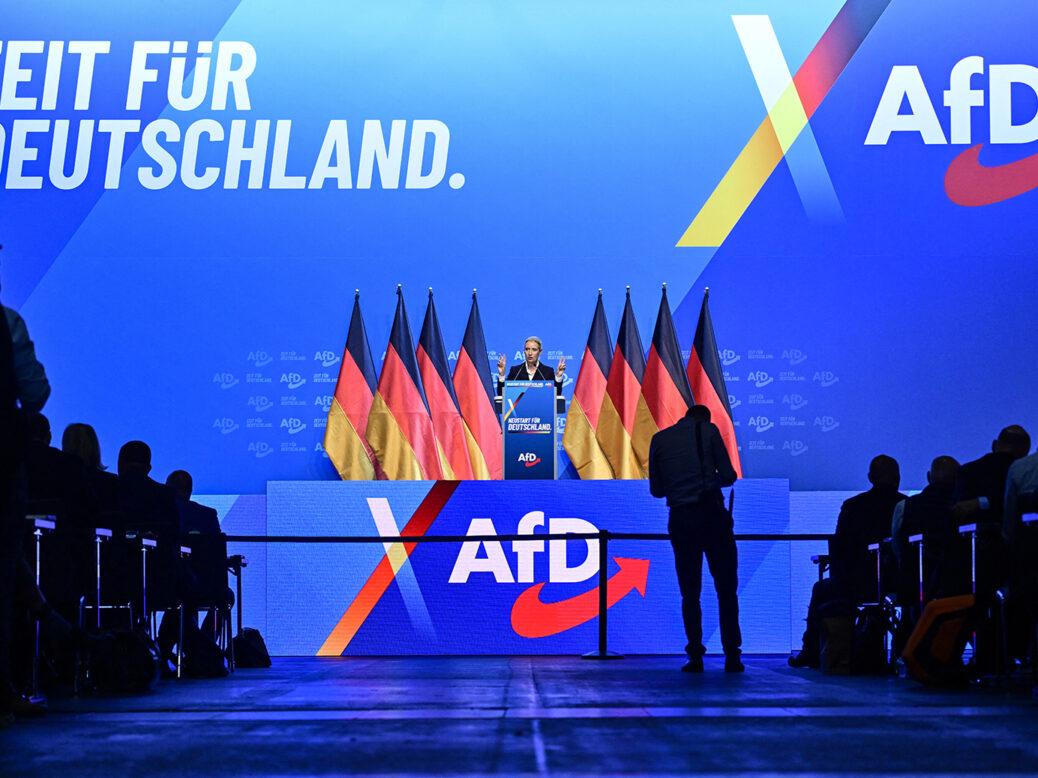
Here are two stories about the rise of the AfD in Germany. Which one do you believe?
First, the “gun-on-the-table” story. In the years before 1914, then far more so in the 1930s, Germans drank a lethal cocktail of hatred, self-pity, arrogance, a warped masculinity that glamorised violence and, above all, an ingrained myth of racial superiority. All this led Europe and the wider world directly into two spasms of unprecedented bloodshed that left tens of millions dead and half the world in ruins.
In the wake of the second and more terrible of those wars, the world vowed “Never again”, and no nation vowed it more deeply than Germany. The generations raised in the war’s shadow seemed profoundly committed to renouncing that past. Germany turned into the world’s most definitively anti-Nazi country, the soil in which such poison could never again take root. By the time Germany was reunited in 1990, the few outsiders who feared resurgent German power, like Margaret Thatcher, sounded ridiculous. That bad old Germany was gone, and even as the rest of Europe began flirting with far-right politics once again in the new century, Germany remained immune.
But like a stage play where the gun on the table will inevitably be fired, a country built around the motto “never again” will, inevitably, do it again. At the start of this September, in the German state elections, “Alternative für Deutschland” came within three seats of an outright majority in Saxony-Anhalt. This weekend (20 September), the AfD won Mecklenburg-Western Pomerania with 38 per cent of the vote, becoming the largest party in that state’s parliament for the first time ever. Friedrich Merz’s chancellorship hangs by a thread. Apparently, German fascism is back. All the taboos and moralising haven’t stopped it. Perhaps it was inevitable: the postwar generations are fading, and in any case, anti-Nazism never ran so deep in the former East Germany. Where else was political dissatisfaction going to go?

The only comfort this story has to offer is that the AfD is not – yet – a majority. The Federal Republic is not – yet – tottering like the Weimar Republic. So there might, just, still be time. So those who believe this story should hold the line, sound the alarm, man the barricades and rally to the defence of the democratic order before it is too late.
And, for those outside Germany, the lesson is basically the same: oh no, here we go again. From Orban and Trump to Le Pen, Farage and Rupert Lowe, we are dealing with the same lethal cocktail, ready to plunge us again into a world of cruelty, tyranny, idiocy and blood. Unless we stop them.
Or there is the other story, the “you-can’t-say-that” story. After the terrible trauma of the 1930s and 1940s, we turned our fears and memories into expansive taboos. We decided that there were questions that were too dangerous to ask and that we should draw an ever-wider exclusion zone around anything that looked a little like something that looked a little like fascism. It was understandable, of course, but it wasn’t sustainable. As the generations which felt those fears and memories in their guts aged, and as the exclusion zone spiralled ever wider, the accusation of “fascism” was used more and more widely with less and less meaning. An ever wider variety of political and social questions were met with a non-answer: you can’t say that.
In this story, the far-right movements of modern politics are a sorry apology for real fascism. No uniformed paramilitaries, no proudly asserted or developed theories of racial superiority, and no lust for conquest or mass warfare. They take part in coalitions. Even if they try to tilt the democratic table or tamper with the rules, when they lose elections, they usually go. You don’t have to like them, but they’re not Nazis. History doesn’t repeat itself.
In fact the real danger, in this story, is believing that it does. Increasingly frantic accusations of fascism from political establishments without any other ideas both drive ordinary voters into the arms of the smoothly plausible taboo breakers, and also risk turning those taboo breakers into exactly what we fear them to be. As well hung for a sheep as a lamb.
So if this is the story you believe: lower the temperature. Drag the far-right into coalitions. Make them collect bins, manage schools, chair meetings. Call their bluff and tame them, till they become the Sweden Democrats or the Brothers of Italy: spiky, maybe ugly, but people we can live with.
So which is it? Does Germany now have an unusually aggressive, hardline and popular far-right political party because, duh, it’s Germany? Or is this a monster conjured into being by the German establishment’s fears, who gave it the greatest political boost they could by distancing themselves from it so fiercely? Is the modern (pseudo-)democratic far-right the larval stage of a full-scale fascist revival? Or is it something… else, for which the past is not a perfect guide? Were the last 80 years unusual because we managed to hold perennial darknesses at bay? Or were they unusual because, for a lifetime, we were so traumatised by fascism that we mistook a particular early-20th-century horror for an eternal threat?
Give it another ten years, and those of us who are still here will have found out.
[Further reading: Will AI kill us all?]
Content from our partners


Related


Join the debate
Subscribe here to commentI follow John Gray’s view that human nature does not change much over the centuries. While technology moves ever forward, human affairs tend to move in cycles so that what was learned through hard experience can be lost over time and the cycle repeats. Progress in technology yes, but no progress for the affairs of man! Better to aim for a system where we can all muddle through as best we can. Beware politicians telling us they have the answers to our problems via simple solutions! John Gray explains it much better than me in his excellent articles and books.
This is Germany. Let them solve their own problems and we will solve ours, eventually. Hitler had a Hitler Youth movement of 70,000 in April 1933, when he became Chancellor. So the Germans want to leave the Euro, deport those millions of Syrians who fled their civil war, organise the economy better ( currently they are a minor variety of China where they export their surplus all over Europe and America). That couldn’t last, as China must inevitably find out. What good is holding a fortune in promissory notes when the country that issued them is broke.
Yes, we muddle through as best we can and each to their own solution hoping it does not casue too much trouble to others.
Is there some hidden tier of NS subscription where we get the essay that follows this very nicely written introduction?