
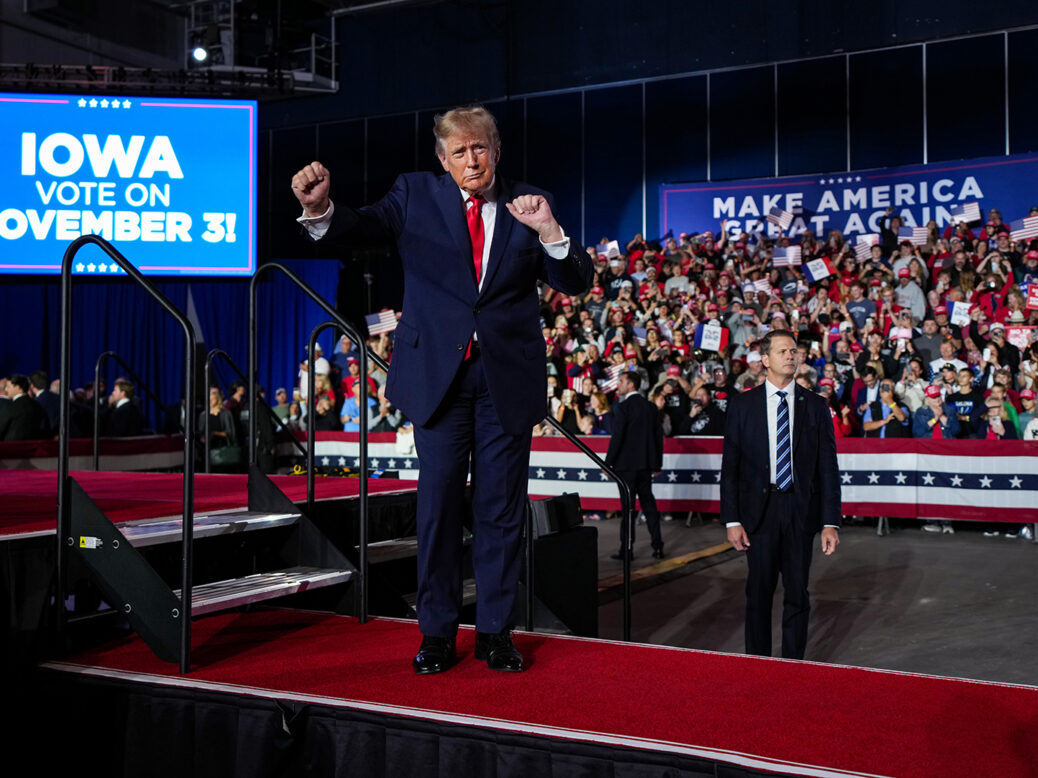
It didn’t seem to matter that these midterm elections could potentially see the President lose control of Congress for his final two years in office. What we were witnessing was a radical reinterpretation of how a president’s time is best spent on the campaign trail. On the final day of the campaign, Donald Trump was down on the National Mall to reopen the Lincoln Memorial reflecting pool. His speech was a ricochet of successive statements unrelated to the election. Someone close to the White House tried to justify the event to me in terms that elevated sycophancy into surrealism: they thought that his staffers were giving him a pleasant activity to put him in a better mood before he learnt the bad news about the election tonight.
“We’re giving serious thought to changing the name to the Trump Reflecting Pool,” the President said. To which he quickly added in a hushed, almost childlike voice: “I’m only kidding, I’m only kidding – please don’t report it.” He looked at a poster showing the pool with the caption: “Back, and more beautiful than ever!” He spent around twenty minutes talking about how the “brand new” pipes dealt with the algae problem, the benefits of granite and whether grass had a life of its own like a human being.
It was a fitting end to his own contribution to the campaign, which has resembled a private joke between him and himself. Trump has been more devoted to commenting on the derrières of everyone from Congressional candidates to Nicki Minaj than he has on sticking to some form of political message. At his midterm convention in Dallas, which was poorly attended by Republican figures, he mocked the local Republican candidate for the way that he spoke and then told the half-empty stadium that it was full. The dramatic irony of this campaign has been offered by the fact that he has told voters to imagine that he was on the ballot when it is obvious to everyone that he is, in fact, the Democrats’ best asset.
The President has failed to read country or party. Some of his candidates have chosen not to campaign with Trump or the vice president when they have visited their states, lest they be contaminated by electoral plague. He has orbited the national debate for the past few months like a rogue satellite leaking nuclear waste.

We have little idea about what the results will be until we have the results themselves. But all the pollsters expect the Republicans to lose the House of Representatives and potentially the Senate. The reasons for Trump’s unpopularity are not indecipherable. Compare the polls from the first term to the second, and one of the main differences is voters’ confidence about the president’s ability to manage the economy. For all the spectacle of the first term, Trump maintained a relatively healthy record on how the public viewed his handling of the economy. Not so in the second term. Particularly since he launched his war in the Persian Gulf, the number of those who think he can competently manage the economy have plummeted. This will not have been helped by Trump’s little ode to grass. “We have a lot of great things planned for Washington, and I could get into the nation,” Trump said at the reflecting pool, “but for that you don’t have enough time.”
It would be more accurate to say that Trump does not have the time. In the past few months, there has been the strange sense that Trump no longer craves to be at the centre of the national conversation. He has retreated to his garden, fiddling with the ponds and the plants as his coalition has broken apart. Without him, the rest of the nation has embarked on a conversation about the future of the country.
The election will shape the relevance of the Democratic Party over the next two years. If they take Congress, they will assume subpoena and investigatory powers that would allow them to haul members of the administration into hearings, giving them a platform to be seen to hold the Trump clan to account. Whatever the substance, these investigations would be likely to dominate the agenda up till the presidential primaries. What is also at stake is the extent to which the Democrats head left. The key race to watch is for the US Senate seat in Michigan, where the party’s candidate Abdul el-Sayed, who takes a hard line on Israel and won the primary in the face of the party establishment, is standing. Expect Democrats on either side to take the result as proof that their camp is best placed to win over voters. Look also at whether the party is able to win its first Senate seat in Texas since 1988.
This election campaign has been a reminder that politics will shunt itself along without the President’s constant attention. That does not mean that he will not make himself felt over the next two years whatever the result – he retains the presidential powers, no matter what. But he has retreated from the national conversation. And, tonight, the Democrats are hoping to rush into the vacuum.
[Further reading: Obama’s last hope]
Content from our partners



Related
Join the debate
Subscribe here to comment