
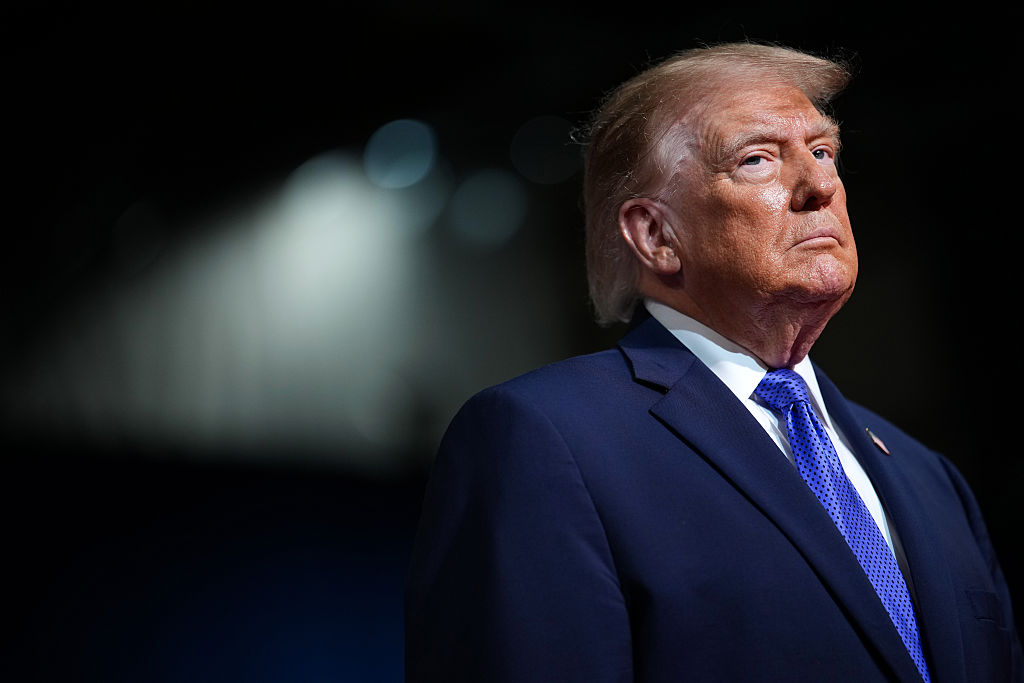
“It’s doomsday,” one Republican staffer said as the room began to realise the scale of the GOP’s losses. Expectations at this midterms Maga watch party were always low, but the results were worse than anyone imagined. What they were watching was a transfer of power – and the beginning of the end for the long Trumpian age.
The Democrats, whose surge was at the top end of what the pollsters had predicted, will take control of both the Senate and the House of Representatives for the next two years. What they do with that power is an open question. But these results are an unequivocal rejection of President Donald Trump. His imperious grip on American politics has been loosened. The way he has governed over the past two years has torn apart the coalition that elected him in 2024. He promised to lower bills, keep the US out of foreign wars and protect the working class. His war in the Persian Gulf – which he has never been able to explain or justify – came to epitomise his failure to deliver on those promises. And the administration’s corruption came to symbolise the fact that his government did not care.
When Bill Clinton lost the midterms to Newt Gingrich’s insurgent Republican Party in 1994, the president looked in need of defibrillation. The Washington Post wrote that he was “pretty much in the Ancient Mariner mode, haunted and babbling”. Trump has many modes, none of which is haunted. One of his life rules is to deny the reality of failure and attempt to manifest his own destiny. Nonetheless, in his phone calls to various reporters over election night, he struck a strangely conciliatory tone and promised to try to work with the Democrats in Congress. For now, he is cowed.
The battle within the Republican Party has already begun. The sense at watch parties around Washington DC was that the GOP has wasted a historic opportunity this term to reshape the nation by engaging on some ill-judged war in the Middle East. That Trump announced on election day he was cutting off aid to Israel was a desperate, last-minute gambit to hold on to voters who distrust Israel, which they partly blame for getting Trump involved in the war. The Democrats have taken up the position of opposing any more foreign wars. As the Maga activist Jack Posobiec posted, “America First didn’t lose tonight – Democrats won by co-opting it.”

Looking around the election map, there were Democratic victories in many unexpected places. Candidates endorsed by Trump suffered across the country: as so many of them knew during the campaign, the president was a liability not an asset. The loss of Trump’s electoral touch can be observed best in Texas where, in James Talarico, the Democrats have a senator from the southern state for the first time since 1988.
Victory has many fathers – and Democrats on both wings of the party are itching to cast the results as proof that their side is ascendant. As one centrist who worked at a senior level on Joe Biden’s 2020 campaign told me, “My concern is that the Democrats misread the results. Everyone hates Trump and that’s why we will do well. The Democratic Party does not poll well. It’s not because we had progressive candidates, but in spite of them.” Those centrists point to the victories of Josh Turek in Iowa and Adam Hamilton in Kansas as signs that it’s their positions that are popular. The scale of the Democrats’ win will be reassuring to those who thought small majorities would allow progressives to hold the party leadership hostage.
But progressives have a succession of wins, too. The election of Abdul el-Sayed as a senator for Michigan means they have a new national leader, one of a young generation of progressive figureheads to have emerged. He will be a strident addition to Washington and will fight to pull the party left on Israel and healthcare.
The fact that nearly all Democratic candidates ran on some form of economic populism combined with anti-Trumpism meant that the differences within the party were largely obscured during the campaign. The exception to this was Michigan, where El-Sayed’s primary opponent in the Democrat party, Haley Stevens, endorsed the Republican Maga candidate because she seemed to believe that El-Sayed’s campaign had drifted into antisemitism. Stevens was roundly criticised for the move – but this was a taste of the debates that are to come.
Trump’s war gave the Democrats a path to victory that did not require unity or a single national message. The party could define itself in contradictory ways because the Republican campaign was beleaguered by the unpopularity of its president. His administration’s inane incompetence and blatant corruption will not disappear overnight. Trump is not going to change into a bureaucrat who governs with efficiency. But what will now take place inside the Democratic Party is a battle for a coherent identity. Is this proof that it doesn’t need to move left to win? Has it simply benefited from Trump’s unpopularity? Who should Democrats investigate and impeach?
These questions have an added urgency because of the party’s new taste of power, for the first time in two years, and its leadership will, inevitably, already be thinking about 2028. Meanwhile, the Republicans cannot believe how easily they gave it up.
[Further reading: Nigel Farage’s bastards]
Content from our partners



Related


Join the debate
Subscribe here to comment