
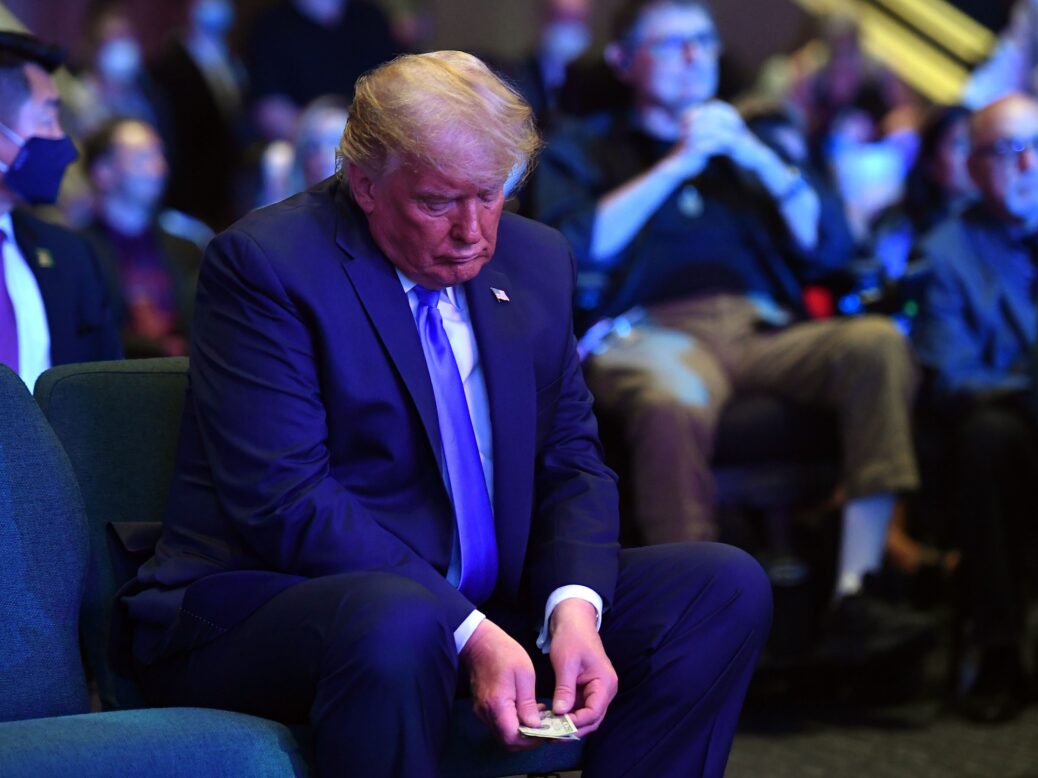
If man was created in the image of God, then this American administration was created in the image of Donald Trump. His lieutenants are loyal to his aesthetic, worldview and unusual morality. The president believes corruption is not really corruption if he is the one that benefits, and that principle, if we can call it that, extends down the branches of his administration. In other words, for all his faults, at least we can say that the president leads by example.
That is not the case across all territories. Britain rattles through prime ministers who routinely lash out at Whitehall when they realise they cannot make it obey. On various supranational matters, European leaders are subordinate to the bureaucracy in Brussels. The same goes for Trump’s first term, which saw him rage in vain against Congress and the Republican establishment.
But this time has been different. Trump was initially gripped by a retributive energy, and his team followed suit. They ripped DEI out of government and lowered the foreign-born population by an estimated 2.9 million from January 2025 to July 2026 (this was after an 8.3 million increase over the previous four years). That project has been led by the single-minded deputy chief of staff Stephen Miller, who a Maga figure once told me had the bedside manner of Heinrich Himmler.
Yes, Elon Musk failed spectacularly in his goal of cutting the deficit by $2trn. But if his real aim was to demoralise the administrative state and make civil servants recognise the unchallengeable power of the Oval Office, then he did a pretty good job. The first year saw a thorough blitzkrieg of malign competency.

And as Trump has lost focus in his second year and become parochial in his interests, so his staffers have lost their way, distracted by side-quests and vanity projects: there was Pete Hegseth’s wild attempt to live stream a jihadist’s execution (since canned by Trump); in October, two of his top advisers for the midterms, James Blair and Chris LaCivita, travelled to Republika Srpska, a self-governing territory in Bosnia and Herzegovina, to give election advice to the pro-Russian government for hundreds of thousands of dollars – much to the chagrin of struggling Republican candidates around the country. Then there was Katie Zacharia, whose five-day tenure as the White House press secretary defied the constraints of a weekly column. Her hasty exit marked a new stage in the way Trump treated his staff: he has generally been quite reluctant to fold to media pressure to get rid of them.
In the first year, the White House seemed relatively leakless and unified – an accomplishment generally credited to a canny chief of staff, Susie Wiles. Now, that cohesion has frayed. Staffers, some of whom have been unnerved by the war in the Persian Gulf, are taking their cues from the president’s own avarice and looking for lucrative opportunities in the private sector or polishing their relationships with his likely successors. The result is an aimless team cowering under a distracted leader they once hoped to emulate.
There is probably no better example than the curious political demise of Kimberly Guilfoyle, who holds the double distinction of being the ex-wife of Gavin Newsom and former fiancée of Donald Trump Jr. It was clear that her appointment as the ambassador to Greece might end in flames after she arrived in Athens on the private jet of a Greek American businessman. She quickly joked to the Greek president that she was looking for a new husband and was spotted in Athenian nightclubs in the early hours, before returning back to the residence to recuperate under the gaze of grand portraits of herself. This all came to a head when the Wall Street Journal reported this month that she had asked a Republican donor to cough up $100,000 to pay off her Amex, and she was, finally, sacked. “She wasn’t a member of my family – she, I guess, dated my son a long time ago,” Trump said in an unsuccessful effort to distance himself from Guilfoyle. She had spent years trying to climb the Trumpian ladder and is now fittingly becoming irrelevant.
The culture of corruption has seeped out of the Oval Office and created an atmosphere where officials feel perfectly comfortable using their public offices to make money. Trump’s sons and the families of his cabinet members have hawked political access in exchange for business. If Republicans do suffer at the midterms as much as current polling implies, then the expectation in Washington is that Trump will look for a scapegoat. Reports suggest Hegseth or Wiles – sacrificial firings which could only compound the sense of drift.
The philosopher John Gray once said that those trying to parse Trump’s words sounded like academic critics trying to interpret Finnegans Wake, in that it wasn’t clear that there was any underlying meaning there. That cluelessness about some deeper truth now applies to Trump’s own team. The extended Trumpian clan is sagging under the weight of its own vanity. Perhaps that is the best tribute they can pay to their leader. So many politicians stress over their legacies, and about having a successor to carry their political vision forward. We already know there will be Trumpians after Trump; he is in the rare position of having not too few political heirs but too many.
[Further reading: French police are revelling in the chaos of these protests]
Content from our partners



Related
This article appears in the 21 Oct 2026 issue of the New Statesman, Sally Rooney is a writer, not a terrorist
Join the debate
Subscribe here to comment