
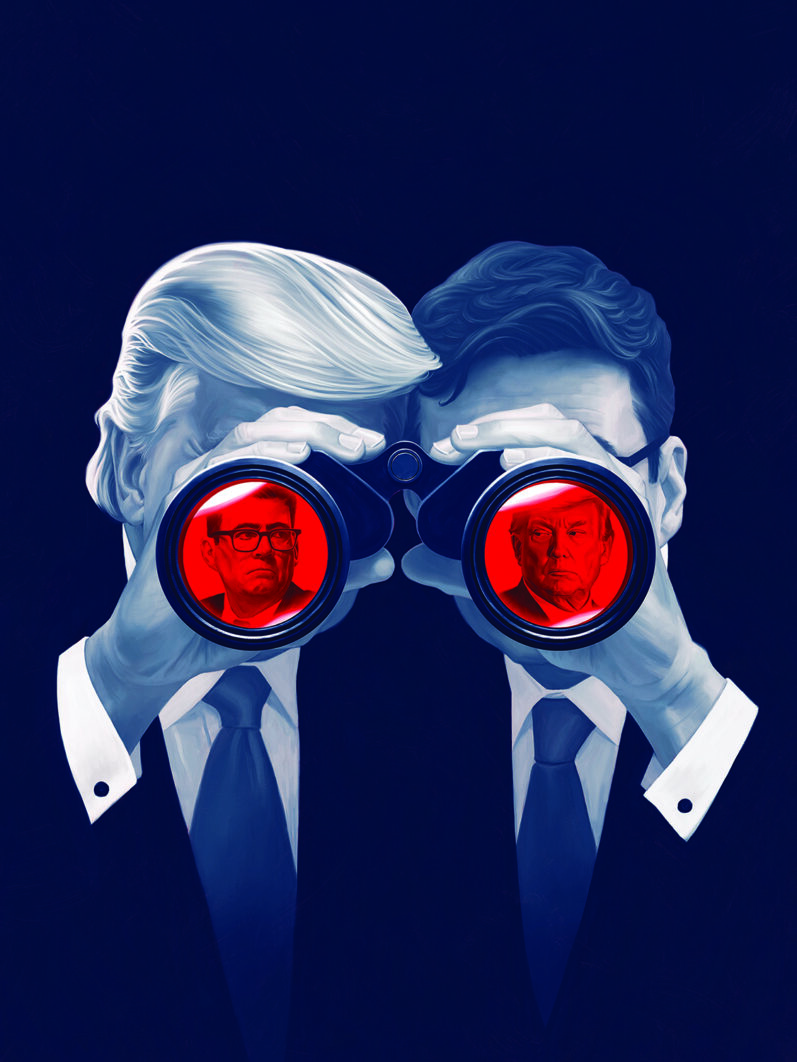
When Andy Burnham met Donald Trump in the modernist UN building beside New York’s East River on 22 September, he looked nervous. The Prime Minister sat low in his chair while Trump appraised the UK with an indifferent, weary air. “There’s great patriotism in the country,” the president said, as if passing judgement on a vassal. “Tremendous potential.” During the meeting, Burnham admitted there had been too much “turbulence” in Westminster, but he avoided the diplomatic hazing other world leaders received at the start of Trump’s term. Burnham had not been bullied or humiliated – at least, not according to the standards of the Trumpian court. British media and officials viewed the meeting as a diplomatic success, partly because it lasted for nearly an hour.
Burnham seems to recognise that flattering the US president will not win his permanent favour – for no relationship is permanent in Trumpworld. So far, the Prime Minister has kept his pledge to be a home-front leader. He didn’t fly straight to the White House bearing gifts and flattery. Photo-ops at global summits are not his priority.
This indifference towards Washington – or at least, the calculated decision to keep his distance from Trump – is reciprocated. Ask what people in Washington DC think about Burnham and it soon becomes clear that he does not make them think at all. A scoff, a shrug, a quizzical raise of the eyebrow, a look of bored pity: these are the common responses when the Prime Minister is mentioned. “He’s new, and the last one was new, and the one before that was new, and the one before that was new,” a White House official told me. “The thinking is: all right, well, on the current trend, he’ll probably be gone next year, too.”
The high turnover of UK leaders has only added to the idea that Britain has little to contribute – it simply does not have the cash, warships or AI firms to matter much to those in Washington looking at their global chessboard. Even Britain’s convening power has been usurped by Pakistan and the Gulf states, where geopolitical influence is purchased by funnelling money towards the Trumpian clan. “Burnham has the weight of the governor of South Dakota,” is how a Maga official put it to me.

Underneath all this is an emotional critique – that successive British governments have been poor custodians of America’s ancestral homeland. The concern is genuine among Maga figures and the tone is proprietorial, as if it were their responsibility to correct what the British elite has got so wrong. The millions of immigrants who have entered Britain over the past decade make the American right shake its head in disappointment. “You go to the UK, and it is not the UK of ten years ago or 20 years ago,” one official lamented.
Keir Starmer’s approach to the White House – which was to skirt around the core schisms between the UK and the US – was always bound to fail. His refrain that he was proud of Britain’s “history of free speech” was at odds with what Maga officials were being fed on social media – short videos of real instances where the British police arrest people for political speech. The cases of Lucy Connolly, who was jailed in 2024 for inciting racial hatred on social media, and Graham Linehan, who was wrongly detained in September 2025 over a series of X posts, for instance, cut through in Washington. (The Met Police later apologised to Linehan and awarded him a cash settlement.) “People can’t go out and express their qualms about what is happening, and it just escalates the problem further,” the official told me. These suspicions about government overreach is just part of a deeper mistrust that imperils the US-UK relationship in general.
While Burnham and Trump were shaking hands at the UN, some in the White House were pondering a more fundamental break in trust: that the British government was attempting to spy on American officials. In September, a White House security official wrote to a colleague in the administration: “The UK is making another attempt to put a backdoor on iCloud. This time by their secret court. They’re going to lean on a court order to justify it. They will use this back door to spy on the administration and Nigel Farage.”
This is a reference to Apple’s encrypted data, which the British state is trying to access. In January 2025, the UK government issued an order to gain access to the cloud back-ups of Apple customers under the sweeping Investigatory Powers Act of 2016, which gives the police and intelligence agencies the power to compel companies to cooperate in investigations. In response, Apple disabled end-to-end encryption tools in the UK, leaving many users with weaker privacy protections.
The UK government’s demand was eventually dropped after the White House found out about it and pushed back. In February last year, Trump described the order as something “you hear about with China”. Trump’s then director of national intelligence, Tulsi Gabbard, posted in August 2025 that, alongside the vice-president, JD Vance, she had lobbied the British government and “the UK has agreed to drop its mandate for Apple to provide a ‘back door’ that would have enabled access to the protected encrypted data of American citizens and encroached on our civil liberties”.
But the Home Office has since reissued the order specifically for Apple’s UK users. This would give the state significant powers to access the messages of any British citizen. However, it is unclear whether these powers would apply to every Apple customer in the country or only to British citizens, largely because the order is shrouded in secrecy.
In August, Apple reportedly filed a claim against the government’s power to issue such orders – hence the heightened anxiety from the White House. The fear among civil rights campaigners is that if Apple breaks end-to-end encryption in the UK, it breaks it for everyone – and that any surveillance of British citizens will not stop there. The White House clearly does not trust that restricting the order to Britain would protect US citizens – or officials – from surveillance.
The “secret court” the White House security official referred to in their warning last month is the Investigatory Powers Tribunal, which hears claims against investigations by the security services. The British government will neither confirm nor deny the order and Apple is unable to talk publicly about the ongoing court case – even to Congress. It is not only the White House that is aghast at what it sees as insidious British authoritarianism, and nor is it just Republicans.
On 11 September, the Democratic senator Ron Wyden and the Republican representative Warren Davidson sent a joint letter to the court complaining that the British government had explicitly banned Apple from talking to Congress about the order. They accused the British of trying to “kneecap the constitutional authority of the US Congress”. They wrote: “The UK government’s unprecedented demands for secrecy in this matter undermine democratic governance in both the United States and the UK, and needlessly strain the relationship between our two nations.”
This secretive attempt to increase the state’s powers to violate citizens’ privacy is going largely unnoticed at home. In the UK, support for civil liberties such as free speech has become largely hard-right coded; the left has vacated this territory. Usually, such orders are not disclosed because the companies involved are prevented from talking about them publicly. In this case, the outrage from the US has forced the issue into the open.
What does it say about the level of trust between the two old allies that senior officials in the White House now actively fear London will spy on them? The distrust has only been compounded with time, leaving Burnham to navigate a relationship riddled with doubt.
W hen Burnham entered No 10 in July, there was a general suspicion in Washington that he was – in some vague way – more left wing than Keir Starmer. “No one in the administration thinks Burnham being in charge is good,” a senior official said. The British government has tried to make assurances that it will not pursue a radical economic agenda. In fact, it has tried to convince the White House that there are vague similarities between Trump’s and Burnham’s economic plans to deal with affordability. At a dinner at the British Embassy on 4 August, Ed Miliband, the UK Foreign Secretary, sat next to the president’s senior aide James Blair, and the pair bonded over the cost-of-living crisis in both countries.
This is an oblique approach: devolution and reindustrialisation are not the issues that animate the US-UK relationship. Those would be free speech, mass migration, defence spending, tariffs, artificial intelligence and the regulation of Big Tech. On each of those matters, London and Washington have divergent capacities, interests and worldviews – with the gaps only expected to grow.
The tension over British regulation of tech would not be so acrimonious if the UK were not so dependent on American technology companies. Since Google purchased the British AI company DeepMind in 2014 for a paltry £400m, Britain has been playing catch-up. The government has regained some influence over the AI sector through its respected AI Security Institute (AISI), which was founded in 2023 and analyses leading models. Burnham said on 22 September that he wants the UK to become the “honest broker” of AI. Yet that pledge was quickly undercut by Trump. The same week Burnham made his pitch, the president rejected any calls for international agreements on AI development, calling them a “globalist scheme”. And now the US Office for the National Cyber Director has explicitly asked two of America’s leading AI companies, OpenAI and Anthropic, not to share their new models with the AISI before they’ve been tested by US authorities – another sign that the White House does not trust the British government to regulate American technology.
These policy disagreements inevitably create diplomatic tension. The King’s state visit in April was heralded as a breakthrough moment in repairing US-UK relations. Four months later, on a trip to Dublin, Trump called for the territorial break-up of the United Kingdom through the reunification of the island of Ireland. “It’s an example of his spite against people who are unduly high-handed and call us imperialists,” one American explained. Trump’s desire to poke Britain in the eye after Starmer distanced the UK from the war in Iran has not waned.
You can see a similar pattern in Washington’s implicit threat to support Argentina’s renewed claims on the Falkland Islands. There is a sense that the Brits don’t have it in them to fight for their own territory, so why not let Javier Milei, Argentina’s president and a Trump ally, take it? The same goes for Diego Garcia in the Chagos Islands, which is effectively a US military base under a British flag. When Donald Trump shot down the deal to hand the islands to Mauritius in his meeting with the Prime Minister – and when Burnham promised to review the deal – that diplomatic fact was made public. Whether over the Falklands, Northern Ireland or the Chagos Islands, Trump has little respect for UK sovereignty.
This does not make the Foreign Office any less optimistic. British diplomats in Washington were ecstatic that Ed Miliband’s sanctions on Israeli settlements in the West Bank were not immediately slapped down by the administration. It was seen as a diplomatic coup. The real picture is a bit more complicated. It is true that Mike Huckabee, the loud-mouthed evangelical US ambassador to Israel who accused Miliband of “Jew-hate” over the sanctions, is seen as a rogue agent in the State Department. An American source said Huckabee’s statements were not cleared by the department and they acknowledged that Israeli settlements do not advance US interests.
A Foreign Office source dismissed Huckabee and said they’d had positive messages from the White House about the sanctions. Another British government source told me: “We built our own coalition of like-minded countries. With the US, we had a respectful exchange where they did not agree with our action but understood our reasons.”
But the chatter at the GOP convention in Dallas in September was that Republicans simply did not want to talk about Israel – a nation that is increasingly unpopular with voters – ahead of the midterms. Ultimately, the sense in Washington is that it doesn’t really matter what Britain’s policy towards Israel is because Britain is no longer a player in the Middle East.
This does not apply to the Republican Party’s pro-Israeli faction, a diminished but still muscular group. Its members hope that the secretary of state, Marco Rubio, runs for president against Vance: the vice-president is seen as too close to Tucker Carlson, who has given soft interviews to antisemites such as the far-right provocateur Nick Fuentes. Rubio’s nomination is unlikely given Vance’s grip on the Maga base – but it would only take urging from Trump for him to run.
For this faction, Miliband’s move was viewed as the betrayal of an ally motivated by the political need to assuage Britain’s Muslim population. Ben Shapiro, the founder of the conservative media company Daily Wire, told me that, “Miliband is a schmuck and when he claims to be a Jew, he’s as Jewish as a ham sandwich.” Shapiro’s influence has waned within the Maga movement, particularly after his support for Trump’s unpopular war in Iran. But he is still an important voice within the wider American right. I put it to Shapiro that the logic of his argument – that being anti-Israel makes someone less Jewish – meant that a Jewish person’s beliefs could render them a non-Jew. “Would you call a person who’s an atheist, a Christian?” he responded. “I’m not saying he’s not a Jew. I’m saying he is not Jewish. There’s a difference.”
Earlier this year, a senior administration official was listening to a British counterpart complain about the rise of the radical right in the UK. The Brit blamed disinformation. The American suggested that they take the public on tours of Birmingham and Blackburn to show that the disinformation was wrong and, in fact, those places were ethnically the same as they were in the 1950s. The Brit seemed to miss the irony in the American’s voice, both of them talking past each other because they had different diagnoses of Britain’s malaise. Some in the administration think there is little chance that Britain can recover under Burnham. “You’re an ally. Sort your stuff out, and we’ll get back to you when you have done that,” one White House official said. Many in the US government hope that Nigel Farage takes Downing Street at the next election. He is seen within Maga as Britain’s best, and probably last, chance. While some on the online right think that Rupert Lowe’s ethno-nationalism is closer to what is needed – Lowe was recently on Joe Rogan’s popular podcast and his posts on X are pushed by Elon Musk – this is not yet a widespread view in the administration. “I see him as a slop purveyor,” one official said. Maga figures are still concerned that Reform lacks a professional operation but, by comparison, they think that Lowe’s Restore is little more than a social media party.
Farage’s popularity within the Republican Party does ebb and flow. One figure remarked to me that he is increasingly thought of as a man standing in a DC bar waiting for someone to recognise him. But he is still seen as being on the same side as Maga. The US government is increasingly protective of right-wingers in Europe who they think are being persecuted by the liberal establishment. It was noted in Washington that when announcing a new centre to counter Russian disinformation in his UN speech, Burnham said he wanted to counter “far-right narratives”.
Those narratives are often identical to the administration’s own policy. Its National Security Strategy from last year laid out how immigration into Europe risked “civilisational erasure” and that if European countries became “majority non-European” they might not treat their alliance with the US “in the same way as those who signed the Nato charter”. In July, the State Department opened a $5m fund for European non-governmental entities which “address national sovereignty, migration, censorship and lawfare challenges in line with shared political philosophy, law and our common Western civilisational heritage”.
The truth is that neither side is dealing with the person – or party – they would like to be in power. But that is the nature of diplomacy. What’s more, no one is in position for ever. A Democratic surge in the midterms could see the Senate and House fall into the hands of Labour’s sister party. This will lead to congressional investigations into the administration and provide a check on Trump’s autonomy over foreign policy. Miliband has made some efforts to engage with Democrats: Steve Ricchetti, who managed Joe Biden’s 2020 campaign, was at the embassy dinner; and Miliband met with the New York City mayor, Zohran Mamdani, on 20 September and discussed the sanctions on Israeli settlements.
But it would be a mistake to think that the Democrats offer a guaranteed return to some idealised Atlanticism of the past. There is a brewing version of America First on the progressive left. When I spoke to Michigan’s Democratic candidate for the Senate, Abdul El-Sayed, earlier this year, he praised the UK-US relationship and called for mutual respect, but pointedly added, “I love my country – and I choose mine over yours any day.”
Whatever happens in November, Trump is not leaving office until 20 January 2029. “He will still be commander-in-chief,” the Foreign Office source told me, by which they meant that Trump will still control US foreign policy even if he loses Congress. On top of that, long before the next presidential election, Vance, Maga’s leading critic of Britain, will become more prominent as he seeks the Republican nomination for the 2028 White House race.
These two allies look at the world in fundamentally different ways. Maga officials who see themselves as the facilitators of the populist nationalist revolt in Europe are always going to be at odds with a social democratic government. This might have been different if the UK were in a position of greater power. But without a strong military, technological sovereignty or a resilient economy, Britain lacks the attributes to help it overcome ideological disagreements and force Washington to sit up and listen to London. This weakness creates the space for the US to dictate terms.
The deepening divisions within the UK-US relationship cannot be solved by warm words between any prime minister and president. The distrust is too great; the White House is so wary of London that it fears the government is trying to spy on US officials. The fact that many in Labour find the Trump administration repellent is only fuelling the party’s longing for Europe. Burnham’s reticence towards Washington is inversely correlated with his warmth towards Brussels. The relationship is reckoning with a new stage of British decline and the rise of cross-border cooperation between the populist nationalist right. We are in a holding pattern, with many in Washington waiting for Farage to take power, and those in Labour praying to find allies in Europe. The relationship is no longer special, if it ever was; it is increasingly suspicious.
[Further reading: “Why would anyone try to defend Hitler?”: Jacob Rees-Mogg on his clash with Tucker Carlson]
Content from our partners


Related

This article appears in the 07 Oct 2026 issue of the New Statesman, The Suspicious Relationship
Join the debate
Subscribe here to commentDoes it matter what Trump and his government officials think of us? I do not think it matters. What matters is how we think we need Americans support to maintain our independence. It is ridiculous that we spend so much of our defence budget on the Trident Submarines which patrol the Atlantic as an ultimate reprisal if Russia should launch a nuclear bomb against either Europe or America. That we (the Captain of the British Nuclear Submarine) would have to obtain the final approval of America to fire its nuclear missiles, assuming the American Administration still existed, and that the option to retaliate was given in the letter issued by the British Prime Minister, is so unlikely to happen, that the entire concept is outdated. This is a good time to secretly downgrade the entire operation and spend the budget on modern methods of defence and retaliation, as demonstrated in Ukraine.
“Millions” of immigrants have not entered Britain since 2015. It is, obviously, difficult to ascertain how many enter the country illegally, but immigration since 2015 is clearly far less than one million, let alone plural millions. This sort of disinformation feeds the far right.