
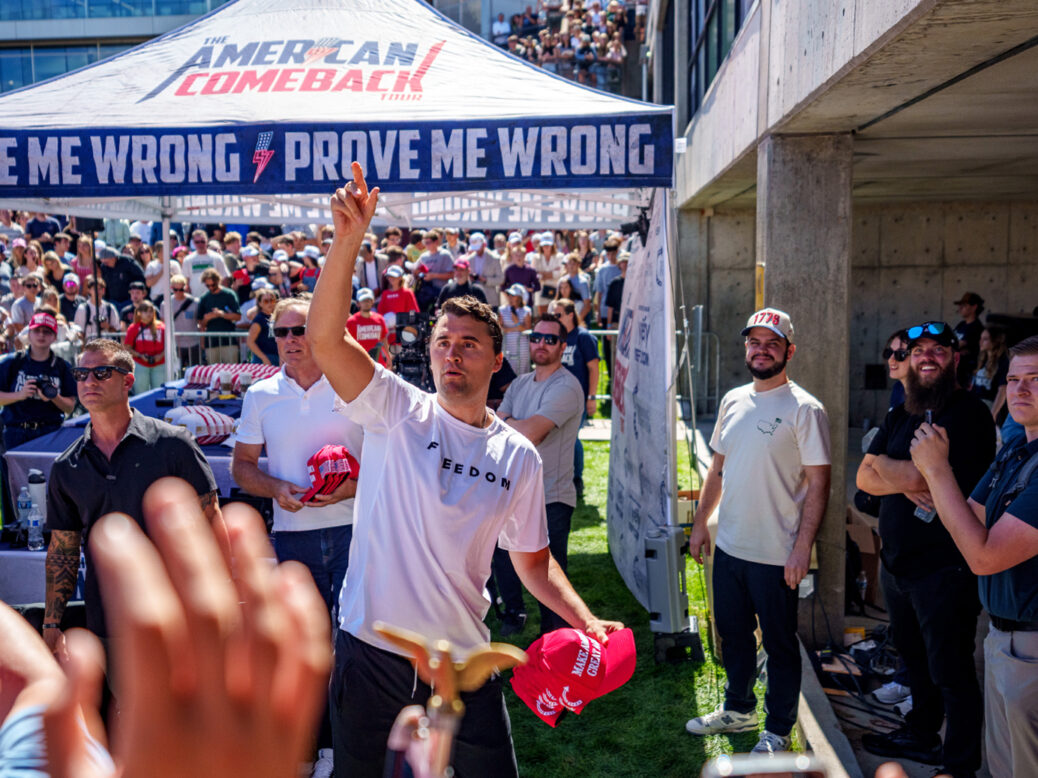
Hours after a bullet struck Charlie Kirk on 10 September last year, the right-wing podcaster Tim Pool proclaimed on X that a “source tells me Charlie is stable. Please god.” Kirk was not, in fact, in stable condition. An hour later, Donald Trump announced the conservative activist’s death on Truth Social. Kirk “was loved and admired by ALL,” the president wrote. “Especially me.” The year since Kirk’s assasination has made plain why Trump, in particular, would have felt that way: Kirk was the rarest thing in his movement, a man who could hold its warring factions together and still make its politics look fun to people under 30. The 12 months since his killing have revealed how much Maga needed him.
Three days before his death, Kirk told Utah’s Deseret News that he intended to fashion his activist group, Turning Point USA, into an institution “as well-known and as powerful as the New York Times, Harvard, and tech companies”. That goal seemed less unrealistic by the day, Kirk having taken on a dizzying number of roles in the conservative movement: close advisor to Trump, architect of a massive campus organizing machine, and titan of the new political media. The organization behind it all reported some $85 million in revenue in the 2025 fiscal year, drawn from roughly half a million donors.
Kirk made his name crisscrossing the country to debate liberal students on college campuses, later posting inflammatory clips of these encounters online with such titles as “Charlie Kirk Wrecks Deluded Gay Pro-Trans Student”. It was during one of these appearances – held in an open courtyard at Utah Valley University before an audience of about 3,000, some five times the number the university had planned for – that he was assassinated.
Tyler Robinson, then 22-years-old, turned himself in to the police shortly afterwards. Last week, a judge ruled that the case against Robinson proceed on all counts, and a trial date is expected to be set on 23 October. But anyone with a social media account knows that if the legal consequences have been conventional and undramatic, Kirk’s afterlife has been anything but.

In the immediate wake of Kirk’s death, the American right attempted a kind of canonisation: commemorative dollars minted, state highways renamed, department buildings draped with his face. A memorial service in Arizona’s State Farm Stadium was attended by Donald Trump, JD Vance, Marco Rubio, and Elon Musk. The President called Kirk “a martyr now for American freedom”. Stephen Miller said, “You thought you could kill Charlie Kirk. You have made him immortal. You have immortalized Charlie Kirk. And now millions will carry on his legacy.”
And millions have, but not in the way Miller foresaw. In fact, no one could have foreseen Kirk’s afterlife. It has been utterly contemporary, impossible before LLMs, the Epstein files and the unique political climate of Trump’s second term.
Kirk is now more recognizable now than he ever was alive. The trouble is that his face has come loose from his body. He’s become a figure in a vast, AI-generated canon of images and videos in his likeness, each iteration a little more lurid than the last.
One such meme, liked over 160,000 times on Instagram, shows Charlie Kirk uttering his real-life last words – “counting or not counting gang violence?” It then cuts to a sniper rifle aimed in his direction. A gunshot rings out, and Kirk’s eyes flick downward. Suddenly, a man stands before him, having seemingly plucked the round from the air like a magician’s coin. Kirk’s gaze climbs up the stranger’s body until it reaches the face, and the face, it turns out, is Jeffrey Epstein’s. In another meme, viewed 2.4 million times on YouTube, Barack Obama’s face is superimposed over Dwayne Johnson’s character in the fifth Fast & Furious film, a federal agent. The forty-fourth president strides forward to arrest the movie’s protagonist, played by Vin Diesel. But wait: it’s not Diesel after all. It’s Kirk, flanked by his widow, Erika Kirk, Benjamin Netanyahu, and the disgraced rapper Diddy.
The classics of the “Kirkification” genre hardly carry any meaning at all. They mash together Kirk, Epstein, Diddy, Obama, Netanyahu, and others for maximal shock value, nothing more. The writer and internet culture researcher Adam Aleksic claims that the first AI-generated Kirk memes came not from an individual seeking to make social commentary, but from the developer behind a cryptocurrency token: $KIRKINATOR, launched on the Solana blockchain on 20 September. The face-swapping began three days after that, when an X user grafted Kirk’s head onto a clip of the streamer IShowSpeed, collecting 144,000 likes. Before it became anything else, Kirkification was a pure grift in pursuit of clout, money, or both.
But the Kirk memes signify real shifts in digital-political culture. In 2024, a larger share of voters under 30 voted for Trump than for any Republican nominee in two decades – a shift Kirk himself helped engineer. Gen Z voters were “potentially the most conservative generation that we’ve experienced maybe in 50 to 60 years,” the Democratic data scientist David Shor told the New York Times’s Ezra Klein. Today, young voters now disapprove of Trump by large margins: this spring Harvard’s Institute of Politics put his approval among 18-to-29-year-olds at 25 per cent, and found young registered voters preferring Democratic control of Congress by 45 percent to 26. What Kirkification represents, then, is the right’s dwindling command over American youth culture. A TikTok user with a passing interest in politics who might have been served Kirk’s debate clips in 2024 today encounters his face in memes and surreal edits. What to make of what has been made of Charlie Kirk?
You could say that the right sabotaged its own attempts to sanctify Kirk. Some sought to make speaking ill of Kirk a fireable offense. “When you see someone celebrating Charlie’s murder, call them out,” JD Vance said in mid-September, guest-hosting Kirk’s own show from the White House. “And, hell, call their employer!” By February, Reuters had counted more than 600 people fired, suspended or investigated for political speech after Kirk’s killing – some for doing nothing more than criticizing his views. A number of those dismissed by public employers have since won settlements for First Amendment retaliation.
And even while demanding a period of mourning from the rest of the country, prominent figures on the right seemed incapable of treating Kirk’s death with actual solemnity. When a reporter asked Trump how he was “holding up” the day after the shooting, Trump replied, “I think very good. And by the way, right there, you see all the trucks?” He gestured toward the site of the new White House ballroom. “They just started construction.” Before Robinson turned himself in, FBI director Kash Patel had already announced that “the subject” was in custody, only to concede less than two hours later that he had had the wrong man. Erika Kirk was widely criticized, even from the right, for making a grand entrance accompanied by pyrotechnics at her husband’s memorial service. Megachurches across the country played their congregants an AI-generated message from the fallen activist, the voice mimicking his own.
In fact, far more than uniting and expanding the right, Kirk’s death has divided and diminished it. The conservative influencer Candace Owens, one of Kirk’s friends and earliest collaborators, drew attention online for wild theories implicating Erika Kirk and the pro-Israel Republican establishment in the killing. When Joe Kent, Trump’s director of the National Counterterrorism Center, resigned in March in protest over the war with Iran, he went on Tucker Carlson’s show the next day and asked why one of the president’s closest advisors had been “suddenly publicly assassinated and we’re not allowed to ask any questions about that”.
Sobriety about Kirk’s death has dissipated on the left, too, and been replaced by something far stranger. When Kirk was killed, the controversial left-wing streamer Hasan Piker wrote a restrained essay for the New York Times opinion page, describing “the horror of seeing someone whom I know” fall victim to “a rising tide of political violence”. Last month, though, Piker mockingly sang the AI-generated Christian power ballad “We Are Charlie Kirk” before a live audience in San Francisco. A Turning Point USA spokesman, described Piker’s performance as “pure, unadulterated evil”.
Why had Piker swung from the first tone to the second? I spoke to Piker last week. He told me his jokes are “not at the expense of Charlie Kirk’s assassination” but at the expense of the Republican movement’s attempts to make of Kirk a “white people’s MLK or something”. “People thought, ‘Well, how do you expect us to take this seriously when you’re not grieving as people normally would?’”
If Americans struggle to take death seriously, Piker told me, it’s because the right eroded their capacity to do so. The enforced reverence for Kirk was “at odds with how they had represented themselves for the longest time” – for instance, by “making George Floyd jokes all the time”. That tone, he said, “leaves a mark on people, right?” Kirk himself was guilty: in 2021, he told an audience in Minnesota, 75 miles from the site of Floyd’s killing, that the dead man “was a scumbag”. Then, in 2023, he told an Americafest crowd that America had “made a mistake when it passed the Civil Rights Act”. And he said that when he saw a black pilot, he thought: “boy, I hope he’s qualified.”
However, Kirk certainly attempted, William F Buckley-style, to police the outer bounds of the conservative movement. He spent the fall of 2019 sparring with supporters of the white supremacist troll Nick Fuentes, the “groypers”. Still, Kirk himself had dabbled in antisemitism: he once endorsed the claim that Jewish political donors had bankrolled anti-white ideology. By the time Kirkification rolled around, Turning Point, having made its name on these provocations, couldn’t suddenly start policing what could and couldn’t be said of its fallen founder.
The coalition Kirk spent a decade assembling has begun to unravel along the seam he alone kept closed. That seam is foreign policy. To the pro-Israel establishment, Kirk was a reliable partner, provoking those sympathetic to Palestinians as eagerly as he provoked everyone else. (If a gay person visited Gaza, he once joked, “they’d throw you off tall buildings. Now they don’t have any tall buildings left.”) But to the anti-interventionists, he was a fellow traveler: Joe Kent claims that, in their final conversation, Kirk begged him to “stop us from getting into a war with Iran.” He excused some right-wing antisemitism as he fought off Fuentes’s followers. This was Kirk’s technique, and it worked long enough to thrust Trump back to power.
The conspiracy theories that have consumed the right in the year since Kirk’s killing are only secondarily about his shooting; their real subject is who may claim his political legacy. As Erika Kirk consolidates control of Turning Point, the speculation has even penetrated the group’s national headquarters.
Only 49 per cent of Republicans aged 18 to 29 approve of Trump’s handling of Iran, against 60 per cent of those between 30 and 49; among all voters under 30, regardless of party affiliation, roughly two-thirds oppose it outright. 43 per cent say the war makes them less likely to back Republicans in the coming midterms. These are Kirk’s recruits, and maybe they could’ve been swung toward supporting the war by a trusted messenger. But no such person exists today.
The boundaries Kirk enforced, meanwhile, have no credible custodian today. Fuentes now has more than 700,000 followers on the livestreaming platform Rumble, and the conservative writer Rod Dreher has suggested that as many as 40 per cent of Gen Z Republican congressional and White House staffers count themselves as his fans. Neoconservative institutions themselves, meanwhile, are thinning out. The Daily Wire, Ben Shapiro’s outlet, has cut staff twice this year. Shapiro’s YouTube audience, meanwhile, has contracted nearly 70 per cent from its 2023 peak, and his podcast sits below Owens’s and Tucker Carlson’s on the charts. Other institutions have become themselves “groyperized”. When Tucker Carlson’s softball interview with Fuentes drew widespread condemnation last October, Heritage Foundation president Kevin Roberts rose to defend the commentator against the “venomous coalition” seeking to cancel Carlson. (Roberts later apologized.)
Brokering the wishes of every faction on the American right was Kirk’s lesser feat. He did so while persuading each camp, by and large, that he had their best interests – and theirs alone – at heart. It was a clever trick, but one that couldn’t survive him. Anyone can make Charlie Kirk say anything now. It is only a slight exaggeration of what he did himself.
[Further reading: JD Vance’s posture problem]
Content from our partners



Related
Join the debate
Subscribe here to comment