
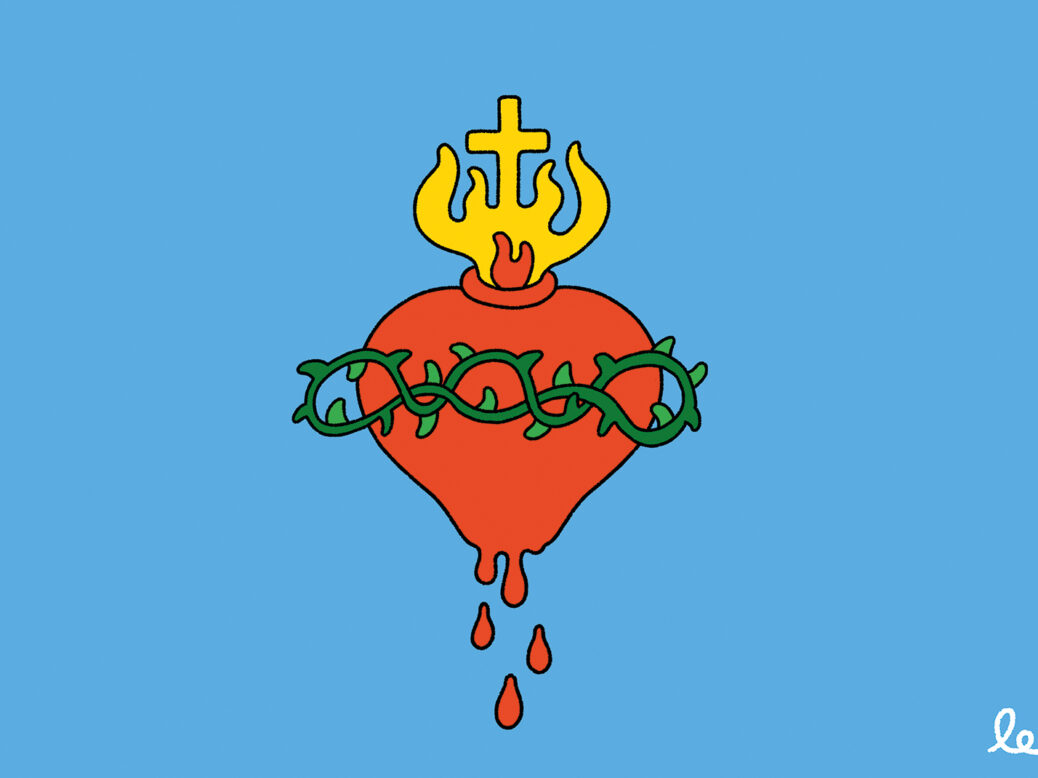
It’s easy to miss St Lewis’ Church in Croft, Warrington. Tucked behind the presbytery, the red-brick chapel is deliberately modest. When it was built in 1827 – the period between the Roman Catholic Relief Act of 1791 and Catholic Emancipation Act of 1829 – there was no question of it having bells or a steeple. It was for agricultural workers and weavers, the poor believers of an unfashionable faith, in a sliver of villages between two great industrial cities: Liverpool and Manchester.
The outside air is crisp and clean, but inside I am met with the familiar smell of old wood, damp, incense and candle wax. Father Gordon Abbs, a powerfully built, softly spoken man, says mass to an 11-strong congregation. It is an unremarkable scene. Yet St Lewis’ has one small claim to fame. It was here that Andy Burnham – Britain’s first Catholic prime minister – worshipped as a boy.
The idea of a Catholic PM is uncontroversial now. But for hundreds of years in Britain, Catholics were regarded as the enemy within. Some of those suspicions remained in law long after most people had forgotten them. When Burnham entered Downing Street, a surviving restriction prevented him from advising the King on appointments to the Church of England. (The government has introduced a bill to change this, which is currently making its way through parliament.)
After the Reformation, Lancashire remained one of the last redoubts of English Catholicism. Recusant families kept the faith alive in private. But this is not Burnham’s religion. His is inherited from his mother: the working-class Catholicism of Liverpool, shaped by waves of Irish immigration. While Catholicism is often viewed as a fundamentally socially conservative faith, this version is shot through with radicalism. As an altar boy in the 1980s, Burnham would play the tape-recorded sermons of Derek Worlock, then the archbishop of Liverpool, to his local congregation. Worlock would preach about social justice and ending unemployment, sentiments that were in opposition to the Thatcher government. Burnham shies away from talking about his religion now, but he once said of the catechism, the Church’s teaching, that he believed that “the enfranchisement of it on Earth was the Labour Party”.

Worlock’s Liverpool in the 1980s has remained Burnham’s political North Star. But when he was one, the family moved to Culcheth, a small village in Cheshire, just two miles away from Croft. From Culcheth, he travelled to St Lewis’ Church. Central to Burnham’s philosophy is his “politics of place”: the belief that local communities should have greater control of their affairs; that devolution is the solution to growing disillusionment with politics. In his telling, it is a philosophy forged by experience, both by the Liverpool of his childhood and his time as mayor of Greater Manchester. But Culcheth is different to these former industrial powerhouses. What to make, then, of the village that raised him?
It’s tempting when writing about the politics of a place to call it a “microcosm of the nation”. But it’s not possible to describe Culcheth this way – 97.5 per cent of residents in the Culcheth, Glazebury and Croft ward identify as white, and the village has high home ownership and low unemployment. In demography, it is closer to the country of the 1950s than the 2020s. It is the sort of England that right-wing politicians invoke in speeches about a nation of village greens lined by independent shops and detached houses lost to mass migration. The Conservatives have historically performed well here, although Labour won all three council seats in this ward in the 2024 local elections.
Culcheth has three Protestant churches, two Methodist and one Anglican. Giant poppy-shaped signs hang from the lamp-posts ahead of Remembrance Sunday. At the Royal British Legion club, Wayne, a 60-year-old volunteer, is preparing for the upcoming parade. The club runs dozens of sports teams as well as fundraisers. On Sundays it serves roast dinners for £6.95. He describes the village as “a little bit conservative”, less in the sense of party politics and more in that people here get things done without involving the state.
“This is seen as a more affluent area, so you’re getting nothing from the council, it’s ‘sort yourself out’,” Wayne says. If the church needs a new roof, or the library’s heating is broken, the locals get involved. I ask Wayne what kind of people Culcheth raises. “Someone who has his eyes open,” he tells me. “You can’t help but be aware of what’s going on in other people’s lives.”
So, what is going on? At the Culcheth Arms I meet Dave, a 65-year-old roofer. He wears a navy fisherman’s guernsey and a khaki cap. He has small, blue eyes and a lined face. He tells me he wouldn’t know whether his neighbours were Catholic or not. “I don’t do politics, I don’t do religion, I let everybody do what they’re doing. I just feel sorry for my grandkids.” I ask why, and he turns away and exhales: “They’re trying to make some of my grandchildren learn about Muslims, and this and that in school.” They have no interest in it, he says. “It’s all changed.” Last year, a former pub in Glazebury was vandalised after it was earmarked to be an HMO. “They wouldn’t like foreigners moving in around here,” Dave says.
Elsewhere in the UK, anxieties about who belongs have turned violent. In the summer of 2024, the stabbings of three girls at a dance class in Southport sparked riots after false rumours circulated that the killer was a Muslim asylum seeker. A local mosque was attacked, with the imam forced to bar himself and fellow worshippers inside as the rioters banged at the door. Disorder spread in the days that followed, and rioters attempted to burn down hotels housing migrants. In June 2026, a man was stabbed on the streets of Belfast, with a video of it quickly circulating online. A male asylum seeker was subsequently charged with attempted murder. A riot began, this time far more clinical in its targeting. It was likened to a modern-day pogrom: homes and businesses belonging to foreigners were set alight. Lists of addresses alleged to house migrants were spread by anti-immigration activists. In each case, awful acts led to terrifying reprisals, with entire communities held responsible.
I first arrived in London from Dublin on Bonfire Night in 2017. Fireworks blazed overhead, celebrating the failure of a Catholic plot to destroy the Palace of Westminster. For the first time I had the sensation of being an outsider. Before I moved to England, I had never had to think about my identity, least of all my religion. On a trip to see Big Ben, I found myself standing, bemused, beneath a statue of Oliver Cromwell outside parliament. Here, the villains of Irish history were celebrated, and the heroes were unknown.
Yet the longer I’ve lived in Britain, the more I’ve come to understand the carnivalesque nature of 5 November, its sense of a social order upturned. Effigies of current political leaders burn next to Guy Fawkes. The mood in the country has changed, too. Decline has brought with it a growing revolutionary fervour. An apathetic establishment seems unprepared for the challenges facing the country, and new plotters are circling outside the palace gates, with designs as destructive as the old.
Inside Downing Street sits a Prime Minister whose faith was once considered an existential threat to the state. More than 400 years since the gunpowder plot, and 200 since St Lewis’ was built, a boy who worshipped in its chapel finds himself leading a country once again beset by religious division, suspicious of its ruling class and restless for change. The UK used to fear that men of his faith would tear it apart. Now one has been charged with holding it together.
[Further reading: Andy Burnham’s strategy: quick fixes and easy wins]
Content from our partners



Related
This article appears in the 05 Nov 2026 issue of the New Statesman, Nigel Farage's bastards
Join the debate
Subscribe here to comment