
The trains were, of course, running late. In the various emails the Home Office and council send formally inviting you to take part in a UK citizenship ceremony, they also warn, multiple times, that you must certainly not be late. (It seems that even when welcoming you into the fold, the Home Office can’t help but admonish foreigners one last time.) The ceremony is the final step in the protracted, years-long process of becoming a UK citizen, and any late arrivals on the day, I have been told, will need to reschedule. On a recent Monday morning, I nearly protracted my own process further because both Southeastern rail and the Tube’s Northern Line were experiencing severe delays.
But I arrive at Islington Town Hall in time – just –and I quickly melt into the queue of soon-to-be Brits shuffling into the grand council chambers. Though I no longer live in Islington, I was married in this Town Hall and have fond memories of it. When I filed my citizenship application, I discovered that you can select anywhere in the country for your ceremony to take place. The meat of each event is largely the same: you sing the national anthem, pledge allegiance to Crown and country, and vow to respect the UK’s democratic ideals. But suspecting – snobbishly and perhaps incorrectly – that the ceremonies in well-heeled Islington might involve more in the way of pageantry and perks than those in my local, cash-strapped borough of Lewisham, I had opted for the pomp. When I survey the refreshments that have been laid out for us in north London – Twinings and Nescafé, alongside small packets of shop-bought biscuits – I begin to question my strategy.
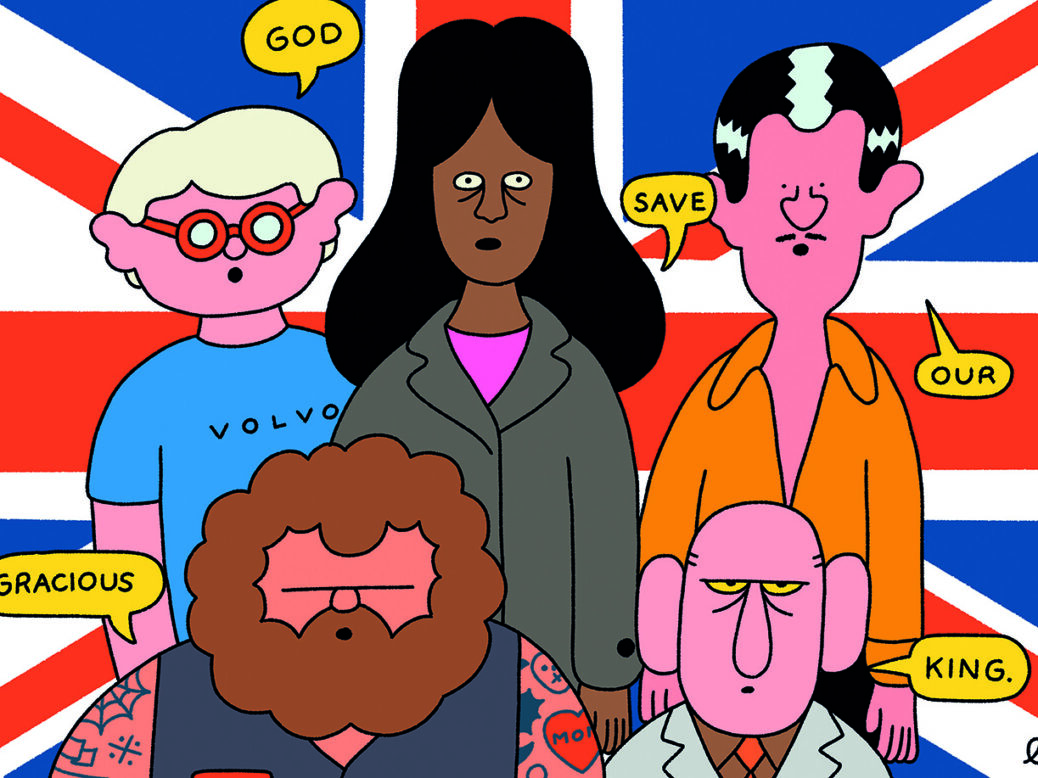
We file into the grand chambers, with their horseshoe pews and domed ceiling, under which a large portrait of King Charles has been displayed, along with the Union Jack and flag of Islington. There are 32 of us becoming citizens here today, including a couple of couples. The majority appear to be in their thirties and European. If there is an unofficial uniform for the ceremony, it seems to be TM Lewin’s finest – judging by the omnipresence of business-casual trousers and rumpled button-downs, many of my new fellow countrymen will be celebrating their citizenship by heading directly back to the office. While there are a few people in jeans and fleeces, no one is outright scruffy; there are a couple of floor-length skirts and suits and ties. One woman wears a tartan blazer. No one quite upstages the event’s photographer, Mario, however: a silver-haired wisecracker dressed in blue shorts, blue braces and improbably glittery brogues.
Then we are divided into two groups, with those who wish to recite a pledge that explicitly references God seated on one side of the chambers’ creaky oak pews; the rest of us making an a-religious pledge are seated on the other. (We are all required to sing “God Save the King” together though – the backing track piped into the chambers through an admittedly impressive speaker system – so perhaps the distinction is pointless.) Seated on either side of me is a man from Sweden whose glasses make him resemble Harry Potter and a man from Greece whose shirt has perhaps one too many buttons undone. In front of me sits a Russian and an American. Others are from France, Spain, Norway, Pakistan and Poland; I am the only Canadian. Our guests – we are allowed to bring just one person each – then trudge in and are seated in the back.

Audra, our beatific master of ceremonies, kicks things off by announcing that a “very special guest” was joining us. We lean forward in our seats, craning to get a glimpse out the chamber door. Is it a royal? James, my husband and guest, later told me he thought it might be Jeremy Corbyn or perhaps the Arsenal manager, Mikel Arteta. Instead, in walks the mayor of Islington, Rosaline Ogunro, her velvet-trimmed, crimson robe swirling around her. Because I don’t actually live in Islington, I had an excuse for not recognising her. But I see more than a few looks of disappointment on faces around the room.
After dutifully welcoming us to the country generally, Ogunro begins regaling us with all that Islington, in particular, has to offer – such as Arsenal and Barnsbury Wood, apparently an unsung wonder. “I encourage you to look it up online,” the mayor keeps saying (if you do, you’ll find it has the honour of being the smallest local nature reserve in London). Across the room, I see a glamorous sexagenarian from Romania nodding off, her eyes closing and head slumping against the baroque Edwardian bench.
Citizenship ceremonies in the UK are a wholly modern rite of passage. It was New Labour that decided to change legally becoming British from an entirely administrative affair to a mostly administrative affair – with a celebratory ritual at the end. To be clear: the ceremony is mandatory, just like the rest of the process that precedes it. (This process includes, famously, the Life in the UK Test, which I sat years ago and is memorable only for its esoterism; sample questions include “What is the voting system in Northern Ireland?” and “What was the population of the UK in 1801?”.)
The first citizenship ceremony took place in February 2004 at Brent Town Hall and the very special guests there were the then home secretary, David Blunkett, and the then Prince of Wales, Charles. During the event, Blunkett said that the new ceremonies would be “the answer to those who fear difference, who fear the diversity that comes with the migration of people coming across the world to live in our community and [would send] a very clear message that those who choose to be part of the family are committing themselves”.
It seems safe to say that citizenship ceremonies have not been the answer that Blunkett had hoped for. When I first moved to the UK in 2011, Nigel Farage’s acolytes were still largely thought of as “fruitcakes, loonies and closet racists”, as David Cameron put it. Fifteen years later, those acolytes – and their fear “of the diversity which comes with migration” – are influencing the policies of the major political parties in the UK in some way. I doubt if they were to witness our solemn pledges and earnest (if tuneless) rendition of “God Save the King”, they would be convinced of our right to be here.
Yet here inside the council chambers, none of that matters. As the ceremony continues, what started out seeming like a formality slowly begins to feel like a celebration. There’s less shifting impatiently in seats; there’s more laughing. One by one, we are summoned to the front of the room, to accept our certificate of naturalisation and shake the mayor’s hand while the rest of the room applauds. We then beam for Mario’s camera, holding up a small Union Jack flag that we aren’t allowed to keep. It takes some time to get through all 32 of us. Yet, save for the sleepy Romanian, we are not bored. We’ve all come a long way. We all want to be here. The longer the ceremony goes on, the harder it seems we clap. When those who are attending on their own without a guest are called up, we all clap harder and longer than ever. What are we clapping for? For the years of hoping, yes, but also for something more. We are grateful and maybe even a little proud.
I had been surprised, when we came to the final line of our pledge, which ends with the words “as a British citizen”, that my eyes had stung and my voice grew rough. Slightly mortified, I managed to compose myself. After years of paperwork and visa fees and biometric appointments, this moment had always loomed in my mind as a destination, a conclusion. So when Audra ends the ceremony, gazing around the room and saying, sweetly and sincerely, “I hope today’s new beginning is all you dreamed of and more,” I can no longer fight it. At last – and for the first time as a British citizen – I cry.
[Further reading: The ghost of Hannah Arendt in the Banality of Evil]
Content from our partners



Related

This article appears in the 14 Oct 2026 issue of the New Statesman, Fool Britannia
Join the debate
Subscribe here to comment