
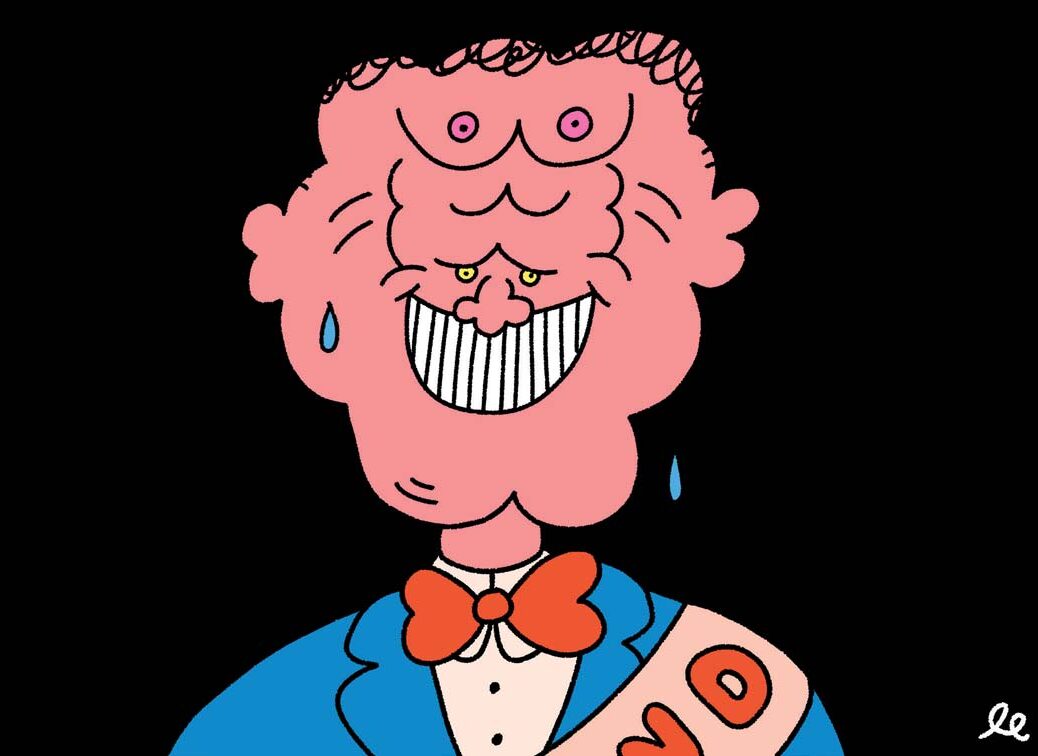
In the back seat of a taxi, Shrirang Deshmukh was dispensing some sage advice. “They’re looking for characters,” he said. “Someone who is funny, jolly, humorous, sensitive, intelligent, and charitable.” He was in a cream hoodie, eyes hidden behind big black shades, humming with a quiet confidence; just a few weeks earlier, he had already proved himself one of the most jolly, humorous, sensitive (and handsome) Asian men in Britain by winning Mr Asiana.
Sitting beside him, Joseph Littlewood was a bit more nervous. Mr England, to which we would be pulling up in a few minutes, was the first beauty pageant that he had ever entered. The 19-year-old film student was pushed into entering by his mum, who had taken part in its female counterpart many years earlier but had failed to win. When his mates had seen online that he was competing, they took the mick. Leaning around from the front seat of the car, I asked if he expected to do well. “I certainly hope so,” he said. “I’m sitting here next to him,” offered Shrirang, “and I can see he’s a good personality.” Any advice for his teenage rival? “Relax and have fun.”
The event nearly didn’t happen at all. Two weeks before it was due to take place, the organiser Angie Beasley was forced to put out a call for more hunks because so few had signed up. English men, she told me when I rang to ask what had gone wrong, are just not as confident as women when it comes to pageants. Those who do compete typically have to be pushed forward by their girlfriends or sisters or mothers, like Joseph. “They’re very shy until they get to the event,” she said, “then they see all the other lads.”
And so here we were in the foyer of a theatre in Melton Mowbray in Leicestershire, where the lads were meeting for the first time. They were in an unusual position. To win a pageant is to become a symbol: in some essential way Miss Coventry, smiling in a pink suit as she greeted the blokes, is the avatar – if not the apogee – of Coventry womanhood. What did it mean to represent England’s young men? Half a million are not in work, education or training. Many spend too much time online attempting to looksmaxx, escape the Matrix or take the red pill. Our conception of masculinity itself is in deep flux. Could pageantry be a solution?

Ten men had made it to the end, with two dropping out at the last minute. Taking the contestants through their paces in a glass-ceilinged hall, Beasley instructs them on how to walk, stand and turn in preparation for the stage. This proved a little confusing for some, who began to look as if they had forgotten how to walk. Joseph, as well as 17-year-old aspiring golfer Luca Devine-Rushbrooke, distinctly resembled newborn foals wobbling out for their first day on Earth.
Voltaire Taiwo De Campus, on the other hand, a tall and elegantly composed Londoner and the only black contestant, brought his own support act: pageant veteran and coach Phephe, who was wearing a diamante-studded jacket with “Team Voltaire” across the back. On her chest sat a badge of Voltaire’s face under the words “The Sky Was Never the Limit”.
“I’m letting people see exactly who I am,” Voltaire told me. “My sole goal is to try and help young people in general.” Voltaire was worried the Covid generation had been deprived of opportunities to socialise. Pageants, he thought, could help to build their confidence. Phephe has previously worked as a teacher in Birmingham, where she watched behavioural standards collapse. At the end of the school day, she would walk boys home to deter their would-be attackers.
Now volunteering with a knife-surrender programme, she recently held a workshop for young men who had committed a stabbing. When she asked one what had driven him, he claimed he’d never expected his victim to actually die. “There’s a real desensitisation,” she said. “In their heart of hearts they don’t think it will happen.” As we spoke, Shrirang was taking advice on his hair. A glossy wet look would be good, suggested Arti, the competition’s stylist: glossy wet hair always looked good under the lights.
At the last Mr England two years ago, a bodybuilder named Chris Hawkins had asked Arti for help oiling up before he flexed his muscles on stage. Pulling up photos of the day on her phone, she showed me an almost completely nude man, glowing orange. Chris failed to win – pageant judges tend to be disposed against such vulgar displays of the human form – but he had captured Arti’s heart, and the two have been dating ever since. As she examined Shrirang’s dense curls, Chris stood behind her tensing his biceps.
He had changed her life, Arti insisted. Obviously, he was very good looking, but he was such a nice person as well. “He carries the traits of how men should be; I wish more people could see him,” she told me. “He shows me how a man should be, how he should treat a woman.” Chris, she seemed to be suggesting, could change my life as well. Maybe he could change everybody’s lives.
I had arrived sceptical of the pageant industry’s claims to select for personality as well as looks. Beasley had told me that Mr England must be kind as well as handsome, that he should be personable, confident and charitable. But surely they were not really selecting the nicest men in England.
Staring into Chris’s bright blue eyes, I realised I might be wrong. “They say that behind every great man is a great woman,” he told me of his girlfriend. “They call her Arti, but she’s the full article.” He spoke like a greeting card, but I couldn’t help but believe him. He told me about a car crash they had survived together that shattered his wrist and forced Arti to undergo life-saving surgery. Love had helped them heal. Love was the most important thing of all. And he could prove it. If I were to accept his follow request on Instagram, he would like every single one of my posts – an instant digital transfusion of love between us.
Later, the lads filed on to the stage to practise with aspiring Miss Englands, whose semi-final would take place that evening. One by one, they handed out imaginary roses, a parody of the courtship ritual. Watching from banked rows of seats, dozens of young women with sleek, straight hair wearing sleek red or white outfits watched and giggled.
Preparing for the sportswear round, testosterone levels started to rise. The boys began bicep curling the tables, overhead pressing the chairs, pumping out press-ups on the floor. The dressing room had become a prison exercise yard. They then changed into their formal outfits: all wore black except for Shrirang, who had selected a crushed red velvet jacket. He played a bouncy electronic tune titled “Luxury” from his phone. He was confident, he said, that he could win.
All too suddenly, it was over. But when Beasley came to announce the results, it was cutting: there would be no Mr England that day. She said too many contestants had entered late, leaving participants baffled about why they had gone to so much effort. They would have to come to the Miss England final on 17 November and do it all again.
When I spoke to the guys afterwards, many seemed deflated. Luca fretted that his parents would not be able to give him another lift. Shrirang was annoyed that his family had driven from Eastbourne for nothing. But Manbir Singh, a quiet young model from Wolverhampton, spotted an opportunity. With another month to work on his confidence, maybe he could win.
[Further reading: What Katie Zacharia’s departure tells us about Trump’s women]
Content from our partners



Related

This article appears in the 21 Oct 2026 issue of the New Statesman, Sally Rooney is a writer, not a terrorist
Join the debate
Subscribe here to comment