
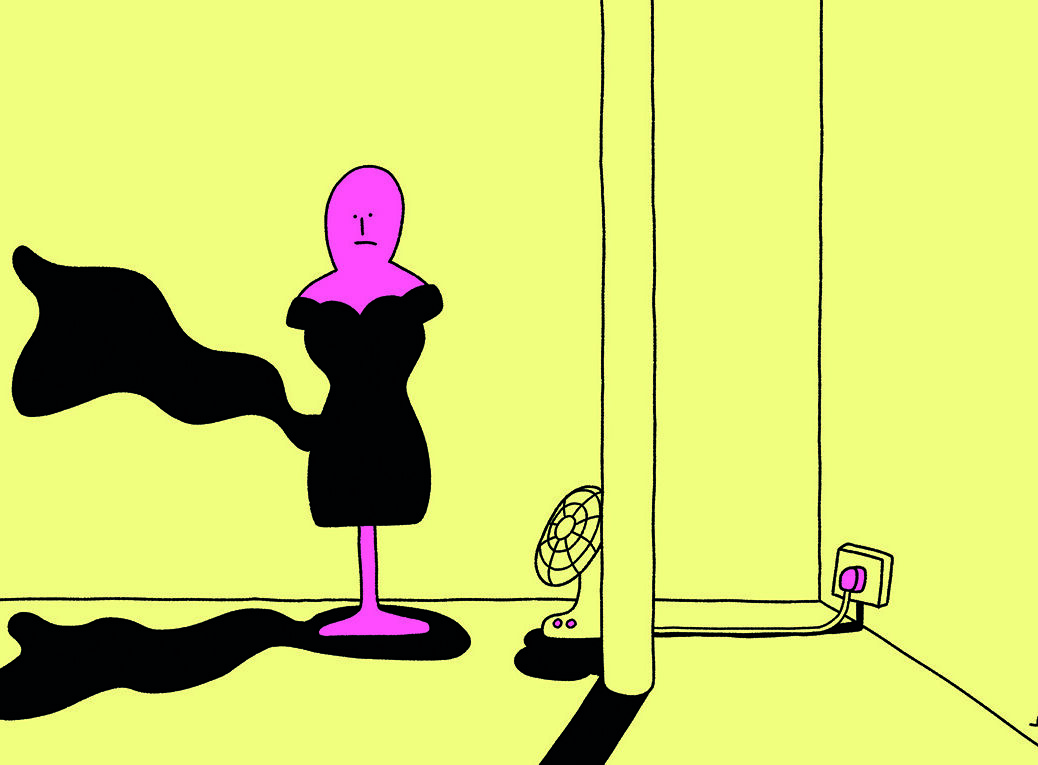
A black silk crepe dress, measuring a petite 78cm at the bust, 74cm at the waist and 82cm at the hip, with a pleated bodice, off-the-shoulder neckline and chiffon train. Among all the fragments of celebrity culture, few have been reproduced with as much dedication as what most of us call Princess Diana’s “revenge dress”, and which Tina Brown called her “fuck-you dress”. As her ex-husband and her brother feud over her legacy, an afterlife that is bizarrely claimed by King-hating republicans and monarchists alike, it seems that she and her clothes remain immovable symbols in our collective life and memory.
But why that dress? Like a pop star, it is embarking on a global tour, going on public display in the UK, Hong Kong and Geneva, before being auctioned in New York later this year. I managed to see the ghostly frock on its London leg, at Sotheby’s, the auction house overseeing its sale. I had expected greater security, greater fanfare. Instead, there were two security guards discussing their shift patterns. Behind a column, a poorly hidden, rather sad-looking plastic fan provided a faint breeze for the dress’s train to gently billow.
The meek exhibition misrepresents the dress’sboth literal and cultural capital. It’s estimated to sell for anywhere between $150,000 and $300,000, though given that a red jumper she wore to a polo match in 1981 went for $1.4m in 2023, that seems conservative. But the dress also has a reverential potency. As the accompanying text on the wall puts it: “More than three decades on, the dress remains a powerful symbol of personal agency and the communicative power of fashion.” The “revenge dress” is “shorthand for clothing used to express transformation, confidence, and self-determination”.
No doubt some of this is true. Diana wore the dress to the Serpentine Gallery’s summer party in June 1994, knowing that later that evening an interview with her husband, Prince Charles, was going to be broadcast in which he would publicly acknowledge his affair with Camilla Parker Bowles. Abandoning the Valentino gown she had planned to wear, she chose magnetism over propriety.

When it was commissioned in 1991, the design, by Christina Stambolian, was aptly described as a “special dress for a special occasion”. Paired with a conspicuous scarlet manicure, Diana’s outfit rejected the conventions of royal dressing and challenged the rigid traditions she felt oppressed by. It was an attempt to alchemise humiliation into power. At the time, her marriage was disintegrating, and under a degree of public scrutiny almost impossible to comprehend. Perhaps she knew better than most the gruelling reality of having to perform pain for the media. (She stopped wearing Chanel following her divorce, as the brand’s interlocking double-C logo was a painful reminder of Charles and Camilla.) The dress may represent defiance, but it exists alongside grief and vulnerability, a public assertion of control over the chaos of her private life.
In his 1943 work of existential philosophy Being and Nothingness, Jean-Paul Sartre wrote that “to be dead is to be a prey for the living”. While alive, a person can articulate and embody selfhood; they can contradict the stories told about them, alter their behaviour, reject an interpretation, reinvent themselves. With death comes the loss of negotiation. What remains is a battle among the living over what the deceased is to mean. Authorship descends into a struggle for authority – of who can claim legacy and what that legacy should be.
Diana was always conscious of her image: a humanitarian shaking hands without wearing gloves with an Aids patient; an unhappy wife secretly providing answers to Andrew Morton for his biography of her. The revenge dress is one more attempt by Diana at self-authorship, of inscribing herself into her own story.
Her death resulted in a proliferation of Dianas, many of which compete with one another. There is the Diana of the monarchy: the Princess of Wales, mother of the future king, a complicated chapter in the institutional history of the Crown. There is the Diana of the Spencer family: daughter, sister, member of an aristocratic dynasty. There is the Diana of the public: the People’s Princess, or as one commenter in a Facebook group says, “beautiful, the Queen of peoples hearts… continue to REIP [sic]”. There is the Diana of fashion, whose wardrobe has been transformed into a visual vocabulary of emancipation. There is the Diana of television, endlessly reconstructed and re-performed. There is the Diana of the tabloids, the documentaries, the anniversaries and the commemorative exhibitions.
Most recently, Diana has been ventriloquised by her brother Charles Spencer, who in September published his memoir Swan Song. He has long invoked the national myth of Diana, playing the roles of both its custodian and beneficiary: his book claims to “provide… the most intimate, loving and honest portrait yet of his sister”, while the dates his Althorp estate will open to the public next summer are bookended by her birthday (1 July) and her death day (31 August).
The dress and the book seem to reinforce the same version of a particular story about Diana: a wife wronged, betrayed by her husband and mistreated by an institution. That both have been in the public eye at the same time is coincidental (the dress is owned privately), but it’s revealing all the same: the woman who had spent much of her life battling against the machinery of celebrity became, in death, one of its most valuable raw materials.
This is, in part, how collective memory becomes commodified. A person stuffed in a dress and rendered visually intelligible. What survives is not necessarily what was most important, but what can be most effectively reproduced. But the market responds to appetite, which makes the sale of the dress a particularly elegant version of a broader cultural disease: our difficulty in allowing Diana a peaceful death. And remembrance becomes all the more confusing when it is contradictory: can Diana be both the victim of the monarchy’s callousness, and the woman who silenced high society with a dress?
Mythologising the dead is a subtly violent act. It’s not necessarily that Diana has been misremembered, but that a definitive version must be asserted, and we cannot decide on which it should be. The specific cruelty inflicted on those who are mythologised is that they have no ending; they are doomed to live in perpetuity. And so she endures, through fashion, biography, television, auction houses and photos of dresses.
When it comes to myths, symbols are more important than reality. In one version of the Diana story, she is a vision of what the monarchy – and the nation – could have become. Aspirational but human; modern but still British. She bridged the gap between the privileged few and the ordinary masses. But the dress reminds us that she was also just another wronged woman, capable of resorting to point-scoring, even in the most stylish possible way. Maybe that is why the dress has become almost as famous as her. And the fact that her memory is such a tangle of contradictions may be the final irony of her story, a story of which she was just one author among many.
[Further reading: What was Charles Spencer thinking?]
Content from our partners



Related


This article appears in the 01 Oct 2026 issue of the New Statesman, Sunshine and Rain
Join the debate
Subscribe here to comment