
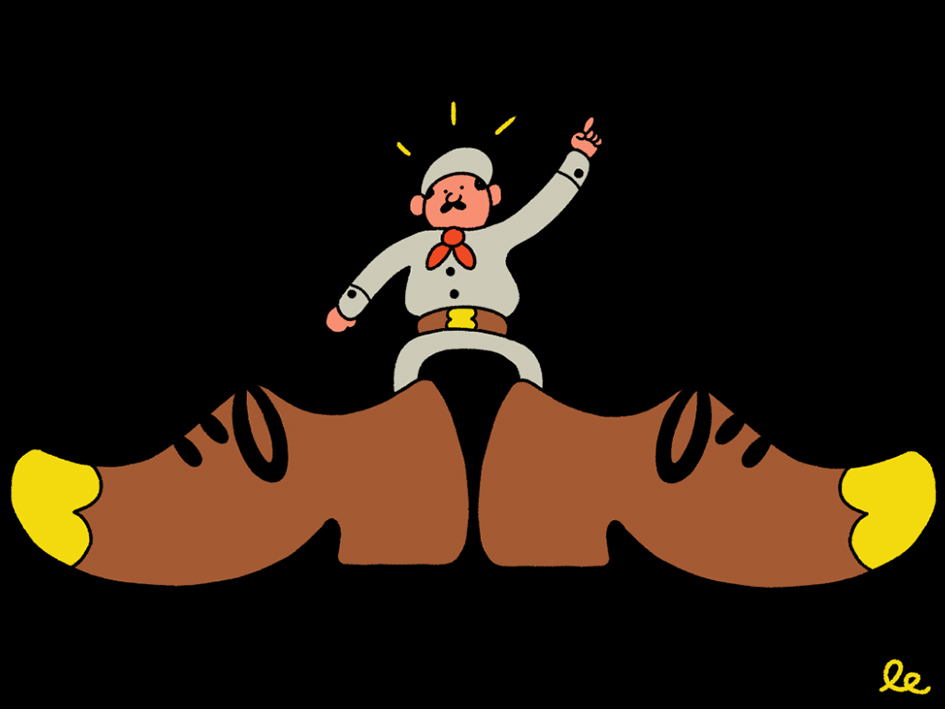
The storm began in the Irish Sea, brooding off the coast of Dublin, working itself into a rage over the 135 miles or so to Blackpool, and then, finally, falling furious over the cobbles of Clitheroe, Lancashire. Though this is not an unusual occurrence, it is an inconvenient one. This weekend, in the middle of September, is Clitheroe Clogfest and, as it turns out, wet cobbles are impossible to clog on. The plan to dance around the town is diverted, as the cloggers instead hole up in the castle (often said to be the smallest Norman keep in England – any claim to fame is better than none, I suppose), or at least its pine-and-glass Blair-era atrium. And so I find myself, on a rain-soaked Saturday afternoon, watching a succession of dancers stomp and click their toes around a makeshift sprung stage. It is a bid to understand why a near-lost pastime that gained popularity during the Industrial Revolution is once again being practised in a town that has consciously shrugged off its industrial heritage, and what that means for this area’s link to its past – and conception of its future.
You must not confuse clogging for Morris dancing, its organisers are at pains to point out; while Morris dancing uses sticks or bells to make noise, clog dancers use only the sound of their feet. The effect is a little like a more stationary, less theatrical tap dance, with legs raised high and toes pointed like show ponies. This weekend’s plans involve a day of exhibition, in which dancers put on performances for the locals, followed by a day of serious competition to determine who is crowned the best clog dancer in the country – or at the very least in Lancashire and Cheshire.
Many of the dancers wear the traditional garb of the bargees who once worked the canals here: white aprons and breeches embroidered with Lancashire roses, bright and red as bloodstains. These are paired with flat caps and corduroy trousers for the men, full skirts for the women and, occasionally, a broad flat belt encrusted with shields – the sign of a champion (win the same class three times, and you are gifted a replica of the belt and “retired” from competing in that category again). Some of the younger contestants go for a contemporary miniskirt and V-neck-tee uniform, as well as an unorthodox vocal accompaniment. “It’s not a cool thing… but we wanted to show it can be this youthful, exciting thing,” says Elizabeth French, who is the next day crowned Lancashire and Cheshire champion.
What unites them all, of course, is the clogs. At the back of the room, a traditional clogmaker, Phil Howard, tugs at his white beard as he chats with audience members buying his handmade leather belts, keychains and shoes, which look akin to heavy, wood-soled brogues. Today, Howard wears a pair of tan clogs, tooled with a decorative pattern and fitted with metal accents that flash when he crosses his legs and bobs his feet to the rhythm. I ask if his is the last clog business still active, but he is quick to correct me. “Oh no, no. You’ll get that said by the BBC, but no.” He has been doing it 20 years, ever since he bought the lasts (wooden templates used to shape the clogs) from a clogger in Stockport who was retiring, and now knows all there is to know about his self-taught craft, including its history. He outlines how clogs went with the working classes from the fields to the mill floors, and were eventually rendered obsolete when cheaper, mass-produced shoes came into fashion. He is both generous and amusingly forthright. When I mention a recent trend for Scandinavian clogs, he scoffs, “Of course, but they’re Scandinavian clogs”; likewise, I am swiftly reprimanded when I refer to the clogs as mere “shoes”.

Howard says that business has suffered since the pandemic. “People stopped joining in. They got in the habit of not making the effort to go out.” There is also the cost element, he tells me, which means increasing numbers of clog teams are choosing, sacrilegiously, to wear cheap tap shoes instead. Yet the sizeable crowd here today is genuinely mixed in both age and experience, including an enthusiastic six-year-old in a K-Pop Demon Hunters T-shirt and an utterly rapt baby who kicks his legs in time with the dancers. Even the distance travelled by spectators is wider than I had first assumed.
One first-timer, a glamorous middle-aged woman with red ringlets, tells me she has come all the way from Kearsley on the train after having seen the event advertised on Facebook, and is loving it so much that she’s coming back to see the competition tomorrow. Though we may be long past the days of being able to make yourself a variety-show star through your dancing, something about the heartbeat rhythm of its percussion still has the power to command attention. I confess I was not quite prepared for how mesmerised I would be by clogging, by the metallic tips flashing like minnows, by the pure perfected skill of it.
Perhaps that is because clogging feels a little ill at ease with contemporary Clitheroe. Like many market towns up and down England, it has been increasingly keen to hew off anything that does not fit its increasingly aspirational image of cocktail bars and interiors shops. Once upon a time it had around 16 working cotton mills, and the backstreets of its outer reaches are still peppered with terraced workers’ cottages. Today, what was its last operating mill is a glossy, tourist-bait quasi-mall that includes a brewery taproom, Everyman cinema and food hall.
Clitheroe is now firmly part of the new northern Range Rover belt, number plates personalised, interiors spotless. Though it was always relatively affluent and gruffly pretty, its grammar school, access to Manchester and Preston, and olde-worlde charm have seen its popularity – and its house prices – ascend in recent years, and sent skywards by the pandemic. Clitheroe is near equidistant to the neighbouring towns of Blackburn and Burnley to the south, though in many ways it is a mirror image of those places: wealthy, while they grapple with poverty; majority white, while they are diverse; agrarian, while they are urban. It is a strange sensation to watch somewhere you have known intimately since you were a child shed its identity piece by piece, and be rewarded for it, purely by virtue of having stone cottages rather than brick terraces.
Clogfest seems to fit the weirder, less picture-perfect spirit of the Clitheroe I knew, before its recent estate-agent-fuelled scrub-up. After all, the town even lies in the shadow of Pendle Hill, site of infamous 17th-century witch trials. At its heart, Clitheroe is a place where the mist rolls down from the fells bone-damp, where a legend tells of a local tailor who tricked the devil and where a local caff, Swales, is decked out in a beautifully haunting 1970s vision of mirrored teak and plastic pot plants. There is, away from the gleaming 4×4s and espresso martinis, a fundamental strangeness, something rich and eerie that clings to the mud.
Descending from the castle, I am left wondering what the future is for clogging. While it is genuinely thrilling to watch and listen to the drum of wood against wood – the precise, geometric angle of the foot – it feels increasingly like a museum exhibit, set against the backdrop of a town that is moving swiftly towards a slick, expensive and tourist-friendly future. Perhaps that is fine, and perhaps the only way these practices can continue is in places with money, where the memory of the poverty of the mills is distant and hazy. I cannot imagine the tap of the steel toes of Clogfest having the same allure in Blackburn, for instance. Perhaps, ultimately, it is a relic enjoyed by those who have left that all long behind, and for whom the past is a curiosity enjoyed in the glow of a rosy future.
[Further reading: This England: Selective memory]
Content from our partners



Related
This article appears in the 24 Sep 2026 issue of the New Statesman, A Sense of Power
Join the debate
Subscribe here to comment‘Don’t some mothers ‘ave ’em?’
And me, stood standing here like cheese at fourpence!