
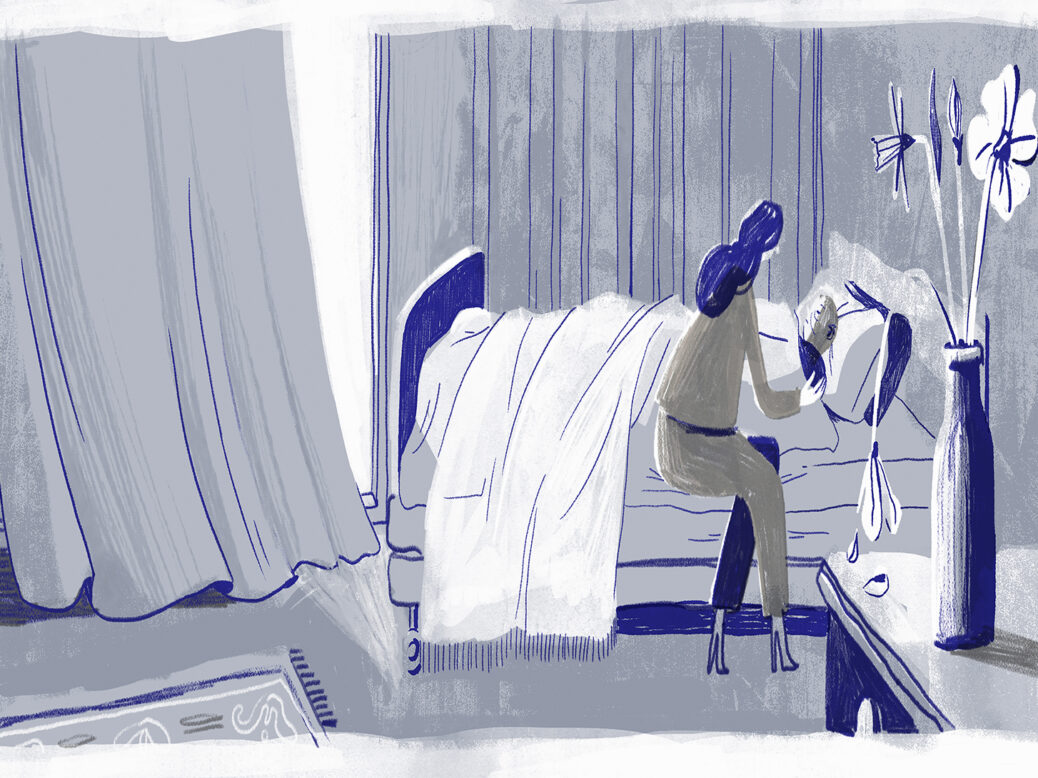
In the final moments of a person’s life, you might hope to take one last look at the people closest to you – friends, family, lovers. But what if you saw Nicole Kidman? Her pale skin and light blue eyes staring down at you, as you pass from this life to the next.
For the sick and sorry of her home state of Tennessee, this is now a possibility. In April, she announced she was in training to become a “death doula” – a non-medical professional who provides emotional, physical and psychological support to the dying. This might take the form of advice, reassurance about what is and isn’t normal, or simply sitting and listening to someone in their final moments. The term derives from that of birth doulas, who help women during pregnancy and childbirth in a non-medical capacity.
Kidman was inspired to start training after the death of her mother in September 2024, having been touched by the “solace and care” doulas provided. “As my mother was passing, she was lonely, and there was only so much the family could provide,” Kidman said. “Between my sister and I, we have so many children and our careers and our work, and wanting to take care of her because my father wasn’t in the world any more, and that’s when I went, ‘I wish there was these people in the world that were there to sit impartially and just provide solace and care.’”
In terms of what her “training” will involve, there is no standardised practice. The presence of death doulas in medical settings is not regulated, and therefore the scope of what the job can involve varies between practitioners. Some doulas have been taught to approach an end-of-life situation by offering practical help around the house – doing dishes and folding the laundry. But others may assist with the endless probate paperwork piling up. At a basic level, they provide comfort and company.

There are now at least 450 doulas in Britain registered to the main professional association, End of Life Doula UK. Former Green Party leader Caroline Lucas even stepped down from parliament to train and work as a death doula. But the number of practicing doulas may be much higher, as some end-of-life companions may operate independently outside of registered membership organisations. And they are filling a hole in British society between medicine, palliative care, and the notoriously strained social care system. With an ageing population and staff shortages, end of life care is strained, with fewer beds available for patients. In 2025 around 90 per cent of people required palliative care at the end of life, however only one in three people received this treatment due to a lack of funding. Andy Burnham is staking his premiership on improving this situation; for now, more and more people are turning to the doulas.
Leading these death doulas in the UK is Dr Emma Clare, 35, a chartered psychologist, chief executive and co-founder of End of Life Doula. Approximately 10 new members join the organisation each month. “Death doulas fill the gaps, and I do think that those gaps are probably bigger than ever, sadly,” Clare says.
Based in York, she is warm and enthusiastic, eager to speak about her lifelong passion. “I’m a good listener,” Clare says. “Most people think they’re good listeners because they think it’s just hearing what someone says but actually listening is a hard and active task. People want to be heard.”
“We’ve had more requests in three weeks than we would normally expect in two months,” she says, following Kidman’s promotion of the practice.
She attributes her interest in death to a childhood incident in the Peak District. In 1998, at the age of 7, Clare was walking through the rich landscape of middle England when she encountered a squirrel lying dead on the ground. “I wasn’t scared,” Clare says.
Before starting the organisation, Clare completed her foundation course in death doula training in 2018 through Living Well Dying Well, a Lewes-based training centre. Shortly after, she received a request from an old university friend. They wanted assistance in how to navigate their final conversations with their father, who was spending his last days at a local hospice. Although reluctant at first, she arrived and sat with the family, answering simple questions. How would they sort their finances? Why was he breathing with such a rattle? Was his loss of appetite normal in these circumstances?
“Having open, honest conversations, nothing particularly complicated, or medical makes such a difference,” Clare says. “Dying is incredibly ordinary.”
Family members often feel frightened and somewhat disturbed by the jarring change in their loved one’s disposition as they fade from this life. One of the most common symptoms a death doula explains is the dying person’s alarming “death rattle”. This is a distinctive gurgle or rattly breathing that occurs when a patient is near the end of life. While it can appear distressing and seems as though the loved one is in pain, in fact, it is simply the weakened muscles trying to clear saliva from the airways.
But in these moments of extreme vulnerability, there have been cases in which the death doula proved more of a burden than an aid. In 2020, a Tennessee funeral director and embalmer, Reid Van Ness, was under state investigation for exploiting grieving immigrant families and neglecting human remains. He had abandoned at least ten bodies in Middle Tennessee funeral home coolers for up to 11 months. Many remains have decomposed beyond recognition.
He then took on a new title: death doula, continuing to perform services that Tennessee regulators considered funeral directing. Van Ness challenged the state’s efforts to regulate him in federal court. The court did not acquit him of fraud, nor did it find the families’ allegations to be untrue. In a 2025 evidentiary ruling, the judge found evidence that a family had paid $4,518 for services but did not receive some promised items, and heard testimony that Van Ness cut locks of the deceased’s hair and distributed them to the children without prior warning. The judge described the family’s testimony as “consistent and heartfelt.” In June 2026, the federal court ultimately ruled against Van Ness, but not because it rejected the families’ allegations. The court dismissed his challenge to Tennessee’s regulation of his work on a technicality because it did not affect him financially.
The dispute showed a blurred line between the role of the death doula and regulated funeral work or medical support. Online forums have also exposed how a lack of standardised training leaves the industry open to scam training. One Reddit thread details this frustration. “I never heard back after the first call, it was such a waste of money,” reads a post.
At End of Life Doula, however, the training is thorough and precise. Doulas-in-waiting undergo an 18-month course before they begin practicing. They must hold a current DBS check, professional indemnity insurance, public liability insurance and safeguarding training.
A trainee end of life doula will cost approximately £25 per hour, compared with more advanced doulas charging closer to £150 per hour. These prices can differ depending on how long the doulas are present – whether they are attending for hours, days or even months. If the client has qualified for free support, they are matched with a volunteering doula.
Palliative care specialist and GP, Catherine Millington-Saunders, 51, has worked closely with End of Life Doula throughout her career. “Grief is an amazing privilege because you get to know someone so deeply throughout their life,” she says. “It’s such a beautiful opportunity to help people die.”
Marian Krawczyk, 61, anthropologist and lecturer of end-of-life studies at the University of Glasgow, came to work in this industry following the death of her brother and sister, both of whom died from cancer. “Dying now is a bureaucratic endeavour,” Krawczyk says. “It’s hard work, there is a lot of paperwork involved, networking and resources needed, and yet, we don’t have the community of care that you need at that stage of life.”
“We’ve come to believe that we should have autonomy in all aspects of our life, including our death. Dying has become a lifestyle choice,” she says.
Throughout history, families have closed the eyes and mouths of the deceased, washed the body and kept them at home for days, holding a wake and inviting others to pay their respects. These were widespread cultural and religious practices, particularly within Jewish communities. Many of these traditional rituals and forms of human connection have faded, but end-of-life doulas may be helping to bring some of them back. While the role of the doula is not inherently religious, it can offer a sense of spirituality and meaning — something the increasingly secular world may be longing for.
“I worry that if death doulas become regulated with oversight and scope of practice that they are going to find themselves restricted in what they can and can’t do,” says Krawczyk. “The NHS system isn’t working and if we replicate the system with doulas, there are going to be the same problems.”
[Further reading: Sheep will be provided]
Content from our partners


Related
Join the debate
Subscribe here to comment