
At the 1878 Congress of Berlin, the German chancellor Otto von Bismarck famously said that Albania was nothing more than “a geographical expression”. To counter this sentiment, Albanian leaders established the League of Prizren to advance Albanian interests and self-determination. But the major powers were dismissive and Albanian land was soon partitioned between neighbouring Serbia, Bulgaria and Montenegro. A century later, communist dictator Enver Hoxha conjured the moment with characteristic venom in his 1982 memoir, The Anglo-American Threat to Albania. “The Anglo-American imperialists, those savage and determined enemies of the Albanian people, have always used our country as a means of exchange in their international transactions,” he wrote. The “Anglo-Americans” were known to transform even their own fields “into golf courses for the lords”, so what would they do to the natural riches of Albania?
Hoxha was a notorious paranoiac who led his country into quasi-autarkic isolation until the system’s collapse in the early 1990s. But on Anglo-American designs on the region, he might have had a point. For foreign powers, Albania has always been prime real estate – and Albanian self-determination has long been an obstacle to fully possessing it.
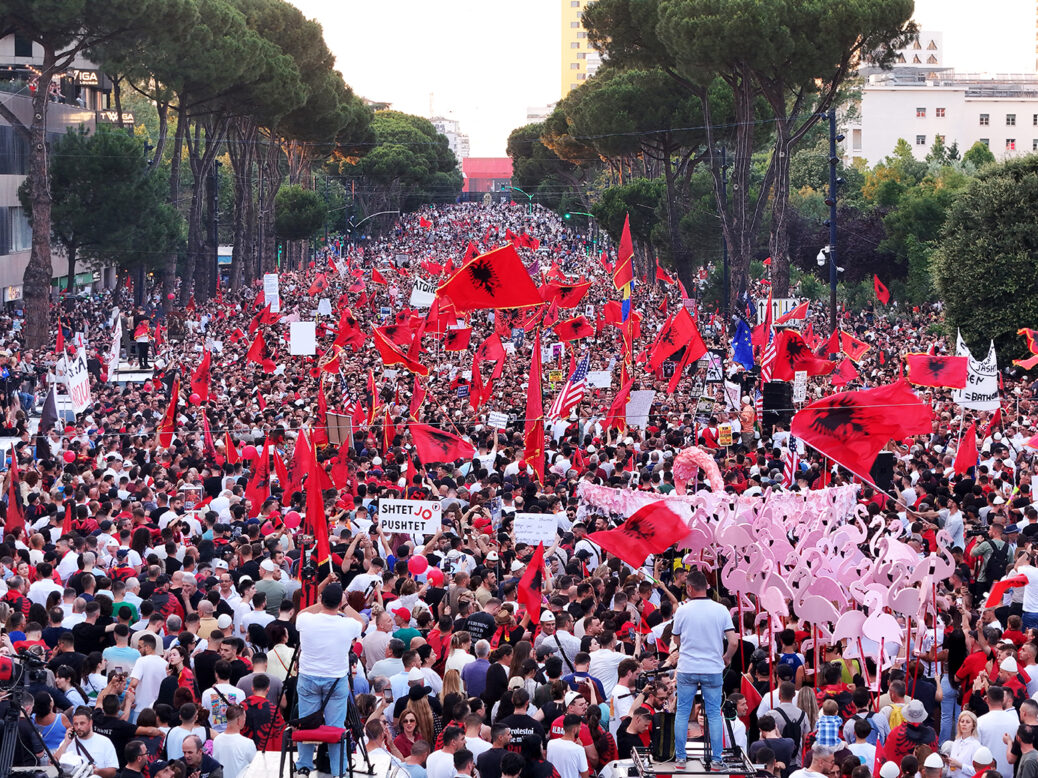
A generation of Albanians have now grown up in the ashes of communism. But the transition to liberal democracy has brought new questions about Albanian sovereignty. In recent months, Jared Kushner, the son-in-law of Donald Trump, has met with furious backlash over his plan to build a multibillion-pound ultra-luxury tourism resort on Albania’s fragile coastline. Plans involve an opulent development on Sazan Island and a separate luxury project on Albania’s southern coast in the municipality of Zvërnec. The Gen Z-led protests in response have been attended by tens of thousands – though some estimates suggest the figure could be as much as 250,000 – making them among the largest in Albania since the fall of communism.
Much of the popular discontent has been levelled at the government of Prime Minister Edi Rama, whom protesters are calling on to resign. Rama, an artist from the Socialist Party, is a flamboyant PR-friendly showman who has many admirers in the West. As mayor of Tirana, Albania’s capital, from 2000 to 2011, he had the facades of grey communist blocs painted in bright colours – an initiative he described as “the avant-garde of democratisation”. Now, protesters accuse him of leading a government that has accepted only the rhetoric of liberal democracy while ushering in a creeping autocratisation.

Kushner’s property plan complements Rama’s own efforts to remake Albanian urban identity through redevelopment projects backed by foreign capital. It’s also a showcase of a kind of Trump globalism: the international network of interwoven real estate – and peace deals – brokered by Trump’s inner circle and bankrolled by Gulf petrodollars. Almost immediately after Trump won the 2024 election, the Albanian government controversially granted “strategic investor” status for the seaside development to Atlantic Incubation Partners – a company linked to Kushner’s Miami-based Affinity Partners fund. Affinity Partners is a private equity firm backed by a dizzying collection of Gulf sovereign wealth funds, primarily Saudi Arabia’s Public Investment Funds (PIF), along with the Qatari and Emirati Investment Authorities. These interests are also knitted together in Gaza’s reconstruction through Trump’s so-called Board of Peace, where Albania and the Gulf states are founding members, and Kushner is an executive board member.
A June protest in the capital of Tirana was organised to coincide with the anniversary of the founding of the League of Prizren. “Today, on the 148th anniversary,” one protester said, “we are in the same situation. Our homeland is in danger, so we are here, we have united to protect Albania from these invaders. To protect our lands [and] nature for our future.” Many of the most burning concerns about the Kushner projects hinge on the threats they could pose to the area’s delicate wildlife. Most troublingly, the coastal development would stretch into the protected Vjosa-Narta lagoon. This is a critical migratory bird habitat that hosts about 40 species of bird, including Dalmatian pelicans and about 3,000 flamingoes, hence the protests’ name – the Flamingo Revolution. In late spring, bulldozers and razor-wire fences started appearing near the Zvërnec site, prompting a violent confrontation in which private security guards assaulted protesters. Rama asserts that they are still only performing an environmental impact assessment and that, until it’s completed, much of the opposition to the project is based on speculation alone.
Predictably, concerns about the project’s questionable legality have dogged Kushner’s luxury development plans. Albania’s independent anti-corruption body SPAK is investigating a suspect set of amendments to the Law on Protected Areas adopted in February 2024, which eliminated a critical legal barrier to the project. (Though the amendments were introduced before the US election, Balkan leaders had long been preparing for the likely return of Trump and were adjusting their policies accordingly.) The revised legislation “rewrote the basic philosophy of protection”, as one recent report put it, changing the priority for protected areas “from ‘nature conservation’ to ‘openness to investment’”. The changes have alarmed the EU as well: on 17 June, the European Parliament adopted a resolution calling for the repeal of amendments to Albania’s Law on Protected Areas and “full compliance with EU nature protection standards”.
The idea that Sazan Island should now become a plaything of the Trump family and the international uber-rich is especially offensive given its history. For much of the 20th century, the island was off-limits to most Albanians. Sazan began the century as an Ottoman possession, then came under Italian colonial dominion in 1914, and remained a base of operations for the Italian Royal Navy until 1947. The island then became a critical Soviet naval position. “From here we can have the whole of the Mediterranean, from Bosporus to Gibraltar, in our hands! We can control everyone,” Nikita Khrushchev allegedly said while visiting the nearby Pasha Liman submarine base.
Then, during the Sino-Soviet split in 1961, Hoxha sided with China and ordered the Soviet base on Sazan to be evacuated. Albania eventually broke with China in 1978 and drifted deeper into international isolation and paranoia: Sazan was allegedly fortified with some 3,600 bunkers along with a complex network of underground tunnels. Even after the collapse of communism, Sazan officially remained a military base and Albanians were prohibited from visiting. It was only in 2015 that civilians were able to start applying for special permits to view the island and, even then, visits were heavily restricted. Regular guided boat tours only started in 2019 but were abruptly halted by the pandemic.
Ivanka Trump recently drew much ridicule when she claimed to have “discovered” the island while sailing on a yacht with British financier Nat Rothschild. “It’s an unbelievable, beautiful 1,400-hectare private island in the middle of the Mediterranean,” she said in a podcast interview this summer. “We were on a friend’s boat and we stopped for a swim. Effectively, that’s how we found it.” It was during that same visit that Edi Rama met with the Kushners on Rothschild’s yacht.
Albania is not the only country in the region where the Kushners’ have displayed predatory interest. In 2024, the same year Affinity Partners announced its plans for the Albanian coast, the company also rolled out a development project for one of the most historically sensitive properties in the Serbian capital of Belgrade: the bombed-out remains of Yugoslavia’s Ministry of Defense building, or Generalštab, which was hit by Nato airstrikes in 1999. Kushner planned to build a gleaming Trump International Hotel atop the ruins. In Serbia, Affinity Partners had planned to partner with the Abu Dhabi-based developer Eagle Hills – a firm already notorious for developing the Dubai-inspired Belgrade Waterfront.
As in Albania, the Serbian plans were of questionable legality: the modernist Generalštab complex had been listed as a protected cultural heritage site for years – an obstacle President Aleksandar Vučić’s government attempted to circumvent by revoking. Minister of Culture Nikola Selaković has been put on trial for the move. He recently pleaded “not guilty” to the charges, and Vučić has vowed to pardon him if he is convicted. Whatever the result of the trial, de-listing Generalštab as protected heritage was for naught: opposition to the planned Trump hotel mobilised an unlikely coalition of architects, urban planners, war veterans, nationalists and leftists. The opprobrium spooked Kushner and he abandoned the Serbian project in December 2025. As a spokesperson for Affinity Partners told local media, “Major projects should unite rather than divide. And, out of respect for the citizens of Serbia and the City of Belgrade, we are withdrawing our application at this time and will not pursue further participation.”
There are other parallels between the Serbian and Albanian cases. In both countries, recent mass anti-government protests have become a generational referendum on the entire post-transition political class. “For the first time ever, the protest is not only against the government, but also against the largest opposition party as part of the ‘old political elite’,” Celik Rruplli, a media analyst based in Tirana, tells me. In Albania, protesters against the Kushner projects have chanted “Rama in prison – Berisha in prison!” – the latter a reference to opposition leader Sali Berisha, who has previously served as both prime minister and president. Berisha was placed under US sanctions for corruption by the Biden administration in 2021, but in June this year, the State Department lifted his “non grata” designation. The protests that have rocked Serbia since a deadly train station canopy collapse in November 2024 are organised according to a similar ethos: targeting the ruling Vučić government, while also unaligning with the official opposition.
Mass mobilisation in both Albania and Serbia demonstrates a fatigue not only with the post-communist political class, but with a critical ideological assumption that came with it: that foreign investment in a frenzy of glittering development projects is a meaningful indicator of progress. More than three decades since the transition to putative democracy, the region is still drowning in concrete and glass. Many luxury developments built for the international elite now disfigure the shores of its rivers and seas, while the young continue to leave the region in droves. Today, the average monthly net salary in Albania is roughly £650; luxury resort vacations are far beyond reach for all but the very richest of the country’s post-communist elite.
Yet Rama still demonstrates defiance. He insists that the requisite assessments will be performed and has vowed that the project will move forward. But protesters are equally determined and say that they will not back down. Demonstrations are still being held every evening and will likely intensify in the autumn once people return from their summer holidays and construction gets underway. Rama may be eager to make his country the avant-garde of global Trumpism, but his citizens are just as eager to prove that Albania is not for sale – that this time, they’re unconquerable.
[Further reading: The Nato paradox]
Content from our partners



Related



Join the debate
Subscribe here to comment