
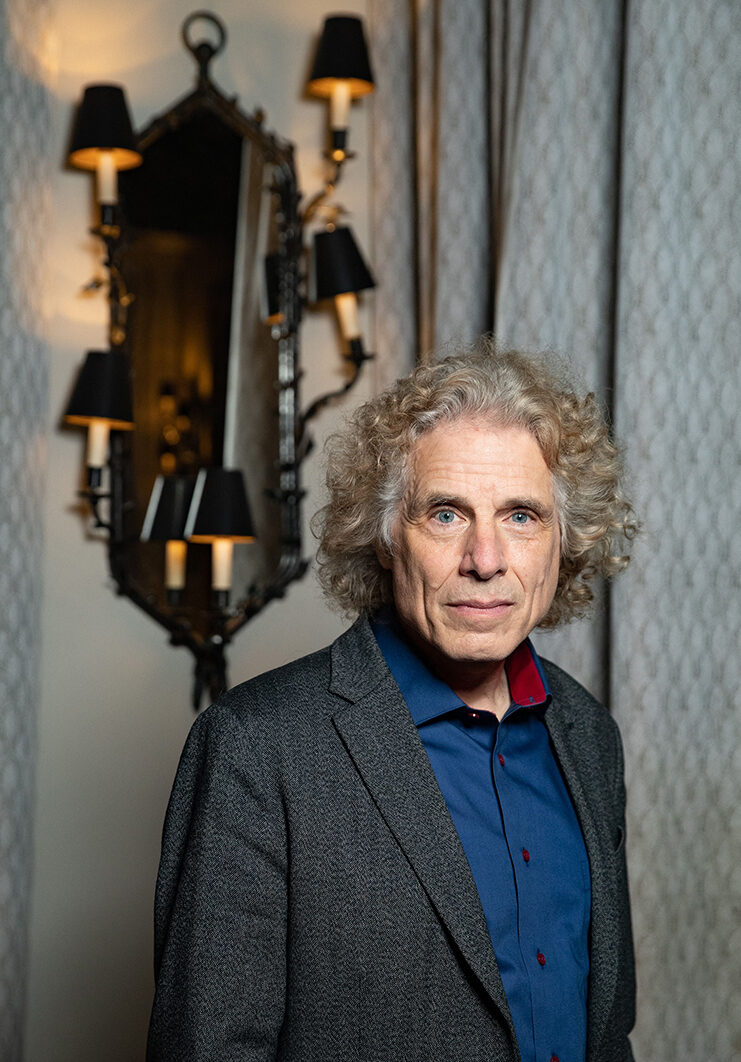
You know what you know, and I know what I know, but only when we know what the other knows do we have “common knowledge”. That’s the crux of cognitive scientist Steven Pinker’s latest book, which focuses on the shift from private to public knowledge, and how this can suddenly change behaviours – even start revolutions.
On this week’s culture podcast, The New Society, I interviewed Pinker about his latest theories and how he got interested in the problems of knowledge, language and communication. Below is an edited extract from our conversation.
Tanjil Rashid: Your new book is When Everyone Knows That Everyone Knows…: Common Knowledge and the Science of Harmony, Hypocrisy and Outrage. What is “common knowledge”?
Steven Pinker: Common knowledge refers to the state in which I know something, you know it, I know that you know it, you know that I know it, I know that you know that I know that you know it, and so on ad infinitum. The term’s a bit misleading. It was devised within game theory and philosophy and economics to refer to this state of knowledge. It doesn’t just mean something that’s widely known, but something that’s known to be known. The reason that’s significant is that common knowledge is necessary for coordination, for two people to be on the same page and make choices that benefit them both as long as they make the same choice. They only have the confidence to do that if each knows that the other one will make it too.

It’s a surprisingly important and central concept, but it’s been buried in the academic literature. I was trying to explain why it’s so significant as a way of making sense of some of the mysteries of money, power, and everyday life.
What I struggled a little to understand was how this idea of common knowledge fits into a broader intellectual development. How do ideas progress or emerge out of common knowledge?
A lot of our rituals and conventions seem to be utterly irrational and arbitrary. But when it comes to coordination, something that’s arbitrary can be highly rational. The most obvious example is driving on the left or driving on the right. What’s the argument for driving on the left? There is no argument for driving on the left. There’s a big argument for driving on the same side that everyone else is driving on.
Many of the seemingly baffling rituals that different subcultures and ethnic groups have may be common knowledge generators that get the population all on the same page, that get them to do things that benefit everyone so long as everyone does it.
I found elements of your theory almost quite beautiful. I loved the line where you say that rational argument should really be more like a dance than a war. What did you mean by that?
That image came from the linguist George Lakoff and the philosopher Mark Johnson in their, their lovely little book called Metaphors We Live By, in which they note that a lot of common language, even if it’s not consciously poetic, centres on certain families of metaphors, and one of them is that argument is a kind of war.
The language that people use to describe an argument is all borrowed from war. “I demolished his argument. He tried to defend it. I attacked it,” and so on. [Lakoff and Johnson] asked, “Well, could we kind interrogate our metaphors and perhaps reconceptualize that part of human life as a result?” In the case of argument, they said, “Could, couldn’t we consider it a cooperative endeavour between two agents like a dance where the goal is to find the truth, and you work together in rather than being adversarial?”
I want to take a step back and ask why you got interested in arguments and how people think? You’re a cognitive scientist. You’ve written a lot about all sorts of issues, including not just trying to understand how people argue and debate and think, but also how they express themselves. You’ve written a book about language. What drew you to this whole arena?
Common knowledge was a rabbit hole of mathematical theorems and analyses in game theory and economics and philosophy. I came to it as a cognitive psychologist interested in language. A major fact about language, known for decades, is that people don’t blurt out what they mean, but that a lot of our language consists of euphemism, innuendo, beating around the bush, shilly-shallying, and hoping that the other person will catch our drift. Politeness is a simple example: “Uh, if you could, uh, if you could pass the sugar, that would be awesome.” That doesn’t literally mean that if you could pass the sugar it would be awesome. There are also veiled threats and veiled bribes. A lot of the language around sexuality doesn’t actually say what people think.
So why don’t we just cut the crap and say what we meant? That’s an interesting phenomenon if you’re a cognitive psychologist interested in language. We don’t even think through the meaning of the words. One of the reasons it took so long to get computers to understand human speech is that if they simply parsed the syntax of the sentence and looked up the words in the dictionary, they would end up with bizarre interpretations, because the literal interpretation just isn’t what people often mean.
The conclusion I came to is that direct speech, blurting something out, is common knowledge. You know what the other guy meant. He knows that you know. And our social relationships are ratified by common knowledge. Two people are friends or lovers or transactional partners because each one knows that they are.
And saying certain things out loud would challenge the nature of your relationship. When you want to keep your relationship but you also need to convey information that contradicts what it’s based on, then by veiling your intentions in double-speak or euphemism you preserve the relationship while getting the message across. That is, you avoid common knowledge. That’s what innuendo does.
How does this fit into your larger project of understanding the world? How does it fit into your previous books? The Better Angels of Our Nature (2011) had this interesting concept of the escalator of reason. It related to the way that knowledge and rationality in human affairs forces people to recognise the futility of cycles of violence and therefore to start to understand violence as a problem to be solved rather than a contest to be won.
It’s a concept I borrowed from the philosopher Peter Singer in trying to explain a phenomenon a lot of people don’t appreciate. If you look at history and try to establish what has happened quantitatively, counting things rather than just being impressed or horrified by headlines, when you actually plot things like poverty, war, homicide, literacy, things like that, most of these are way better now than they used to be.
Now, how did that happen? I float a number of hypotheses as to why cooperation and human flourishing in general have increased. One is an expanding circle of empathy, another concept from Singer, that as we rub shoulders and exchange stories with people unlike ourselves, we come to realise that we’re not special just because we’re us and they’re them. You’re bound to understand people when you see the world from their shoes.
But another hypothesis, and this again Singer suggested, is that sheer raw reason can make us more moral, cosmopolitan and universal as we realise there’s nothing special about me just because I’m me. There’s something inherently disinterested and universal about reason.
Of course, I care about me more than I care about other people, but I can’t convince you that that is a moral imperative. So just symmetry pushes towards a more ethical code: a golden rule, the categorical imperative, the veil of ignorance, where simply discounting your own proprietary interest in yourself steers you towards a defensible morality.
Do you still think that violence is dramatically decreasing over time? Do you still think that humanity is making progress on that front?
It’s not a question of what I think but what the data show. And it depends on the type of violence. In The Better Angels of Our Nature, I divide violence into different scales. Homicides and wars and cruel judicial punishments are all different phenomena, even though each of them has decreased over historical time.
In terms of, say, the 15 years since I wrote the book, what’s happened? War deaths are worse now than they were when I sent the book off to press, although still better than they were in most of the 20th century. Losing some ground, by the way, always happens when you plot curves of progress. They’re never straight lines. They always have kinks and blips and reversals. We can hope that the current partial reversal is temporary and that we’ll revert to the trend. Of course we can’t know that.
But in other kinds violence, such as homicides, the progress has definitely continued. The homicide rates for most countries and for the world as a whole is better now than it was 15 years ago. And when it comes to certain kinds of institutional forms of violence like capital punishment or criminalisation of victimless practices like homosexuality, laws that protect children against abuse, all of those have continued to go in the right direction.
Are you an optimist by nature?
If I am, that would be kind of a nuisance. I think I probably am just because my father was and most psychological traits are heritable. But I try not to let that distort how I document human history and human progress. My own personality should be irrelevant to what’s happening in the world.
But is it irrelevant? I mean, is your personal disposition irrelevant to the fact you have constructed a worldview that is quite optimistic?
Well it may not be for me to judge. I try for it not to be. Something maybe for you do judge is how strong a case I make based on the data, independent of whatever DNA I happen to inherit from my father.
It’s possible none of us really knows how much our own personality affects our intellectual conclusions. As a cognitive psychologist, I’m aware enough about it. I also know, as a cognitive psychologist, that none of us necessarily succeeds in discounting it as much as we should. So I can’t deny that there might be some self-deception simply because I study people and that’s the way people are. You know, I try my best not to be self-deluded.
Are you an “Enlightenment bro”? Are you, are you familiar even with the concept of the Enlightenment bro? Have you heard this term?
I haven’t heard the bro part, but I wrote a book called Enlightenment Now. So yes, I’m a big fan of Enlightenment ideals.
Why do you think those Enlightenment values have come under such sustained attack recently, especially within academia?
You know, the Enlightenment ideals of science, of humanism, of progress, I think they’re defensible ideals. They’ve made us better off. Human nature doesn’t find them particularly intuitive. They’re kind of weird, and no sooner did the Enlightenment happen than there was a counter-Enlightenment in the 19th century, romantic militarism or romantic nationalism, Nietzsche and so on, which I would say led to some pretty catastrophic consequences. So while I think the Enlightenment is a very good thing, it’s not particularly intuitive, and there’s always a countercurrent.
The Enlightenment ideas always need a positive defence because it’s much more natural to think in terms of our tribe needing a strong charismatic leader as opposed to government is a social contract agreed upon for the benefit of the governed. It’s much easier to think in zero-sum terms than to recognise the unintuitive positive sum benefits of trade and cooperation.
But what’s your response to some of the criticisms? For instance, we know that during the Enlightenment, various forms of violence and cruelty and inhumanity were strongly critiqued by philosophers. At the same time, many of those philosophers had very reactionary or indeed racist views. We know what Voltaire thought of Jews, for instance, that Jews were from a sort of inferior earlier humanoid species. And a lot of the critique of the Enlightenment thinkers relates to the fact that there might have been less violence in Europe, but violence was exported through empires at the same time.
In the actual guys who wrote those Enlightenment tracts, it’s completely irrelevant. They were guys. They were human beings. They were obviously infinfluenced by their culture. The point is not that the Enlightenment got rid of the religious saints and substituted its own saints so the fact that they’re not saints means that the whole thing was a mistake. It’s the ideas that count, not the people.
The people are always subject to flaws in human nature and flaws of their contemporary culture and politics. You ought to recognise which ideas are worth preserving.
Also, I think it’s actually bad history to say that it was the Enlightenment ideas that resulted in things like slavery and imperialism. Those were as old as civilisation. I mean, you go to Passover Seder, it’s about slavery. Slavery was more the rule than the exception, as was imperial expansion. “I came, I saw, I conquered.” You didn’t need David Hume in order to go out and capture slaves and, and, uh, and start an empire. That’s just what everyone did.
[Further reading: Joyce Carol Oates contradicts herself]
Content from our partners



Related



Join the debate
Subscribe here to commentI’m totally with John Gray on the Enlightenment and progress. Advances in technology and science are additive but any advances in the way humans conduct their political and ethical lives goes in cycles with recurring catastrophes. The four big enlightenment projects, Empire, Communism, Nazism and Free Market Global Democracy have all collapsed. Empire, Communism and Nazism were incredibly violent with Communism topping the list in terms of human lives lost and environmental devastation. The last project of Free Market Global Democracy is falling apart before our very eyes in real time. We are going to have a multi-system religous and secular world so we are just going to have to learn to ‘rub along together’ as John Gray puts it. I wish Steven Pinker was right but unfortunately he is wrong.