
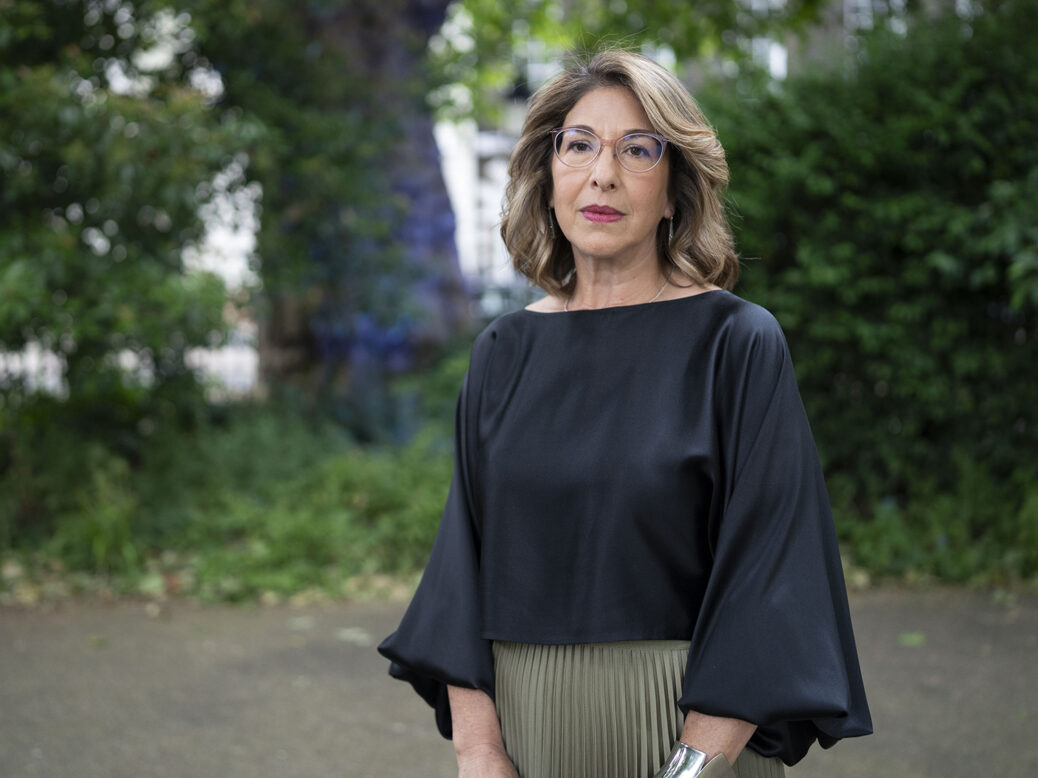
Oli Dugmore: You have written this book, End Times Fascism, in collaboration with Astra Taylor. This is your first collaborative work. Why did you want to collaborate on a project like this?
Naomi Klein: What we’re arguing in the book is a global phenomenon. I live in Canada and the US is threatening to annex us, but even if I didn’t live right next door, we all need to pay attention. We wanted to get it out before the US midterms to give people a framework.
Astra is a friend and a collaborator, a comrade, and has different areas of expertise from me. She’s been studying democracy for a long time. We were able to divide, conquer and edit each other’s work to put the book together pretty quickly. We wanted to do it as a timely intervention about the stakes of what we are up against, not just in the United States – but we live in a world that is very much affected by what happens in that country.
It’s great to have a collaborator on a book like this, because it’s scary. We could take turns just freaking out and the other one could say, “We’re going to get through it.”

How did your creative process as a writer change?
I already had this framework of trying to find what unites the religious hard right with the tech oligarchs and the bunkering of the nation. But it was such an overwhelming time that I just couldn’t do it. The news was changing so quickly. This was just in the first couple months of Donald Trump’s second term, and I was just drowning in it. I could not tame the beast to just get this distilled.
I did a public event with Astra and was trying to name the fact that I really think that climate breakdown is really central to this feeling of scarcity, seeing migrants as invaders, bunkering the nation, looking outward for supplies. Canada’s got water. Ukraine’s got critical minerals. Greenland’s got oil. There was this sense that this was not just like old-school colonialism but this kind of supersized prepping.
Astra said, “You know, Elon Musk keeps saying he wants us to be multi-planetary, but what he wants is for humans to eke out a living on two dead orbs after they’ve finished with Earth. It’ll be drained of life and then they want to go to Mars, which is essentially a cancerous planet, incredibly hostile to life. I’d rather live on a multi-species planet here on Earth.” And I was like, “Astra, can you please help me? Because I’m really having trouble with this article.”
She came in and kind of saved me on that piece. At that point, I had dumped 10,000 words into a document. That essay, “The Rise of End Times Fascism“, went viral. A lot of people asked us at that point to write a book but we didn’t want to spend that much time in the brains of some of these people. We weren’t sure that we wanted to commit to spending more time in this world.
Then Astra just said, “You know, I’m down the rabbit hole anyway. I’ve been listening to the TheoBros podcast. I can’t stop. We may as well feel like we’re being productive and not just spectators.” That convinced me because I realised the same thing was happening with me. We kind of split up the work, came together for some intensive writing retreats, and we got it done.
Is “end times fascism” something that is happening right now or something that is coming towards us?
I would reframe it a little: is this something that is already victorious, dominant, running everything or is this something that is ascendant?
It is here. We are not writing about people without power. We are writing about people who have tremendous amounts of power in the US government, in the Israeli government, who have already started wars, expanded wars and have built with staggering speed an AI arms race between themselves and China. I don’t think it is foretold that they will have all their dreams come true. In fact, as we were writing the book, we started to feel like we were racing to keep up with the opposition and they started to retreat in certain areas.
It’s always useful to remember what, for instance, [Trump’s political adviser] Stephen Miller said to that crowd at Charlie Kirk’s memorial. It was a very fascist speech. There was a really clear narrative to say, this [Kirk’s assassination] was not the work of one man, it was the work of the left. We must crush the left – we are the builders, they are the destroyers. It was a very chilling moment.
You have mentioned that you have some discomfort about the word, right? That’s because when we think about what fascism is, if we’re thinking about Europe after the First World War and during the Second World War, we think about the maximalist moment. Not the stages leading up to it, not when fascism was not totalising, or it was not at its most violent and genocidal stage. That took years. We don’t want to wait until they have achieved all their goals to say “Hey, OK, now I think we can call it fascism.”
There is a point of political organisation at which it may be too late. You’ve alluded to an alliance on the right. Who are we talking about here? What is that alliance?
First of all, fascism is always an alliance. Fascism is an alliance of the injured strong and this differentiates it from a proletarian revolution, which are uprisings of the oppressed. Fascism is a counter-revolution. It emerges in times of crisis. When there is a threat from below, those are usually the conditions under which fascism rises.
Now we’ve got AI. Of course, we’ve got nukes. These were all things unknown to Hitler and Mussolini, which is why it’s important to understand that our crises are different from their crises. Our crises have changed out of all of our imaginaries, including the fascist imaginary, because they are in conversation with these planetary-scale crises.
The people that we’re talking about does not include everybody on the right and it does not include everybody who voted for Trump. It does include three powerful factions who share some things in common and also have some really significant differences.
The first group are the religious end-timers. These are both Christian nationalists and Messianic Jews who are interpreting the planetary-scale crises like climate change, pandemics, the economic shocks of a very interconnected economy – crises that are real. The end-time religious folks are focused on Heaven beyond. They follow a theology which interprets very bad things as good things because in their religious texts the plagues and the floods and the fires is, “Hey, guys. We’re coming. It’s go-time.” The reason they’re excited is that these are the conditions that are going to create the return of the Messiah or the arrival of the Messiah for the first time, according to their stories.
We heard reports from US soldiers that their commanders kept telling them, in the early days of the attack on Iran, that it was the Armageddon and the bloodier the better. They were complaining because they thought there was a separation of church and state, and that they were not fighting a holy war. But in fact, they were told by some of their commanders that they were. They see crises as wonderful, salutary signs that the Messiah is coming and Heaven awaits beyond in their golden cities in the sky, their new Jerusalems.
The second group is the tech oligarchs. We were struck that the stories they were telling about AI were increasingly taking on religious overtones that mimicked these religious stories so precisely that they verged on plagiarism. They were talking about inventing a technology like they were summoning a god, a demon. They’re having debates about whether it’s species-ist not to build superintelligence.
Lastly, you have the ethno-nationalists. That story is kind of hazier, but it is the base of the movement. The numbers are smaller in these other groups, but the ethno-nationalists are across Europe.
The story on the hard right is obsessively focused on borders, on migrants, and those who are cast not as human beings in search of safety and survival but as an invading army. The discourse of the invasion has been the discourse that brought Trump to power twice. As somebody who’s been studying the climate crisis for a long time, I can say this is something that we knew was coming. If you fail to act in the face of this crisis that is already making large parts of the world less inhabitable, all that is left to deny is the humanity of your fellow humans. We’re seeing a sadistic form of climate adaptation where the nation state in relatively wealthy parts of the world imagined itself as the bunker, as the saviour, as the lifeboat. That’s really viscerally felt on an island.
Let’s talk about the word itself as a piece of political vocabulary – fascism. If we’re talking about potentially the armed forces knocking on doors, rounding up people of different ethnicities and nationalities, and deporting them from the country, what do you describe that as?
I think fascism is a political term. While I think, perhaps, the best example of it is probably Mussolini and Italy, and I say that not because I don’t think the Nazis were fascists, but I view Nazism as this kind of very specific and unique thing that differs.
Can you talk about the importance of technology, about a militarised society? There are significant differences between last-century fascism and now. Simultaneously, I don’t know how to describe what is happening without using the word. It feels so different to the origin of where the term comes from. I have this hesitation that if we misapply the term that it perhaps cheapens it.
So you’re worried about it being cheapened. What would happen if that happened?
People would stop listening if you say, “This is fascism. We have to resist this with all our worth.”
What I’m telling you is that the only thing that has pushed these people back is exactly that. That happened in Minneapolis [where Immigration and Customs Enforcement, or Ice, shot and killed two US citizens] and in Chicago, and in Los Angeles there was also a lot of pushback.
But in Minneapolis, it was a total occupation. It was thousands of masked Ice agents who were not the demobilised soldiers but those who see themselves as the forgotten working class. They were given big signing bonuses, very little training, masks to cover their faces and pumped up by different figures in the Trump administration who certainly play with fascist tropes. I don’t know if people understand the extent of Minneapolis’s organisation and fightback. I want to come back to how we define fascism and how much of a rupture it actually is and how it should be understood, because I don’t find it as exceptional as you’re painting it.
There is a history in the through-line of fascism of people drawing their blinds, not responding when people get bundled into cars, looking away and knowing, in this state of double consciousness, that this is what allowed fascism to grow more powerful and more sadistic. A great deal of criminality takes place. Criminality has a velocity to it because then you have to protect yourself – you have to not end up in jail, you need to destroy the institutions that might hold you accountable or might vote you out. The more crimes that are committed, whether they are violent crimes or financial crimes, the more crimes need to take place.
There is a definition of fascism that I think you’ve been alluding to that holds that Mussolini, who coined the term, self-described as fascist, invented it. It was this extreme rupture in European history, a real diversion that grew out of those crises. There’s no doubt that it was a blood-soaked, hideous chapter in European history, but there was always a counter story to the idea that it was a rupture that was being voiced by a few at the time. There are very direct lines between the Nazi party and the race science that emerged from the concentration camps in Africa that the Germans ran. If you accept the premise that fascism has a prehistory, that it was not in fact a rupture in time and space that came out of nowhere, but that it came out of somewhere, it looked different because history does not move in a loop.
Technology changes us. Economic conditions change us. We are much less organised, much more atomised, so the fascism that we have just looks like us. It’s all about monetising. Everything’s online. It’s influencers, not like generals. It looks like the culture it comes out of. We’ve got AI. We have automated mass killing now as opposed to the Fordist factory. If we are looking for a repeat, we will constantly say it doesn’t match. The fascism that we face is dealing with trillionaires, atomised populace, influencers fighting with each other over clicks.
I mean, why wouldn’t it look like us? It comes from us.
You’ve mentioned the AI race already in this centrifugal force of the competition between the various companies and China too. I have a quote from Sam Altman in 2016. He said: “I have guns, gold, potassium iodide, antibiotics, batteries, water, gas masks from the Israeli Defence Forces and a big patch of land in Big Sur I can fly to.” Hearing it now, does it give you a slightly different perspective on it? How does that connect to the theory that you’re proposing?
Even without the more sci-fi scenarios – where AI escapes all control and decides that the most efficient way that it can achieve its goals is by wiping out humanity – this is an incredibly dangerous technology.
Up until now, they have been defining this point that they’re working towards as the point at which technology is able to perform the majority of economically productive activities. When Donald Trump says whoever wins AI wins it all, people truly believe this. Or, at least, they have convinced a lot of people with a lot of money that what they are now racing towards is not like dominating the taxi market or displacing hotels or connecting you with your friends, but everything.
Everything is running through their technology. It’s performing our jobs. We live under capitalism, not fully automated luxury communism. What happens to all the people who used to do those economically productive activities? That is a kind of apocalyptic scenario.
We don’t actually think that the companies that are driving towards this will have any plan to care for the people who are being economically displaced by it – and people are already being economically displaced by AI. In some cases, it’s bosses who are just using it as an excuse to lay off workers and actually the tech is not good enough yet. It is a pretty rough time to enter the job market for a young person. It’s already having economic effects that we should be talking about, as well as these sci-fi scenarios.
The other thing we know is that AI is already affecting carbon levels in the atmosphere. Last year, the International Energy Agency said that there were two places where we’re seeing unexpected increases in carbon emissions. One was the use of air-conditioning and this was in response to climate change. The other unexpected increase was the build-out of data centres in the United States powered by fossil fuels.
It’s being used within existing wars. This is the problem with the sci-fi scenarios: we’re not talking about the fact that in the first 24 hours of the US-Israeli attack on Iran, AI models generated a thousand targets. We do know that in those 24 hours a girls’ school was targeted. We do know there were some old maps online that showed it as a military target, and anybody who has used AI could very easily picture this technology using some old maps and mislabelling a school.
I’m personally not one of these people who completely discounts the sci-fi scenarios because I know that they’re building something that they don’t understand and are genuinely afraid of. I don’t think you should be allowed to build things that you don’t understand and you’re genuinely afraid of.
At the end of your 2023 book, Doppelgänger: A Trip into the Mirror World, there’s a chapter on Israel which you describe as the ultimate doppelgänger. In the time since that’s been published and where we are now, how is AI interplaying with it all?
Everything I wrote about in Doppelgänger has only accelerated and worsened. The book came out a month before 7 October. I talked about how these societies were twinned and used the figure of the doppelgänger because in stories about doppelgänger you often project everything that you cannot bear to see about yourself on to your hated double. I think Israeli society does that with Palestinians. It projects everything that it refuses to see about itself, including the accusation of genocide.
In the book I talk about this misunderstanding of what fascism is and the consequences of that refusal to understand. If you refuse to see what German Nazis learned from their own colonial projects in Africa and Britain’s colonial projects around the world, then you will not see how the project continues in a settler-colonial project in Israel. You will call it reparations, when in fact it is a continuation of these logics of apartheid, of racial hierarchy and supremacy, of unseeing the Other.
These are not my ideas. This was said by Palestinians and anti-colonial leaders and scholars from the beginning. There was a refusal – not an inability – to see, especially in the countries who only wanted to tell a story of the Second World War in which the Allies were able to cast ourselves in heroic terms alone. We didn’t want to know what the Nazis had learned from the Indian residential schools and the Jim Crow South and British colonialism. We wanted to be the superheroes who defeated the Nazis, so we emerge from it purified instead of looking in the mirror and seeing our own contributions. The cost of that has been borne by Palestinians.
You recently said in an interview, “I feel most sadness and rage at a willingness to let it all burn or to try to escape when I see a dorsal fin of an orca slice through the waters.” Could you talk more about how beauty, natural beauty, informs your politics and how you think about the very sombre, very serious and very upsetting themes that the new book focuses on?
I think that people have different motivating forces. I am very attached to wild animals in terms of what powers me. I like people too, don’t get me wrong. My son, who cared very deeply about the natural world, challenged me after Trump was re-elected on whether I had done enough in the election to keep it from happening. I told him: “I want you to know I’ve spent my whole life trying to prevent this from happening.” He said, “What specifically did you do in this electoral cycle, though?” When I went on this tour I said “do you have any messages?” He said “The stakes. Tell them the stakes.”
My mother became disabled when I was a teenager and couldn’t deal with cold and snow the way she used to. They moved to this beautiful part of the world that I had never been to before, British Columbia, and I think all of us in British Columbia understand how lucky we are to live among such wildness. There’s so much we have to lose. We feel on a knife-edge, like it could all collapse, because it could.
Musk says we need to colonise space because you need something to look forward to, and I think that it is so sad for you that you don’t have anything to look forward to down here.
It’s an existential crisis for us. We just have to stop them.
These are excerpts from Naomi Klein’s interview on The Exchange podcast, which have been edited for length and clarity.
[Further reading: Live streaming an execution is a very Trumpian form of pornography]
Content from our partners



Related

Join the debate
Subscribe here to commentI am always heartened by Naomi Klein’s fierce frankness about Israel and Zionism. The coverage of the Green Party ‘Zionism is Racism’ vote has been disgracefully biased and demonstrates a lack of interest in analysing what has been and is still going on in Israel (ref NAZA). Shame on the New Statesman for its own reflex contributions to this non-debate. As Naomi Klein says in this interview excerpt, The cost of that [Western colonialism] has been borne by Palestinians.