
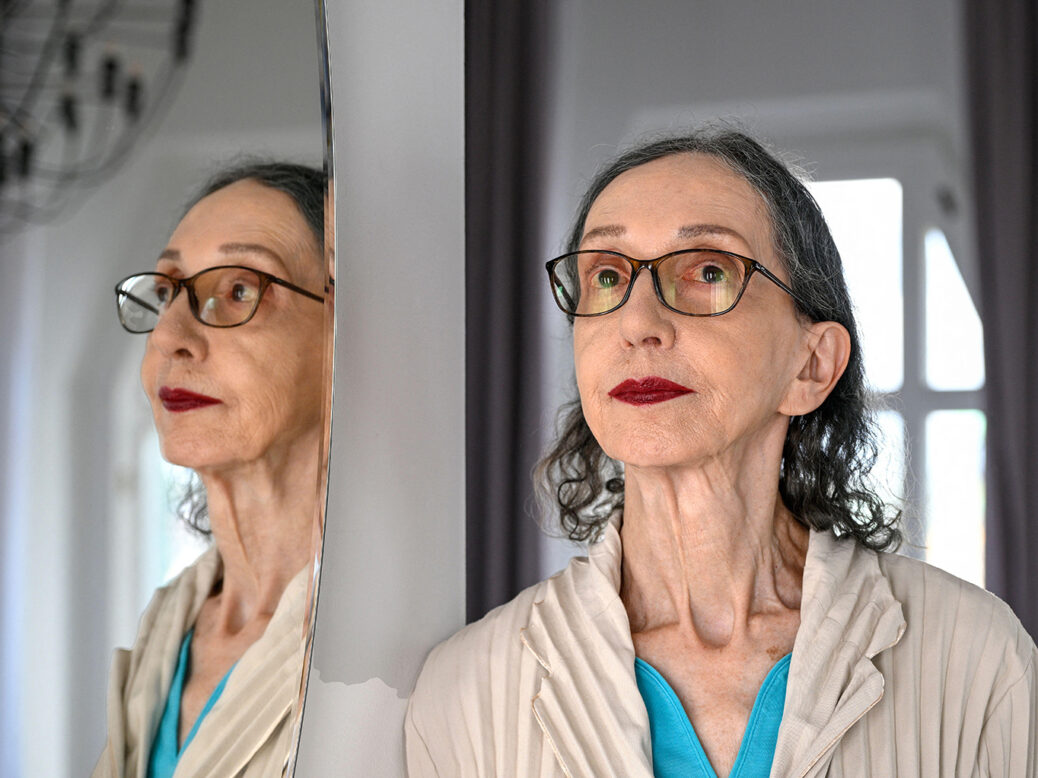
“He’s sort of talking. He’s sort of distracting to me. He seems to be sort of talking to himself.”
With that – and a mildly startled look from the bluetooth-headphoned professional in the middle of a work call beside us – 88-year-old American novelist Joyce Carol Oates is up and across the hotel lobby, taking my phone with her. I gather my coffee and follow to the new table. No caffeine for Oates; her constitution has long been too “sensitive” even for tea, though “excitable” might be a better word. “On the plane coming over I didn’t sleep at all,” she says. “I was working on a story, it was very quiet. At a certain point everybody’s asleep and you think, ‘Maybe I should be asleep,’ but I can never be asleep so I was just working.… It always seems so exciting. Even almost too exciting.”
Oates minds you with large eyeballs and claims to have a “transparent personality”. She is elusive, asking in a gentle New York accent, “Is that a question? What is your question?” Many interviews seem to end up revealing much more of the interviewer than of her. “I don’t have a strong personality,” is how she explains it. “It’s just me. If you say shall we walk to Kensington Garden or Regent’s Park, I would say what would you like to do? If I’m with some friend and he wants to do this or that I would rather just do what they want to do. I don’t have strong opinions.”
That view might surprise Oates’s newer fans. To them, a more believable detail would be that she types on her iPhone exclusively with her middle finger. In recent years, she has been discussed more than anything for her combative “Twitter” presence. A Guardian article last year argued her social feed “might be her greatest contribution to literature”. In November she fought with Elon Musk, who she said seemed “totally uneducated, uncultured”.

At the start of our meeting, she asks me to wait a moment while she does “emails”. Checking her Twitter account’s timestamps later, I see that she must have been posting, answering a post saying “I really think this beneath you, Joyce” with “Almost everything I do, people say it’s beneath me. Tsssk!”
She thinks it natural that a feted writer would tweet. “Joyce would have liked Twitter because it’s all this chatter,” she explains, meaning James Joyce. Her birth, in 1938 (and, as it happens, on Bloomsday), is much closer to James Joyce’s than to Twitter’s; indeed it is closer to James Joyce’s than to mine. In the afternoon she tweets a picture of an early edition of Ulysses, her favourite novel, from a private tour of the British Library. Between our interview in the morning and her talk in the evening, she shares 61 posts, including three about her cats, 19 about justice for rape victims and the “Cornell Seven” case, and 31 from her tour of the British Library. These include pictures of Sylvia Plath poems, the Declaration of Independence, and an early edition of Ernest Hemingway’s first short story collection In Our Time.
It was “Soldier’s Home” from that collection that first moved Oates to try writing herself. But where Hemingway sought only to write one book about each thing he knew, and so produced a limited corpus whose shape has mostly endured, Oates has written well over a hundred books.
Nevertheless a kind of consensus canon has emerged, helped by Oates winning more prizes than almost any living American author. It most fixedly includes 1969’s them, an account of a Detroit family ending with the 1967 riots, which won the National Book Award for Fiction, and 2000’s Blonde, a fictional life of Marilyn Monroe, which Oates says was her hardest book to write. The first draft was 1,400 pages. She describes leaving a movie to go and write in the car because she was so anxious about never finishing it. She ends the anecdote “I miss that misery.”
At the talk, part of the British Library’s American Writers Week, one audience member offers, “As someone who has read more than 70 of your books, thank you for the consistency and high quality.” But there is a slightly melancholy sense that the volume of her output has drowned all common ways of understanding – or even approaching – her work. Three books have appeared under her name this year. It is almost unthinkable that anyone will ever read all of her again.
I wanted to meet her because of a 2001 suicide case that had stayed with me since I first saw it on the internet. A man in his early- or mid-twenties checked into a motel in Washington, left some money with a note saying “for the room”, and hanged himself with a belt from a metal clothes rack. There are extremely haunting pictures of his oddly serene face. DNA technology identified him in 2018, but at the time, and for 17 years, the only name associated with him was the false one he used to check in: “Lyle Stevik”.
Lyle Stevick is a character in Oates’s 1987 novel You Must Remember This. He is not central to the book, only the father of its core family, though John Updike’s review noted the persuasiveness of his “jumbled timorous mind”. Stevick repeatedly thinks about the length of rope he keeps hidden, and in one scene, after contemplating how his family know him as “a vigorous tireless ebullient soul” while really he is “phony and tattered”, he throws the rope over a beam, and winds it round, but does not go through with it.
The case is a haunting transfer from art to life, one which Oates’s work has made in reverse many times, with fiction based on Charles Manson, Jeffrey Dahmer and JonBenét Ramsey. I suppose the young man’s suicide fantasy contained, as many do, a vanishing chance of sudden, saving sympathy – if, in this case, the receptionist who took his name had read the Joyce Carol Oates book, and remembered the Joyce Carol Oates character.
“What made you think of that?” Oates asks me, looking up the case on her phone. “Where did you see this? When did he kill himself? Where? Was this the United States? I was told about it at the time but it was 2001 and I didn’t have any way of researching it. That is very strange. I don’t understand that. Lyle Stevick was really a character, not a main character, kind of a secondary character. I mean, it doesn’t make much sense, but I guess, nothing makes sense. It’s irrational. A person who is very depressed would not be rational. That’s amazing. I should look that up today. … I don’t think it has any relationship to my writing or anything real. Hm, look at this. ‘A mysterious criminal case to keep you up at night’. It’s not criminal, is it? They use the word criminal repeatedly! ‘One of the most mysterious criminal cases in history’?! I would just say it’s a mystery but I don’t think it’s criminal. Hm. Well now you’ve given me a subject for something to write about.”
It has often been suggested, especially in early reviews, that Oates’s core subject is violence. Edmund White told the New Yorker her signature scene was “a teen-age girl, holding her books tight to her very flat chest, and crossing a field while being pursued by a madman.” She disagrees. “I’ve never written a book in which the primary plot is violent. It’s usually the consequences of violence, and dealing with them, assimilating trauma into a life to make a life endurable. … It’s over with and people are living in houses and they’re dealing with the consequences. Most of our lives are post-violent, we’re dealing with consequences, it could be of political violence, social violence, or personal violence. That’s what I write about.”
Her body of work is now as she once described Moby-Dick: “unwieldy, extravagant, and unique”. But you do notice a kind of warning in her writing. It describes the balance between home and away. Since, for Oates, all character rises from setting, this is also the balance between childhood and age. The victim in Black Water (1992), keeps telling the senator driving her (based on Ted Kennedy) that she thinks they are “lost”. Being lost is an adventure, then it is scary, and then she drowns in the lake he drives into and abandons her in. In Oates’s greatest short story, Where Are You Going, Where Have You Been?, a young girl realises the danger a strange man poses by the way her house becomes unfamiliar. As she is abducted, her childhood surrounds become “so much land that Connie had never seen before and did not recognize”. Our homes, our youths and our selves are closely bound, and can be lost with hardly a moment’s notice.
If Oates’s own life involved any such dramatic or violent estrangement, there is no clue to it in her different works of memoir, and in her fiction, she says, “I think I’ve never written about anybody I knew.” Nevertheless, she was radically removed from home by her success, though she resists that word. She was raised on a small farm in upstate New York. She reflects on how “implausible” her position is. “The life I might have lived, that my cousins did, that’s a life more plausible for me.” Many changes were “purely incidental to my own volition – my whole life is filled with these little turns”.
Now, as well as the rare dislocation of eminence, there is the universal dislocation of age. Time, Oates has written, “makes exiles of us all”. Initially – when she went to college, for example – her relatives were still in upstate New York. The small farm she grew up on no longer exists. “Everything changes… I can’t really imagine living in the place that I was born, because everybody is gone.” Oates is twice widowed and has no children. The deaths of her husbands shocked and exhausted her but did not change her, she says. “The personality probably doesn’t change that much. I’ve always had sort of the same personality.”
There is something hard to know about Oates, both because she has said so much and because she says so little. She much sooner asks about your life, family and reading than muses on her own life. When some of her letters were published by her biographer Greg Johnson, she couldn’t read them. “Would you like to read something written by yourself when you were much younger? I think you’d probably be cringing! It’s the sort of thing that is ephemeral – like who cares?”
About her past words, too, there is reticence. She once said a fine fate for writers is dying “with one’s romantic fantasies intact”: what were hers? “I don’t know that I really had any.” But didn’t she say her first stories differed from Hemingway’s because they were “much more romantic”? “I never was writing romance in my fiction.” What about the end of Finnegans Wake, that she reads to her students for its “glorious”, “heartbreaking”, “almost overwhelmingly beautiful emotion” as a character grows old and changes from her husband – has she ever felt like that? “I don’t know how to answer that. That’s a mythic character, not really a specific character.”
After pausing, she makes some allowance. “I think if I were literally in a hospice and dying I might feel that way. But I’m actually on my trip in London! So I’m not feeling that I’m fading away.” The order of today, it seems, is a kind of simple happiness. Teaching students is “really wonderful”. Her “gift to myself” on the flight home will be “six or eight hours of blissful uninterrupted work”. Additionally, “Well I like to walk and run and bicycle, I have some friends.”
She is going for a walk after we speak: she is on her trip to London. Of living here with her husband in the seventies, she says: “I remember walking around in the park and just being really happy. So I guess I’ll do that again and I’ll probably have the same sort of attitude.” When some of her journals were published in 2007, she described the London period as a time of “loneliness, dislocation, and general melancholy-malaise that seemed to have descended upon me”. Revisiting the past for the publication was, she wrote, “somehow so excruciating, I haven’t the words to guess why”.
Talking to you, Oates plays with her rings in her hand, and her thin watch slumps loosely under her thin wrist. Then, in the evening, she throws open the auditorium door and strides onto the stage ahead of her interviewer looking tall, fast and dashing, instantly summoning a forest of at least 20 phone cameras. Then she relaxes into her chair and jokes about her cats. Afterwards she waits to sign books and exchange words with all her readers.
What I keep wanting to ask is whether she writes in order to last – what else could sustain so long and so total a commitment to living by writing? She scorns Ovid writing to be remembered forever: “That’s so pathetic at the end of Ovid, he speaks about his lines making him immortal.” But she also says that “if you don’t have permanence, life just doesn’t add up to anything.” But she also says she doesn’t think about legacy “at all, I just think about stories”. But she also says that loved ones are only “around for a while, it’s semi-permanence… say when you’re 75 years old and you look at your life, you say, well, I did this, I wrote this book, I wrote this short story, I won this prize. It’s sort of like you do have, you might have a shelf of books.”
Eventually she meets my questions with a quote from a favourite. “Walt Whitman said: ‘Do I contradict myself? Very well then I contradict myself.’”
“That’s the best line,” she says. “Because it’s human.”
[Further reading: The passion of Will Self]
Content from our partners



Related
Join the debate
Subscribe here to comment