
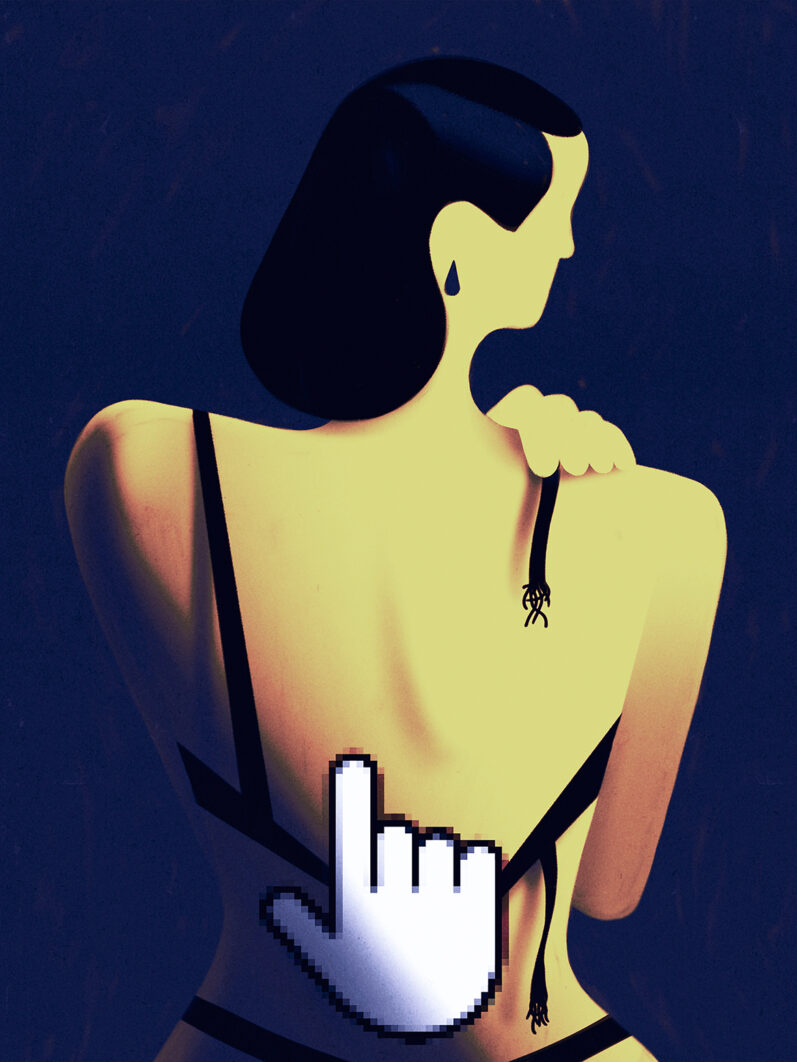
Oli Dugmore: I am really interested in how porn is shaping the internet, but I also want to talk about shame as a force. There’s a symbiotic relationship between publisher and consumer.
Patricia Nilsson: Absolutely. I open my book, Guilty Pleasure: The Pornification of the Internet, the Economy, and Everything Else, with a scene from a porn party I went to in Prague, which has become a hub for what some people call hardcore, or I would call humiliation, porn. I met a porn producer and he said, “Do you think I want to shoot this kind of shit? I don’t think this is sexy. I don’t like this at all. This is not the kind of porn I would like to do, but directors today are completely directed by data, and this is what people click on. Porn looks like this because this is what people want.”
And he pointed his finger at me and he said, “You are the perverts.” And that was for me this moment where I was like, “Oh my God, what if he’s right? Is it the porn industry that has issues with women, or is it us?”
What surprised you the most in the process of writing the book?

The modern business of porn is not about porn at all. It’s not about sex at all. It’s about attention. Porn has been algorithmically engineered to arouse you.
It is the perfect metaphor for our relationship with our phones, and this is not a coincidence. Because if you look at a lot of the technologies that are enabling companies to capture us in this way, they’re coming from early porn pioneers. Things like live streaming, instant payments, tracking affiliate marketing. Porn sites were early laboratories for these types of technologies.
And the first people who started creating online personas were cam models. These models had to start thinking: how can I attract attention? How can I monetise this attention? How can I fulfil the fantasies that the person on the other side of the screen wants to believe about themselves? These types of parasocial relationship are what we today call the influencer economy. The way we interact with each other online is, we’re consuming each other.
Could we talk about the history? It seems crazy to say now, but porn was almost a mainstream thing at one point. That has changed, hasn’t it?
It used to be seen as something transgressive. It was as if, by consuming porn, by talking about sex in this way, you were cool. This is back in the late 1960s, early 1970s, the sexual revolution. There was a conservative backlash, and a strong feminist backlash as well.
But there used to be a lot of money in the porn industry. That has practically disappeared. There used to be porn feature films. Now, they just shoot scenes: it’s much faster, it’s much harder, it’s much more visceral. And the sexual cliches have very much changed.
Porn cliches like the sexy plumber or the naughty nurse – these are stereotypes from an older era. The tropes in the internet era are different. For example, the rise in so-called fascist pornography. It’s really difficult to go on a tube site today and not come across pornographic films that are between a stepmother, stepbrother, stepfather, and so on. Why are we watching this? What impulses is the algorithm pulling out? And how is that influencing what we’re actually seeing? Why is there so much fascist pornography out there today? It’s absolutely booming. And you speak to porn performers, and they say, “It’s just impossible to avoid.”
But of course, for porn performers, it doesn’t make a big difference because the sex is still the same. It’s just the framing that’s different.
Another way in which pornography has changed in the internet era is that it’s become very extreme. Sadomasochistic fetishes have become very mainstream. In a user-generated economy, you just need to shock. But this has influenced how we’re having sex.
I wanted to ask you about the Online Safety Act and Section 230 as well, because there have been legislative attempts to control porn and abusive material. Is that possible?
Many years ago, before the Online Safety Act, I spoke to an MP who was instrumental in shaping the act about Pornhub. I asked her about MindGeek, and she said she didn’t know what it was. MindGeek is the company that owns Pornhub. And I was like, “How can you not know this? How can you not know what the biggest company in the industry you’re looking to regulate is called?” And she said, “Yeah, well, you know, this is not something I can really Google on my work laptop.”
And that, that really says it all. I think the reason why there is so much porn everywhere is that we don’t dare to talk about it. No one wants to be the person who puts their hands up and says, “Look, I was on Pornhub the other day, and I was thinking…”
“There’s too much stepmum stuff out there actually. There’s too much stepdad stuff. I think we need to stop that.”
Yeah, exactly. It’s not going to happen at work, is it? It’s one of the last taboos. Shame plays a very big role in this.
When we think about the power imbalance between us and the companies that are profiting from us living more and more of our lives online, part of the power they hold over us is this shame over what they know about us.
We’ve spoken about camming a couple of times in this interview. To what extent do you think loneliness has to be a part of this conversation?
Yes – for camgirls, it’s about nudity, it’s about sex, but it’s very, very much about validation and about making someone feel seen.
I think that this is a type of parasocial intimacy which is becoming very important in the online economy today. Last year, people kept saying, “Have we reached peak social media?” Because most people are actually posting less and less.
I don’t think we’ve reached peak social media. I just think we’re interacting with social media in a different way. And so what we’re seeing the rise of online personalities.
It’s a part of the influencer economy, but I’m thinking about Twitch streamers. I’m thinking about people on TikTok. I’m thinking about e-commerce in China. When you’re watching a live video, it feels like this is really happening right now with you.
These are excerpts from Patricia Nilsson’s interview on The Exchange podcast, which have been edited for length and clarity.
[Further reading: There should be social norms against torturing AI]
Content from our partners



Related


Join the debate
Subscribe here to comment