
Jimmy Lai spends 23 hours a day in a small, stiflingly hot concrete cell. At first, he could see a narrow patch of sunlight, but then the guards covered the windows. He is held on his own, away from the other prisoners, on a separate floor of Hong Kong’s oldest maximum-security jail. When the guards move him around the prison, they put up tarpaulins so that he cannot be seen. “It’s like they’re trying to make him disappear,” one of Lai’s supporters remarked to me. More than 15 days in solitary confinement can cause irreversible psychological damage and may amount to torture, according to UN experts. Lai, who is 78 and a British citizen, has been held in near-continuous solitary confinement in Hong Kong for more than five years.
“He now has heart issues, his nails fall off, his teeth are rotting, and during the summer he bleeds all over his body because of his rashes,” his son, Sebastien Lai, told me during a visit to Washington this month, where he appealed to the US and UK governments to help secure his father’s release. The past summer had been particularly brutal, with Hong Kong experiencing record-breaking heat and temperatures approaching 40 degrees Celsius. “The heat traps in there and he essentially bakes in his cell,” Lai told me. “If something is not done soon, he will die in prison.”
Jimmy Lai was born in China in 1947, in the final years of the Chinese civil war. He fled to Hong Kong during the severe famine that followed Mao Zedong’s Great Leap Forward campaign, stowing away on a fishing boat as a 12-year-old boy to reach the territory, which was then under British rule. He worked – and initially slept – in a glove factory, working his way up through the industry to start his own fast-fashion clothing business and eventually becoming one of Hong Kong’s wealthiest entrepreneurs. After the Chinese government’s bloody crackdown on young protesters in and around Tiananmen Square in 1989, he condemned the killings and increasingly turned his attention – and his personal fortune – to the media. In 1995, he founded the popular tabloid Apple Daily. Lai, who converted to Catholicism soon afterwards, has said the name was a reference to the forbidden fruit in the Bible, without which, “there would be no sin… and of course, no news”.
Lai was a self-proclaimed “troublemaker”, although he insisted “one with a good conscience,” who could be brash and combative, while Apple Daily was unapologetically sensationalist, indulging in rumour-mongering and breathless coverage of celebrity sex scandals. But the newspaper also uncovered official corruption and was as vehemently pro-democracy as its founder. The paper closely documented Beijing’s tightening grip on Hong Kong and the protest movement that followed. When Hong Kong was transferred from the UK to China in 1997, the territory was guaranteed a “high degree of autonomy” under an arrangement known as “one country, two systems,” which was meant to preserve existing rights, including freedom of the press for the next 50 years.

But after popular protests in 2014 and 2019 – freedom of assembly was also supposed to be preserved – Beijing imposed a sweeping national security law on Hong Kong in 2020, effectively criminalising dissent and granting wide-ranging powers to the police and special courts. By the time the Apple Daily newsroom was raided by the police in August 2020, it was one of the last remaining bastions of Hong Kong’s once-vibrant free press. The newspaper was finally forced to close in 2021. Lai was arrested at his mansion the same day as the police raid. He was convicted of conspiring to collude with foreign forces and conspiracy to publish seditious materials last December, and sentenced to 20 years in prison earlier this year, which his family regards as a “death sentence”.
Lai’s arrest and the assault on Apple Daily was not a surprise. He could easily have fled Hong Kong for a comfortable life in exile in the UK. But, his son told me, that is not the kind of man he is. “He knew that he could have left,” Sebastien said. “He could have been there with his family; he could be having lunch with mum and seeing his grandkids. But he knew that he needed to not only defend the movement, but also defend the people.” As his father had explained at the time: “If I leave, I live comfortably. But if I stay, I live meaningfully.”
In the almost six years his father has been imprisoned, Sebastien, now 32, has become a father himself. He has a newborn baby and a two-year-old at home, neither of whom his father has been able to meet, although he has sent photographs to the prison. They communicate by writing letters, which Sebastien assumes are carefully monitored by the authorities and can take a long time to get through. “I was born in 1994, around the time he started Apple Daily,” he said. “He always used to tell me as a kid, ‘look, don’t overthink these things, because you can always convince yourself not to do the right thing’.” For his father, he explained, that meant continuing to fight for Hong Kong’s democracy, despite the personal costs.
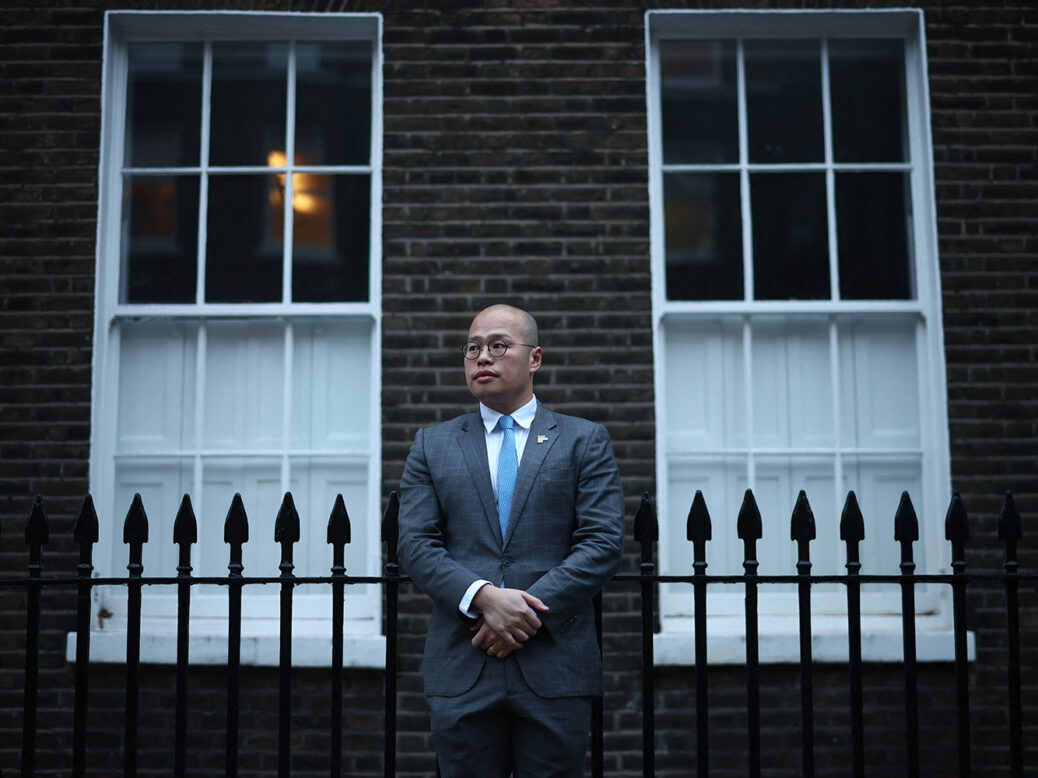
“For someone of his age, of his stature, you don’t necessarily see people like him in the fray, but I still remember in 2014 he’d be up front, getting tear-gassed with the other protesters,” Sebastien Lai recalled. He spoke softly, dressed impeccably in a dark suit and pale blue tie, with a “Free Jimmy Lai” pin on his lapel. “Dad talks about sitting in that little prison cell and having no regrets.”
This was not the first time in Jimmy Lai’s life he had faced a difficult choice. After he spoke out against the Tiananmen Square crackdown in 1989, Sebastien said his father was pressured by the authorities to keep quiet or risk losing his clothing business in mainland China. “He had to decide: do you keep expanding your business, or do you stick by what you believe in, what you know to be right? And obviously everybody knows the path he chose.”
Sebastien’s younger sister, Claire Lai, 30, was supposed to accompany him to Washington to testify about their father’s case before the Congressional-Executive Commission on China. But she was recently diagnosed with an aggressive form of cancer. He sat with her in London as she began her chemotherapy treatment earlier this month, then he travelled to the US to appeal to lawmakers on the family’s behalf to push for his father’s release when Xi Jinping arrived in the capital for a summit with Donald Trump on 24 September.
“My father learned of his own daughter’s diagnosis from a maximum-security prison,” Sebastien told the hearing. “He cannot hold her hand. She wants nothing more than to have him with her for this fight. We hope the Chinese authorities will consider what compassionate release would mean for her, and for a 78-year-old man who has already suffered enough.” Chris Smith, the Republican congressman from New Jersey who co-chaired the hearing, said he was confident that Trump would raise Lai’s case with Xi, and that Marco Rubio, the US secretary of state and a previous co-chair of the commission, “gets it 100 per cent.” Smith introduced a bill in Lai’s name in the House that afternoon, alongside Democratic congressman Tom Suozzi, that would require the US to investigate the death of any political prisoner in Hong Kong and sanction any officials found responsible. Bipartisan legislation was also introduced in the Senate the same day.
Trump, who promised during his 2024 presidential election campaign that it would be “very easy” to secure Lai’s release, has already raised the case directly with Xi on two previous occasions, as did Keir Starmer when he was prime minister. Throughout our interview, Sebastien Lai was assiduously diplomatic in his answers, declining to criticise British efforts to free his father. But there were a few conspicuous omissions: he praised the “moral courage” of the US in pushing for his freedom, for example, but made no similar reference to the UK, merely noting that the British government had been “much stronger on my father’s case as of late,” seeming to imply this had not always been the case. Chris Patten, Hong Kong’s last British governor, has been more outspoken, accusing the UK government in 2023 of adopting a “demeaning and delusional approach” to China by soft-pedalling criticism or fear of jeopardising trade.
Sebastien also made a glancing allusion to the “successive” nature of recent British governments, which meant that he had yet to meet the latest prime minister, Andy Burnham or the foreign secretary, Ed Miliband, although he had heard that the latter wanted to meet him. “He’s very new to the job,” he noted. “I hope that he takes this up.
Jimmy Lai is just one of the hundreds of people currently being held on political or protest-related charges in Hong Kong, according to rights groups. The young pro-democracy activist Joshua Wong, who will turn 30 in October, is already serving a five-year prison term and awaiting sentencing on further charges, which carry a maximum sentence of life in prison. Chow Hang-tung, a human rights lawyer who has been detained since 2021 for organising a vigil to commemorate the Tiananmen Square crackdown, was found guilty of “incitement to subversion” in August alongside her co-defendant, Lee Cheuk-yan, and could face up to 10 years in jail.
Still, Lai’s family has not given up hope. “I don’t believe this is a lost cause, but it is urgent.” Sebastien Lai said. “We cannot let this man die in prison.” He is pragmatic enough to understand that Xi Jinping is unlikely to be moved by the family’s appeals for compassion – to allow his father to live out his remaining years with his children and grandchildren in peace. Instead, he hopes to persuade the Chinese leadership that his father is more dangerous dead than alive, that if he dies in prison in Hong Kong, they risk turning him into an enduring symbol of injustice. “What is the point for them for my father to die?” he asked. “Why would they want to make him a martyr?”
[Further reading: Andy Burnham’s plan for Britain]
Content from our partners


Related
Join the debate
Subscribe here to comment