
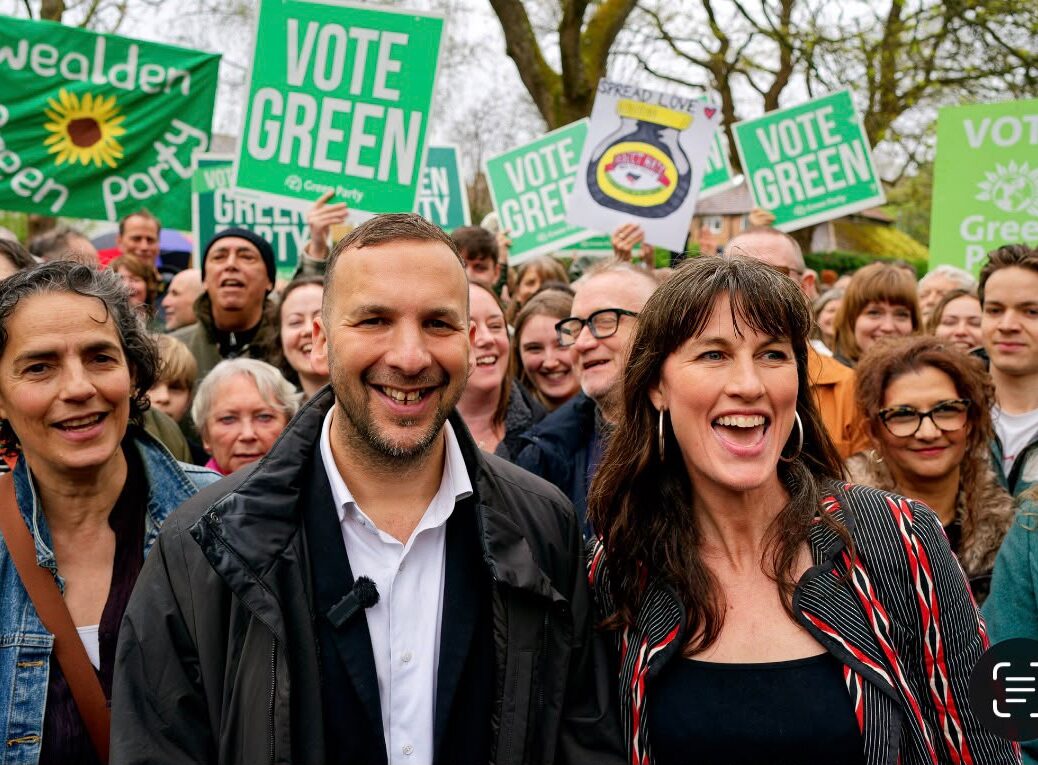
In April 2019, hordes of Extinction Rebellion activists brought London to a standstill. At four points across the capital – Marble Arch, Oxford Circus, Waterloo Bridge and Parliament Square – thousands of people, worried about rising global temperatures, gathered to peacefully protest the planet’s torrid future.
One of the activists sitting on Waterloo Bridge that spring was Rachel Millward, now one of two deputy leaders of the Green Party. Millward’s “eco-anxiety” and sleepless nights worrying about the future had driven her to join the crowds of campaigners who poured into London for the ten-day protest. On Waterloo Bridge, speakers, some from island nations in the Pacific, addressed the sitting crowd. They spoke of the damage inflicted on their homes by the extreme weather effects caused by man-made climate change: high tides, contaminated fresh water, cyclones, famines and droughts. Those gathered listened on in horror.
This moment galvanised Millward. “I had this feeling that I had to step forward,” she told me when we spoke in late August this year. When she returned home from the protest in 2019, Milward took her first steps towards a life in frontline politics, getting involved in the local river action group. From there she became a member of her local Green Party and before long, after a by-election was triggered in her local council, Millward stepped up. She was elected as the first Green Councillor on Wealden District Council in 2021. After the 2023 local elections, when the Greens’ presence on the council exponentially grew, Millward was appointed co-leader of the council, a role she shares with her Lib Dem counterpart James Partridge. (The pair alternate years as leader of the council. In 2026 it’s Millward’s turn).
More than seven years on from the protest on Waterloo Bridge, Millward – alongside her co-deputy Mothin Ali and the party’s eco-populist leader, Zack Polanski – now fronts the Green Party. Over the past 12 months, the Greens have shot up in the polls, ballooned in membership and won a by-election in Greater Manchester, bringing their tally of MPs to five. But recently, the buzz around them has plateaued. This is mainly owing to the arrival of Andy Burnham as the UK’s new, progressive prime minister, gently urging the disgruntled former Labour voters who may have drifted to the Greens back into the fold. It is also, in part, perhaps due to a series of social media blunders made by Polanski and an ongoing internal policy battle over how radical the party should be.

But the Greens are newly hopeful. Keir Starmer’s decision to stand down as the MP for Holborn and St Pancras has offered another chance to increase the Green showing in parliament. Green Party candidates are selected by the local party and – at the time of writing – Polanski has put himself forward.
“It’s a hugely exciting opportunity,” Millward told me when we spoke over the phone again on Friday 4 September. She described Zack as an “incredible candidate” (“of course, it’s a decision for the local party”), before offering a hint of what we can expect from the Green campaign in the constituency. A vote for Zack Polanski, she suggested, would be a vote to push Burnham further to the left. “We know how effective it is to have Zack holding Labour to account,” she said. She pointed to Burnham’s remarks on North Sea drilling and rumours that his government could approve licences for the Jackdaw and Rosebank fields. “I do think that even people who voted for Labour or are Labour Party members could see [voting for Zack] as a strong signal to this Labour government to be the best version of itself,” she said. “That’s the impact Zack has.”
More widely, Millward thinks this is the political space that the Green Party should occupy: replacing Labour as the party of the left. “I think we can take credit for having Burnham and not Starmer,” Millward said. “We as the Greens made it really clear the extent to which Starmer was failing.” The Greens did this, Millward said, by making the cost-of-living crisis their priority. She referenced the party’s success in the February Gorton and Denton by-election, where Hannah Spencer overturned a historic Labour majority and became the party’s fifth MP. The by-election was a “dreamy highlight” of Millward’s first year in office. “It gave a real sense of the possibility that is open to us.”
Millward is viewed as a safe pair of hands by her Green colleagues. Party insiders speak of her as a good media performer, an experienced leader, hardworking and compassionate. Some, however, feel she is being under-used. One senior Green source said the party is not doing enough to boost Millward’s profile and thereby benefit from her abilities to speak to both progressive urban graduates and more traditional Greens in rural heartlands. They explained this as a capacity issue – with the Green Party machinery growing at a far slower rate than its public profile or membership numbers – rather than a deliberate attempt to sideline Millward. After the difficulties faced by Polanski over the summer, and ahead of next May’s local elections, there seems to be a recognition that others in the leadership team – such Millward, Ali and the party’s MPs – need to take a more prominent role. “It can’t all be on Zack,” one insider quipped.
Millward is clearly keen to serve. She splits her role as deputy with her work on Wealden Council, “one of the best performing councils in the country,” she told me. As leader, she has focused on improving the district’s sport and leisure provision and ensured investment in nature restoration (a true Green value). “Greens haven’t been in power very much, or for very long,” she told me, “it’s brilliant to show what we can do.” And it’s true. Since the local elections in May the party now has majority control of six councils and has formed coalitions with other parties in several more (the party is in power in 21 councils across England). “I’m really proud to be part of the Greens in power movement,” Millward said.
Still, the party’s expansion has – as one source put it to me – come with “growing pains”. Some of these are due to be aired at the party’s annual conference in early October. As an ultra-democratic party, the Greens’ policy is set by their members who may submit motions to be debated on the conference floor and potentially adopted. The submission of several contentious motions by members – one of which calls for the party to accept that Zionism is a form of racism – have caused a deluge of negative press coverage. And as this is the party’s biggest conference yet, following a rapid growth in membership over the past few months, there is internal recognition that things need to change.
Millward accepts that things have been difficult. “It’s something we need to look at really closely, and work out how we can increase the democratic involvement and participation of our members in a way that’s appropriate for the scale of the party.” She argued that the party needed to modernise its process of developing and adopting policies, while retaining its democratic principles. “Because we really need the policies to put in a manifesto so that we can deliver in power.”
For now, though, the Green Party’s leadership will be focused on supporting the chosen candidate in Holborn and St Pancras. “The idea of having Zack in parliament is very exciting,” she told me, “we can definitely win it.”
[Further reading: Who will win the Holborn & St Pancras by-election?]
Content from our partners


Related
Join the debate
Subscribe here to commentAs a Green I love the idea that we are ‘ultra democratic’. How would you describe Labour’s internal processes? Guided democracy perhaps?