
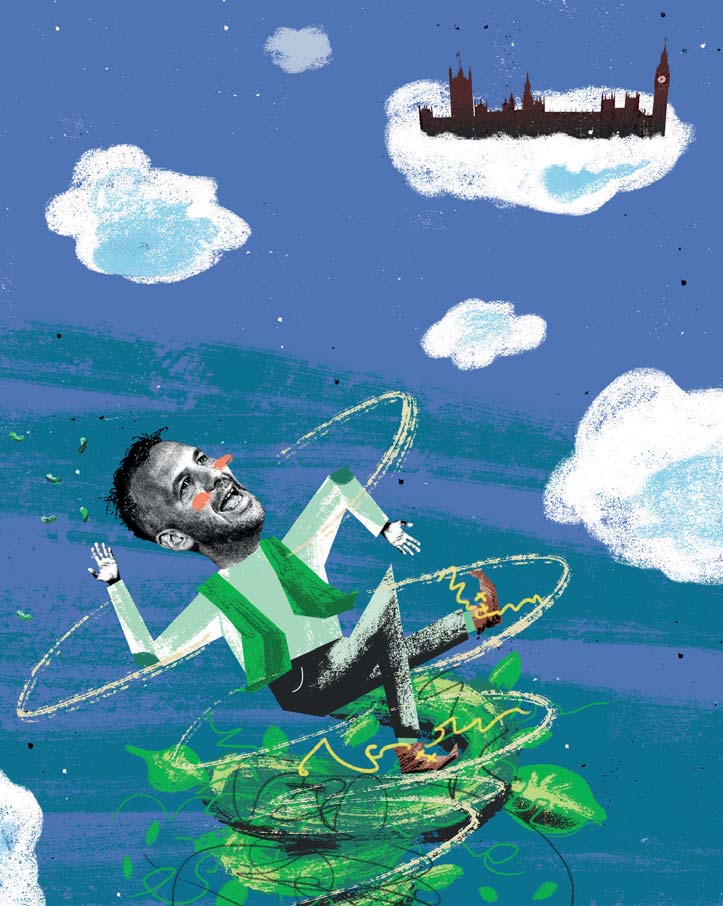
On a drizzly morning last September, Zack Polanski delivered his first speech as leader of the Green Party. The avowed eco-populist, who won the leadership election with 84 per cent of the members’ vote, set out his party’s course: to deliver the growth in membership and poll ratings his predecessors could only have dreamed of. He made an audacious promise. “My message to Labour is very clear,” he said. “We’re not here to be disappointed by you. We’re not here to be concerned by you. We’re here to replace you.”
A year on, it is clear that his strategy was unsustainable. New polling by More in Common, shared exclusively with the New Statesman, reveals his personal net approval rating has hit a low of -35 per cent. (His high was -3 per cent.) Half the country thinks he’s doing a bad job. This has coincided with a slump in the polls for the party. A previous poll from More in Common, which covered the period in which Polanski lost the Holborn and St Pancras by-election, had the Greens at 7 per cent, their lowest showing since before he was elected. The promise Polanski made on his victory lap is beginning to look like wishful thinking.
The problem with this pledge might not have been its ambition, but the assumption that the Greens were ready to fulfil it. Polanski’s call came at an opportune moment: an unpopular Labour government was a year into its term in office; the cost-of-living crisis was, and still is, biting; and voters were aching for change. If Labour wouldn’t deliver the progressive policies its base so desperately wanted, then another party would.
There was a moment when this strategy appeared to be working. Shortly after Polanski’s election, the Green Party began to tick up in the polls. Membership of the party, too, started to soar, from 68,000 when he was first elected to 230,000 today. Then, in February 2026, the party secured what it assumed to be a proof-of-concept victory when the Green candidate Hannah Spencer romped home with a 4,400-vote majority in the Gorton and Denton by-election – a seat that was previously safely Labour. Soon after, the party was basking in its highest national poll rating ever, at 21 per cent.

There were some – even a few allies of Polanski – who worried about the scale of his ambition. One compared the pledge to the ill-fated claim made during the 2019 general election by the Liberal Democrat leader, Jo Swinson, that she was a candidate for prime minister, before subsequently losing her seat. But after Gorton and Denton, at the height of the Greens’ success, even those figures held their tongues, hoping they would be proved wrong. The Greens, long seen as a party of protest, had for the first time glimpsed the heights they could achieve by taking progressive voters from Labour.
Andy Burnham’s arrival in No 10 changed everything. It exposed a fundamental flaw in Polanski’s strategy: that it depended too heavily on a disappointing Labour government. Burnham’s normie-populist demeanour, talk of increased public ownership, and moves to sanction illegal Israeli settlements in the West Bank have allowed Labour to regain the progressive ground. All of a sudden, the terms of the contest have changed: the battle for the left is no longer about the Greens taking pot shots at Keir Starmer’s flailing Labour Party: it’s about convincing voters they are a realistic alternative, with a coherent policy programme. And the challenge cuts deeper than that. If the Greens are to be serious contenders, they will need to prove they are capable and disciplined enough to manage the compromises and scrutiny that power would entail.
So far, the opposite has been true. The party’s handling of the “Zionism is racism” motion at its October conference is a perfect illustration of the problem. This has enshrined an unnecessarily divisive position as policy – one the public finds unacceptable and makes it look as if the Greens cannot run their own affairs. It has been a catastrophic own goal.
Though a majority of the Greens’ senior figures opposed the motion, they had little control over the outcome because it was voted through at the conference – forcing a split between the party’s elected representatives and its members.
Former leader Caroline Lucas, the party’s co-deputy leader Rachel Millward and four of the party’s five MPs (Carla Denyer, Siân Berry, Adrian Ramsay and Ellie Chowns) all spoke against the motion, urging members not to back it. “There’s so much more to the Green Party than that motion,” Chowns told me. “There’s a huge, urgent need for a strong Green voice, especially in the context of the climate crisis, the cost of living and inequality.”
Their critics argue they left it too late. “Zionism is racism” first appeared at the Green Party’s spring conference in March. One source suggested to me recently that some who opposed the motion felt apprehensive about speaking out. And you can see why. Some of its supporters have since made internal complaints about Lucas, who they accused of “bringing the party into disrepute”. (A party insider told the New Statesman that they have no plans to investigate Lucas.)
Polanski too has been criticised for how he handled the “Zionism is racism” controversy. He did not vote; instead he skipped the conference, apart from his leader’s speech, to campaign in Holborn and St Pancras. Some argue that he should have used his influence to push for two amendments he supported. But he had limited control over the outcome, and now he must defend this policy until at least 2028 – which is the first opportunity for the party to reverse it, according to its standing orders. One source worried what this says to voters: “It suggests to people that the leadership has no power in the party and it can’t control the membership – that it’s sort of asleep at the wheel. That’s not a good look.”
The position has already had serious political consequences for the Greens. More in Common’s polling reveals that one in four people now think the party has a serious antisemitism problem, up from one in five in August. That increase has been most acute among progressive voters – the very bloc the party needs to win over.
And on 14 October, Burnham gave Polanski and his party an ultimatum: disavow “Zionism is racism” or forgo electoral pacts with Labour. Such a moratorium could collapse the 15 local authorities in which the Greens have a power-sharing agreement with Labour. Ramsay, another former leader, has urged local Green groups to comply to keep those arrangements intact. In drawing this red line, Burnham has proved his ability to neutralise Polanski’s threat of moving Labour to the left by proving that – on this issue at least – his party is unbending.
Despite the damage inflicted by the “Zionism is racism” position and his low personal ratings, Polanski will undoubtedly remain leader. The Green Party has always lacked the killer instinct to get rid of its leaders, and there’s no obvious heir. To trigger a leadership election, 10 per cent of the membership (equivalent to 23,000 members) must write to Green Party Council, or two thirds of that council would need to vote to have him removed. Though the public may have doubts, his support among the membership remains strong. Such a removal scenario is highly unlikely. As the party constitution dictates, he will be up for re-election next September. Instead, the Greens are looking to change their strategy.
New factions are beginning to form. “In the old guard – everyone who joined before last year – there is a real culture against factionalism,” said one Green source. “That really needs to change.” The party will begin selecting candidates for the general election later in the autumn; its emerging special interest groups will be keen to ensure their candidates make the cut.
As a result, Greens Organise – the left-wing faction behind the election of Polanski – is beginning to mobilise. On 15 October, it elected new officers to manage and represent the group. They include Jamie Driscoll, the former mayor of the North of Tyne, who has his own ideas of how the Greens can regain the progressive momentum. One is the appointment of a shadow cabinet of senior Green figures, all of whom can be deployed to argue the party’s programme. If properly organised, they could hold the balance of power.
Some are sanguine. They see the past few weeks as a mere blip. One figure pointed to the response to Labour’s loss of the Copeland by-election under Jeremy Corbyn in 2017 and drew parallels with where the Greens are. That by-election loss was viewed as a major setback, yet Labour went on to exceed all expectations at the snap general election later that year. They argued this was down to the strength of Labour’s economic arguments which were based on public ownership, redistribution and anti-austerity politics – not too dissimilar to those being put forward by the Greens. If the Green Party is still able to cut through on these issues, they said, it remains in with a chance. “Things can change very quickly,” the internal figure mused. “Bread-and-butter issues will win out.”
Green sources believe the party’s influence will return if and when Burnham fails. The Budget on 28 October will be the first great test of the PM’s ability to keep progressive voters onside: until John Healey steps away from the despatch box, there is no way of knowing how that will land.
But building a political strategy in the hope of a persistently unpopular Labour Party has only set the Greens up for failure. Now, Polanski and his party will need to overhaul their approach – to give swing voters positive reasons to back the Greens rather than simply as a protest. And they will need to stop making mistakes. Should they fail to improve before the next election, the Green Party could fade back into irrelevance, and their dreams of replacing Labour would become a cautionary tale of dreaming too big too fast.
[Further reading: Andy Burnham now has a blueprint to rejoin the EU]
Content from our partners



Related
This article appears in the 21 Oct 2026 issue of the New Statesman, Sally Rooney is a writer, not a terrorist
Join the debate
Subscribe here to comment