
There is normal politics – the kind we fill this magazine with – and there is the just-ahead new politics of the age of artificial intelligence. I’ve spent a lot of the summer talking to people in the tech world, and come to the conclusion that we are all on the edge of a humanity-scale change so big we haven’t got even the words for it yet.
In an era of potentially out-of-control AI agents embedded in the defence industry; of rapid, cascading job losses among educated workers; of the leering surveillance promised by “smart“ glasses; and of the unscalable gap between the successful AI companies and the rest of the straggling industrial world, many traditional political arguments are out of date.
On 8 September the Labour MP Alex Sobel proposed his Artificial Superintelligence Security Bill in parliament. It’s more of a statement of intent than actual legislation, but the organisation ControlAI, which drafted the bill, claimed it has the support of more than 130 MPs and peers. This is just the start. Talking to friends high up in the California tech world, and others looking on in bewilderment, I came to realise that we should expect some kind of popular revolt.
We don’t yet know the names of its leaders, or the main organisations, but it will be bigger than Black Lives Matter, or the culture wars over gender or decolonisation, because it will be framed as the fight between humans and the machines.

The politics of AI will require new thinking, and new philosophical approaches to power. Forget Thatcher, Marx or Crosland. We should start with the AI Futures Project. Co-founded by Daniel Kokotajlo, Eli Lifland, and Thomas Larsen last year, it is focused on the likelihood of a catastrophic loss of human control. Its latest paper is called “AI 2040: Plan A” and is a visionary critique of what’s ahead. The project calls on the US and China to come together to slow the rush to super-intelligence. It argues that by the end of the decade, as part of a global deal on de-escalation, the US should place its AI data centres in Mongolia, and China’s in Canada. Fat chance? Perhaps, but AI is the new arms race and this is the push for a nuclear test ban treaty. Anyway, if I was in my early twenties and starting out as a political writer, I’d turn my back on Westminster and focus almost entirely on the challenging, awesome new political world of AI.
The Tapestry’s rich life
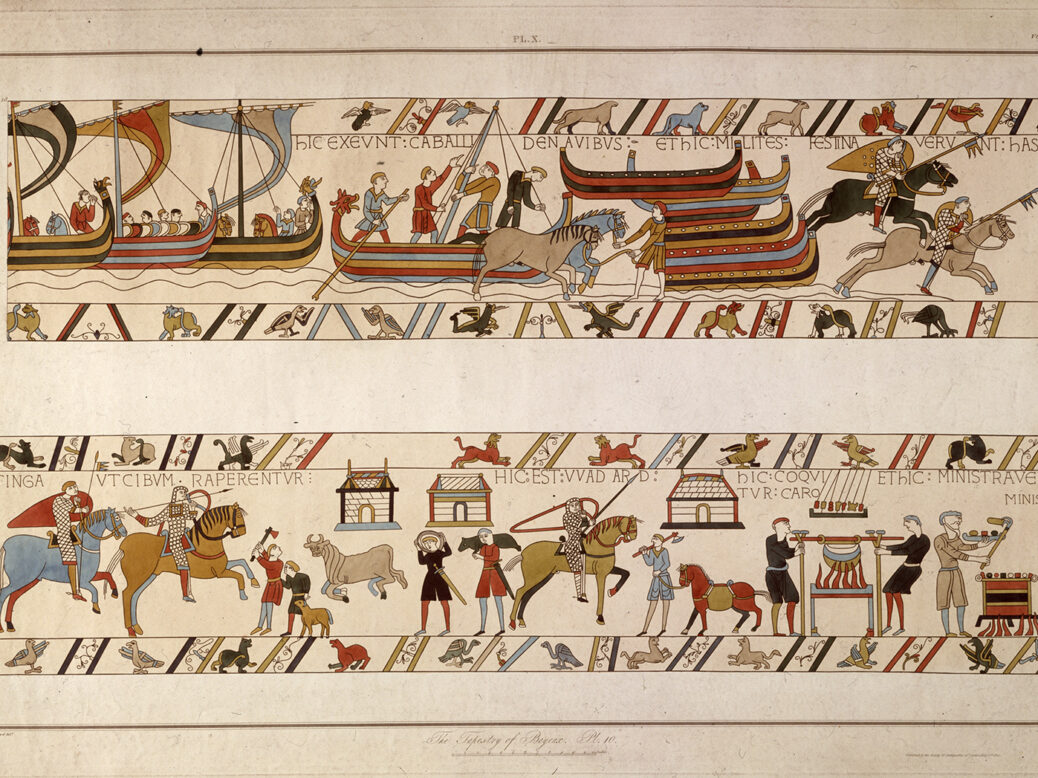
Is the Bayeux Tapestry worth going to see for yourself? It is now at the British Museum, on these shores for the first time in nearly a millennium. So much of it feels over-familiar. Harold with the arrow in his eye (if it’s really him), the ships coming across the channel, the charging Norman knights…
Even so, I went, and jotted down the following notes: “Peacock, quicksand, harrowing, ploughing, the flasher, buildings with colourful tiles – it was a colourful period – endless hand gestures, suggesting conversational noise – it was a noisy period – tree surgeons, carpenters, barbecues, a chicken rotisserie, dragons, seagulls, dogs…” In other words, if you go, you get a richer sense of life in 1066.
The final battle scene is frankly horrific. Only when you walk along the full length of the artwork do you feel the forward propulsion of the Norman cavalry, crashing into the English shield wall, with effects bloodier than most Hollywood films of ancient conflict: poled bodies, severed arms and heads, armour swiftly stripped off corpses, horrible wounds. It may have been stitched by English women as Norman propaganda, but it’s one of the most eloquent anti-war pieces I’ve ever seen.
Conference season, watered down
I mentioned being a young reporter. How I miss the old party conference season, with all-night carousing: wild parties where you could hear the Thatcher cabinet being outrageously indiscreet; electric Tribune meetings in which old enemies on the left clashed so articulately. It tested a journalist’s resilience: for a while, it lasted six weeks – the TUC, the Scottish Nationalists, Liberals, the SDP, Labour and the Tories.
Now it’s all been ruined. I blame the lobbyists, the control-freak officials, the cost of accommodation, the decline of the mainstream media, and – worst of all – the mineral water-driven self-control of politicians. Blimey. I’m almost beginning to feel nostalgic for the hangovers, the mornings when even your socks smelled of cigarettes.
A scandalous one-liner
Leafing through one of my old diaries, I find the following joke, from a Labour cabinet minister. It’s dirty, but too good to vanish forever. The then prime minister had just had some trouble with atrial fibrillation; the then US president was embroiled in the Lewinsky scandal. “Tony,” said his minister, “has a dickie heart. With Bill, it’s the other way round.”
[Further reading: Nigel Farage’s oyster politics]
Content from our partners



Related

This article appears in the 10 Sep 2026 issue of the New Statesman, The World According To Ed
Join the debate
Subscribe here to comment