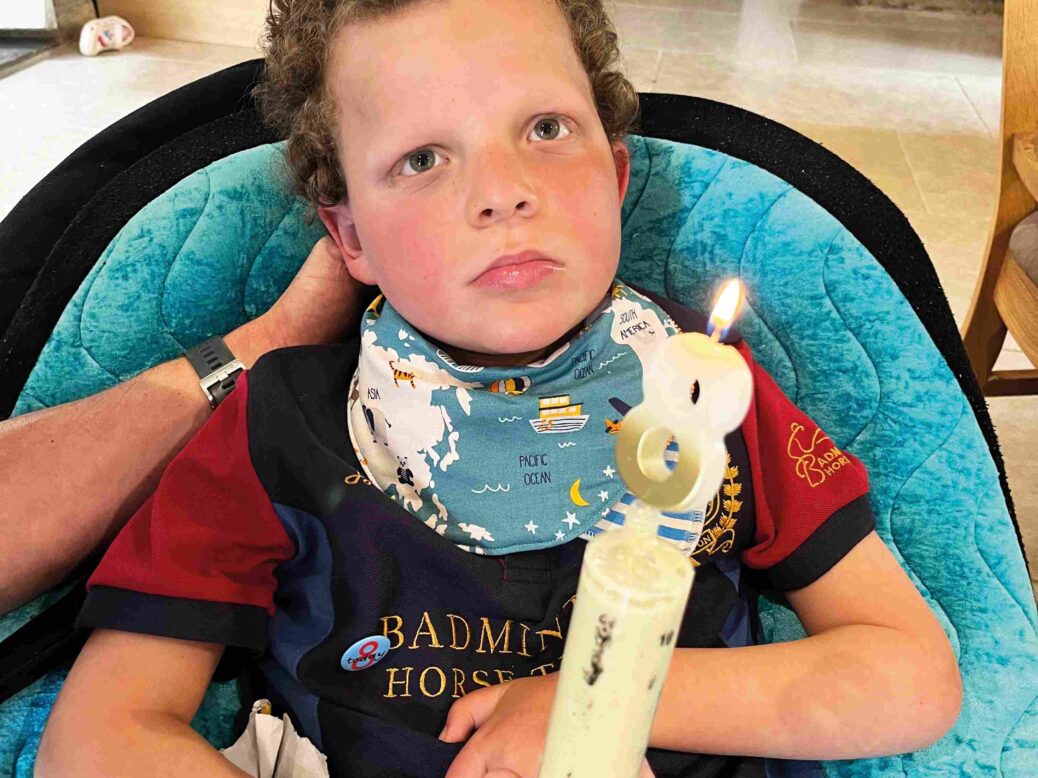
“I want to be William’s dad,” Gareth Birkett says. “That’s really important to me.”
But caring for his 11-year-old son, born with a rare form of epilepsy and needing care around the clock, often requires Birkett to act as a healthcare professional as much as a parent. There are appointments, prescriptions, admissions into hospital and endless phone calls.
“The administration burden is complex,” he says. “I don’t really want to be a nurse. The whole thing is a shambles.”
Every child with complex needs has unique circumstances, but the difficulty William and Gareth have accessing care will be familiar to many parents. While medical advances mean the number of children living with life-limiting conditions in England has almost trebled since 2003-04, the scaling up of care has not kept pace.
The Modern Service Framework (MSF) for Palliative and End-of-Life Care, expected to be published this autumn, is intended to counteract variation in palliative care standards and availability in England.
But campaigners warn babies, children and young people are not explicitly referenced, risking that the specific requirements of children’s palliative care are overlooked.
That sense of being unseen gnaws at parents. When asked about the day-to-day care of William, Birkett says he is frustrated by the “lack of pragmatism” by local clinical services.
Capacity is a recurring issue. Together for Short Lives (TFSL), a charity that helps children living with serious illness and their families, estimates only 973 children’s community nurses are employed in England, short of the 4,963 needed to meet safe staffing levels recommended by the Royal College of Nursing (RCN).
Recent figures show the UK having just 24.4 whole-time-equivalent specialist paediatric palliative medicine consultants, against an estimated requirement of 40 to 60.
Like most parents of children with complex needs, Birkett can cite numerous examples of the failures in his son’s care driven by workforce challenges.
“William has to have a nurse go to school with him every day because of his respiratory management,” he says. “If they’re not available, he can’t go to school. This Thursday, the nurse is not available because something has come up, so William is off school, and that’s a day off work for one of us. That’s really common.”
The challenges facing families like Birkett’s also expose a wider problem with how children’s palliative care is understood and delivered. Unlike the end-of-life care with which the term is often associated, children’s palliative care can span years, encompassing symptom management, respite and support for the wider family.
James Cooper, associate director of external affairs and membership at TFSL, tells Spotlight that policy on palliative care is often planned around ‘all-ages’, and while he does not want to see two parallel systems, structures designed with adults in mind are not always helpful for children. “We’re not just talking about adults in the last moments of their life; we’re talking about families and siblings around them. Getting this wrong has a lifelong impact on all of them.”
Last year, the government pledged £80m over three years to children’s and young people’s hospices, which offer services ranging from respite and symptom management to end-of-life care. The multi-year settlement was intended to provide “certainty for vital services”.
While Cooper welcomes the increase, he still sees it as “inadequate”, citing his charity’s own estimates that there is a £310m annual funding gap. “The key thing is that no one really knows how much money specifically there is for children’s palliative care.”
Compounded by the funding gap are the blurred lines between integrated care boards (ICBs), local authorities, and the voluntary sector. ICBs are legally obliged under the Health and Care Act 2022 to commission palliative care that meets local needs.
Freedom of information requests sent by TFSL found that only 31 per cent of ICBs provided evidence that they formally commission round-the-clock end-of-life care for children at home, while 36 per cent were unable to provide such evidence.
“I don’t think ICBs have much sense of what they’re actually putting into children’s palliative care,” Cooper says. “There’s no nationally collected data about the extent to which integrated care boards are commissioning any of the standards around children’s palliative care, except for the work we do. That should be a job for the government.”
Cooper would like to see a national standard set across all ICBs delivering this legal duty and implementation. “It shouldn’t be left to the charity sector to find out whether national standards are being met. We need a clear mechanism to enable the NHS to scrutinise ICBs to meet their legal duty on children’s palliative care.”
A lack of ‘joined-up planning’ between services and councils can also make access to care difficult. Zoe Warner has two children. Aidan, aged eight, has cerebral palsy, epilepsy and severe gastrointestinal complications requiring highly specialised care, while his younger brother, Kylan, is autistic and also has epilepsy.
Warner has accessed valuable support and care from Helen & Douglas House, a hospice in Oxford. “They’ve been a lifeline for us,” she says. However, she experiences inconsistent support for her son at school. “[Kylan] goes to school outside of the county. He can access some of the school’s therapies, but there is always a debate whether he should.
“With Aidan, he requires deep suctioning. The NHS will allow their carers to do that, but the education carers are not allowed to, even if the NHS provides the funding, because of the policies that are done by the education system.
“I find it quite baffling. Why should he miss out because of red tape? I know a lot of other complex-needs mums are exactly the same. Unless they know what they’re entitled to, they don’t get it. And even then you still have to fight for it.”
Baroness Ilora Finlay, a professor of palliative medicine, sits on the APPG for Children Who Need Palliative Care. She tells Spotlight that siblings of children with complex needs also risk becoming victims of the system. “Quite often you’ll find that the other child in the family, the one who is well, effectively becomes a carer.”
Palliative care, she says, needs to consider the whole family and not just the patient: “You’re storing up problems for the long term.”
She argues that the government needs to do more to ease the palliative care transition in adult services. Young people turning 18 can find themselves moving from highly specialised children’s services into adult provision offering a different level of support.
“It’s really difficult when children are under different services, and that becomes much harder when they transition towards adult services,” she says. “It is quite rare for all the services to come together.”
The experiences of the Birkett and Warner families reveal a care system struggling to adapt to children living longer with complex illnesses. Without better coordination between health, social care and education, much of the responsibility for holding those services together will continue to fall to families themselves.

Content from our partners



Related