It was one of Andy Burnham’s first statements as Prime Minister: “Britain reindustrialised, getting those good jobs back into all of our regions.”
This is an approach already established by the UK’s space industry, with it distributed across the regions, supported by a robust cluster model.
Looking ahead though, there’s now an opportunity to create an integrated industrial ecosystem, with space recognised not as a niche technology sector, but a regional growth engine supporting high-value jobs across Britain.
For many years, UKspace, our members and our peers across the space sector have argued that space should not be viewed solely as a science programme. Space is now an advanced manufacturing industry, a strategic national capability and a critical enabler of economic growth, defence, digital infrastructure, artificial intelligence (AI) and public services.

For this reason, the recent establishment of the Department for Business, Innovation, Science and Trade (DBIST) – in which the UK Space Agency sits – presents a significant strategic opportunity for our industry, providing a much broader platform from which to grow the sector. DBIST’s creation places space alongside the very policy levers that will determine the sector’s success: industrial strategy, innovation, investment, advanced manufacturing, exports and business growth.
The UK’s 14 space clusters – covering England, Northern Ireland, Scotland and Wales – collectively make up a network of connected regional ecosystems in which companies, universities, investors, government and supply chains can collaborate more effectively.
Building upon the whole industry’s growth during the past 15 years, the clusters’ focus is increasingly on spreading, accelerating and deepening that progress.
Furthermore, through each cluster, member organisations don’t need to build every capability themselves. Instead, they can access academic expertise, specialist equipment, testing facilities, suppliers, skilled people, investors and potential customers within a connected ecosystem.
The employment landscape is also being heavily influenced by the clusters’ evolution and that of the wider sector.
The expanding UK space ecosystem requires people in areas such as spacecraft, software, systems and radio-frequency (RF) engineering, propulsion, electronics, robotics, advanced materials, AI and machine learning, cloud computing, cyber security, data science and geospatial analytics.
Meanwhile, the diversification and adoption of space applications into so many industries means subject matter experts are sought after in areas covering Earth observation (EO), climate and environmental monitoring, agriculture, maritime, transport, insurance and financial services.

And underpinning the business growth are commercial jobs covering sales, business development, international trade, programme management, regulation and more.
The boundary between civil and defence space is becoming increasingly blurred. No longer is “dual-use” a transfer or transformation of civil space technology into a military application. Increasingly, we are seeing the underlying infrastructure, data, software and services being designed from the outset to serve both markets.
This shift aligns with the Space Industrial Plan – published in March 2024 – which the government at the time described as a “joint civil-defence plan that sets out to modernise the relationship between government and the commercial space sector, establishing clear visions, missions and actions to unlock growth and develop resilient space capabilities”. The plan identified five specific capability goals where the UK seeks leadership across: Space Domain Awareness; In-orbit Servicing, Assembly and Manufacturing; space data for Earth applications; Position, Navigation and Timing; and satellite communications.
For the UK space industry, this is particularly significant since it plays directly into our strengths in EO, satellite communications, data analytics, spacecraft technology, autonomy and advanced manufacturing. Companies such as Spaceflux and Space Forge are among this new generation of UK-based specialists leading the way.
Spaceflux’s technology delivers real-time, taskable, continuous and high-precision space intelligence to help governments and operators respond faster and act with certainty in orbit.
In June 2026, the company announced a Memorandum of Understanding (MoU) with Mitsubishi Electric Corporation to assess opportunities to bring advanced space domain awareness capabilities to the Japanese market.
“Space Domain Awareness sits at the heart of the UK’s evolving defence posture,” says Marco Rocchetto, CEO of Spaceflux. “As the volume and complexity of activity in orbit grows, understanding what is happening in space, and predicting what happens next, is becoming mission critical for defence and government. Spaceflux’s Pattern of Life capability, developed and owned entirely in the UK, gives defence customers an independent, sovereign route to that understanding, free from the export control constraints that limit many of our international competitors.”
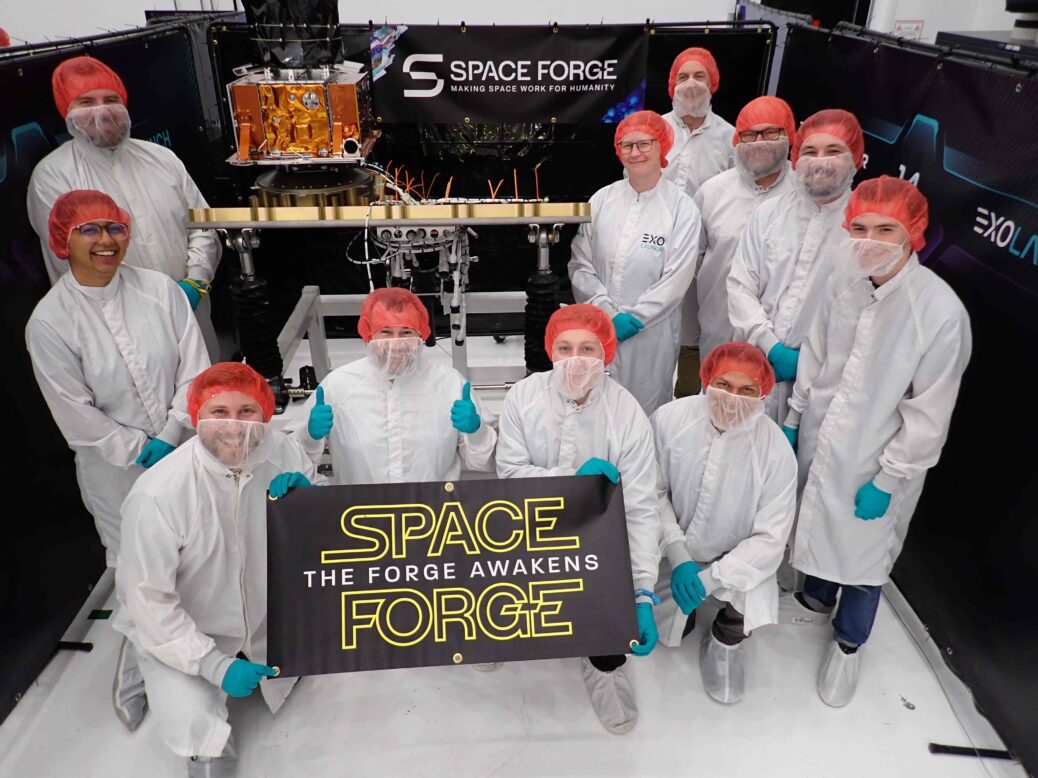
Through ForgeStar-1 – the world’s first commercial space mission for in-orbit manufacturing of semiconductor materials – Space Forge is creating advanced materials from the atomic level up. This is unlocking new performance, efficiency and capabilities for the industries that power our economy, as Space Forge CEO and co-founder Josh Western explains.
“With ForgeStar-1, we fired up the first commercial semiconductor factory in space. The materials we make in orbit can’t be made on Earth, and they will dramatically improve the power efficiency of the vast computing infrastructure behind data, AI and quantum technologies. These are the fastest-growing markets in the world, and the UK, via Space Forge, is positioned to supply a critical component of all three.”
Not only are these companies smashing through technology barriers, but they are also creating a raft of export opportunities with commercial and institutional customers around the world. “Space Forge is proudly headquartered in Cardiff and scaling in the UK, with established operations in the United States and Europe that put us on the doorstep of the world’s largest semiconductor customers,” adds Western. “Advanced semiconductors are fast becoming a defining component of every modern, high-growth economy. Designed, flown and returned by a British company.”
Rochetto echoes this. “Our growing international footprint – from the MoU we signed with Mitsubishi Electric in Japan to our participation in Nato’s Defence Innovation Accelerator for the North Atlantic (Diana) programme – reflects the global appetite for UK-owned space domain awareness capability. Every export we win takes British technology and standards into new markets, and reinforces the UK’s position as a trusted, sovereign partner in space security,” he says.
We must grasp the opportunities at hand, creating an integrated industrial ecosystem whereby commercial innovation strengthens national security. This would see the UK’s dynamic and innovative commercial space sector create better defence capability, accelerate the demand for defence commercial technology, and build globally exportable UK businesses for stakeholders.
Companies of all sizes are set to benefit from this approach. For start-ups, defence can become an important anchor customer without them having to turn into a traditional defence company.
For small- and medium-sized enterprises, dual-use capability can provide a route from technology development into larger domestic and international markets. And for larger businesses, they can provide the integration, infrastructure and scale needed to turn innovative technologies into national capabilities.
Furthermore, on the government side, buying capability from the UK’s commercial space ecosystem can stimulate national security and economic growth.
Related