

Britain’s economic revival and the investment, opportunities, and prosperity it can create will not be written in one city.
Success will depend on every region and nation being able to turn its strengths into productive businesses, investible projects and well-paid jobs. Financial and related professional services is central to making that happen.
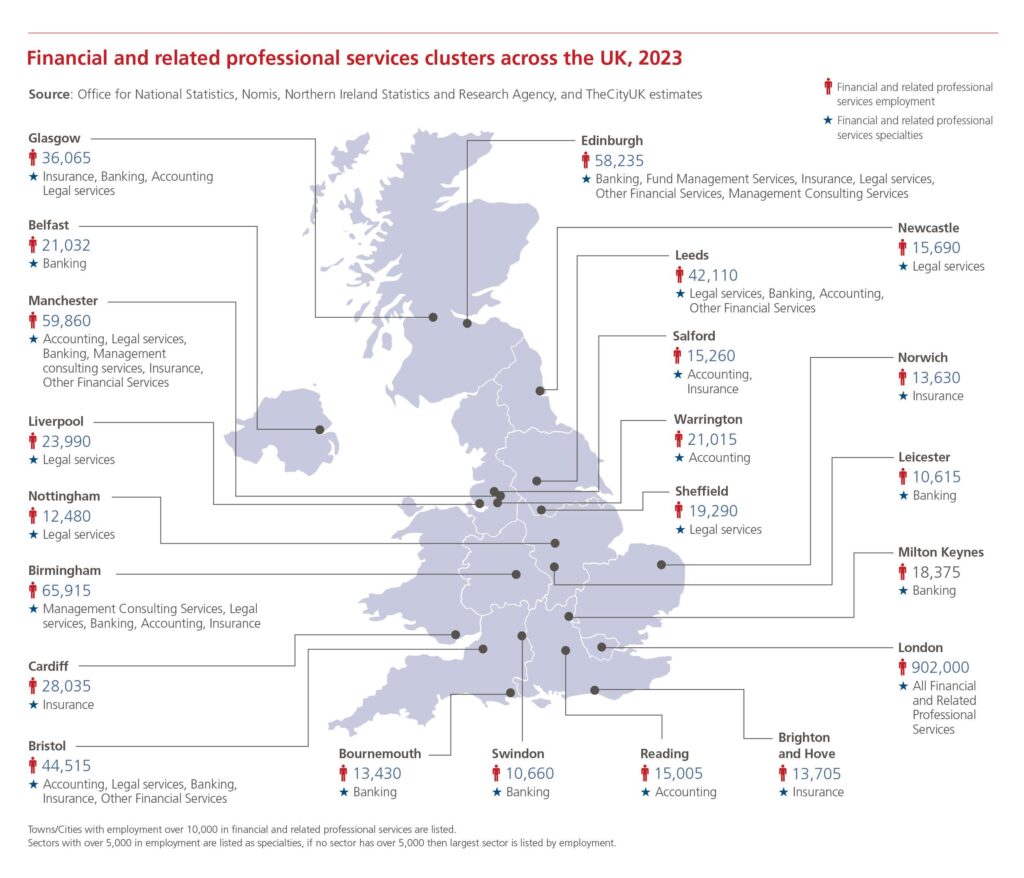
Across the UK, around one in every 13 working people are employed in financial and related professional services, with two thirds of those jobs outside London. From fintech specialities in Scotland and cyber security in Belfast to insurance in Wales and banking in Leeds, its breadth and expertise are significant.
This footprint gives the industry both the reach and ability to enable nationwide growth.

TheCityUK’s longstanding work across the regions and nations has focused on practical priorities: improving access to growth capital, building stronger pipelines of investible projects, deepening local skills and specialist clusters, and connecting regional businesses to international markets.
The UK does not lack capital, talent or ambition. The challenge is connecting them meaningfully with businesses, infrastructure and fast-growing sectors that can change the fortunes of towns and cities.
With government focused on growth and investment, the opportunity is to match the UK’s financial expertise more effectively with regional and national ambitions.
Manchester, Birmingham and Leeds have become major centres for banking, professional services and data analytics. Edinburgh and Glasgow have global strengths in asset management, pensions and fintech, while Belfast and Cardiff are building expertise in legal services, cyber security and regulatory technology.
These successful clusters create jobs, attract talent and connect local businesses to international markets.
These local strengths also support the UK’s export performance. TheCityUK’s research shows that 49 per cent of the industry’s exports in 2023 originated outside London. Bolstering this export capability would strengthen the UK’s overall competitiveness while helping more high-value activity grow across the country.
Mayors, combined authorities and devolved administrations have a critical role in turning local strengths into growth. They can align skills, infrastructure, housing, planning and transport around a shared economic vision, convene local partners and develop credible project pipelines.
With clear accountability, long-term certainty and access to private-sector expertise, strong local leadership can connect national policy with the realities facing businesses and communities.
The investment challenge is substantial. Over the coming decade, the UK will need at least £725bn for infrastructure, alongside major investment needs in energy security, housing, defence and advanced technologies. Meeting those needs requires stronger partnerships between government, investors and industry to mobilise both domestic and international capital.
The financial and related professional services industry can help meet that challenge by putting long-term savings and pension assets, along with industry expertise, to work.
Directing more of these resources towards national and regional priorities would help to unlock investment, raise productivity and create high-quality jobs across the country.
Growth in every part of the country also depends on finance being available to small businesses and scale-ups. While the UK has a strong venture capital ecosystem, many growing companies continue to struggle to secure later-stage finance.
The local consequences are significant: businesses may delay expansion, create fewer skilled jobs or move closer to established funding networks.
Better access to growth capital would help successful companies scale in the places where they started, strengthen local supply chains and create opportunities closer to home.
Capital alone is not enough. Investors need viable projects, clarity on risks and a route to delivery. Some places have the commercial, financial and planning ability to put that package together; others do not. Closing that capability gap would help more viable projects move from the drawing board to delivery.
Practical initiatives like the government’s Strategic Investment Opportunities Unit (SIOU) can help close that gap.
TheCityUK called for a “national investment broker” to build a pipeline of investible projects, help those on the ground to present opportunities with confidence and better connect capital to those projects.
Working with mayors, public bodies and devolved administrations, the SIOU is driving that function and can help promising projects find the right capital and tackle obstacles to delivery.
Turning these opportunities into reality requires private-sector expertise in finance, insurance, legal services, planning and procurement.
Bringing this expertise together early can help local teams develop robust propositions and bring viable projects to market more quickly.
Investors can also provide early guidance on scale, structure and returns. TheCityUK and its members are already working with the Office for Investment and local partners to support this approach.
This partnership between policymakers and industry will be essential to delivering growth. Its success should be judged by visible results: stronger project pipelines, faster decisions, more capital invested and more high-quality jobs across the UK.
The potential gains are substantial. TheCityUK and PwC’s No Time to Lose report, based on interviews with over 300 senior leaders across the industry and policymaking, suggests that a more ambitious approach to competitiveness, investment and capital mobilisation could add £53bn a year to the economy by 2035.
Realising that potential would support stronger businesses, better jobs, greater household wealth and more resilient communities across the country.
Regions and nations need local leaders, industry and government to work together turning their strengths into investment and delivery.
Get that connection right and growth will be measured not in promises but in thriving businesses, better jobs and stronger communities. Financial and related professional services can help ensure the benefits are felt nationwide.
Related