
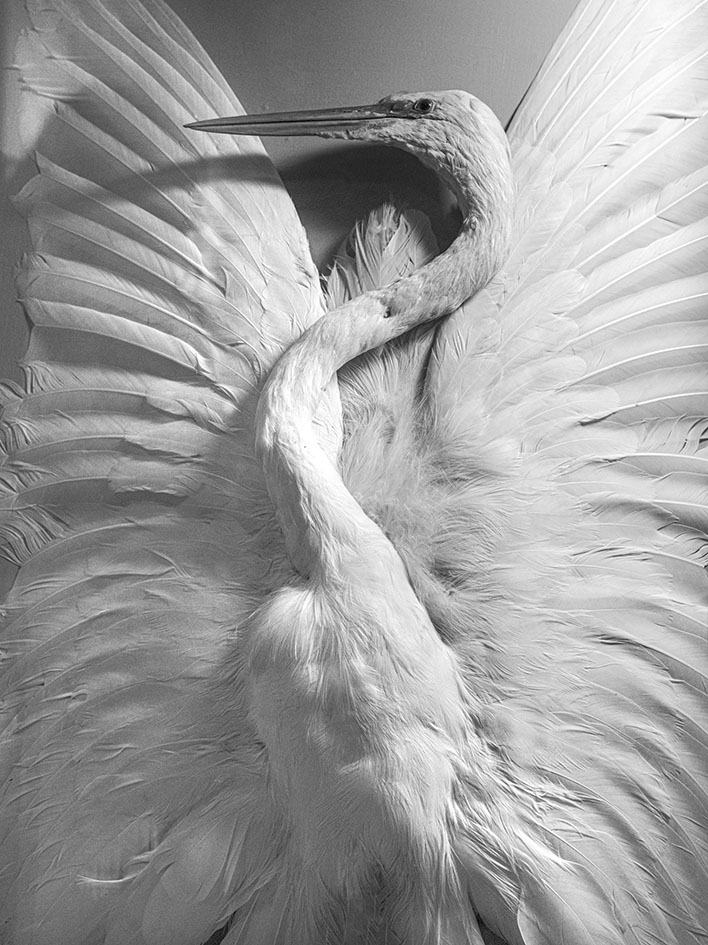
When my wife told me she was pregnant, I started thinking about death. More than ever, I needed to stay alive, to pay for my half of the child. Death mattered more, now that I mattered more, which meant my long-standing fear of dying had doubled overnight. I needed, my wife said, to repress that fear. And where better to deny the reality of mortality than the UK Guild of Taxidermists Annual Conference? All forms of art are an attempt to deny death: to enable the artist to live forever in another vessel. Taxidermy distils that denial to its essence by attempting to literally preserve life at its most lifelike – as if the animal is the same dead as alive, as if nothing fearsome has happened.
In 50 years no journalist had ever bothered to attend the conference. A by-default exclusive, the conference gathers the United Kingdom’s 50 foremost taxidermists for a series of talks, arguments and competitions – to produce the best mammal, best bird, best fish and so on – judged by taxidermists flown in from Europe (following accusations of “favouritism” levelled at the British judges of earlier decades).
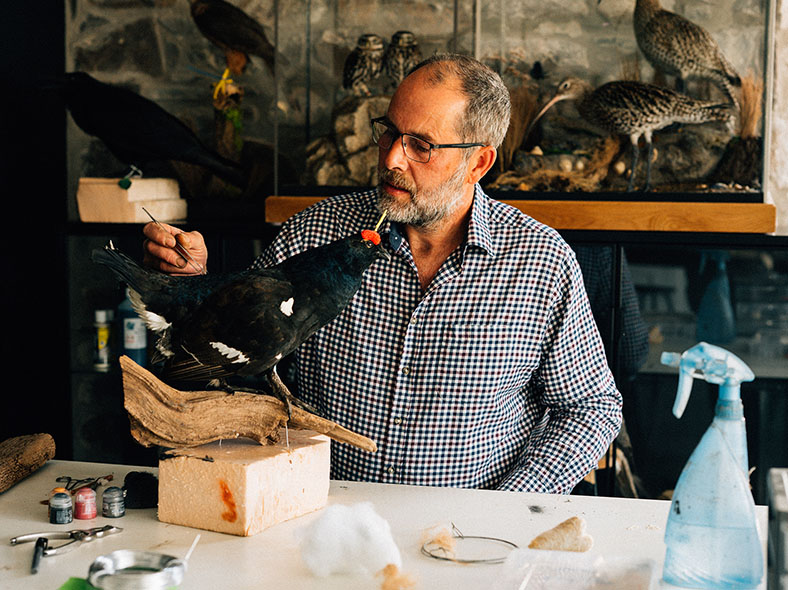
Taxidermist and chair of the guild Steve Smith is a kindly bearded man in his fifties. The first thing he told me was that he wasn’t “in it for the money”. Instead, Smith preserves carcasses to “celebrate life”, viewing these competitions as competitions to make the most accurate recreation of the living animal, not the strongest denial of death.
Most of his customers fall into one of two categories: either buying carcasses he’s sourced and stuffed or bringing in their own. Both tend to be impartial in taste, choosing random animals based on “instinctive reaction”. Few collect particular species or breeds, although those collectors do exist, obsessively filling houses with endless permutations of, say, a very specific crow. Smith says stuffing dead pets is “big business” but many taxidermists reject the commissions, after unsettling experiences with grieving pet owners – confused women on doorsteps clutching frozen rabbits or pale men telling them to “take good care of Buster”.

In his home studio, Smith gestured at the various dead animals displayed on his wall. “This is a hawk,” he said, “this is a falcon.” They were unnervingly lifelike. I’d expected more whimsy: badgers playing croquet, kittens clinking glasses. On the floor, animal skins floated in buckets of acid. Virtually every taxidermist I met at the conference was eager to dispel the myth that they kill these “specimens”.
Smith took me on a drive around the moors he circles in search of carcasses, showing me where he’d found grouse, merlin and owls. I kept an eye on the speedometer, half expecting him to accelerate if he spotted a stag in the road (taxidermists can clean and restitch roadkill). Most of his own carcasses, though, are sourced from a network of local gardeners, farmers and gamekeepers.
“You develop an eye for death,” his wife, Danielle, had said back at their house, lamenting the romantic getaways interrupted so that her husband could pull the car over and peel bloodied animals off the motorway.
But what taxidermists pride themselves on is their eye for life. To arrange a dead bird in a posture that resembles it in life, they must watch and study living birds, to understand their anatomy. Struggling to pose a heron, Smith once found himself lifting one of his own legs, trying to balance, perhaps gently flapping, to imagine and feel and be the heron. I thought of Michelangelo. To sculpt the human form better, he dissected corpses until he understood how the movement of our muscles shapes our surface. “Would that appeal to you, Steve?” I’d asked as we took our seats in his living room. He sighed. “My art, too,” he said, “is a lifetime of frustration, slowly driving you insane.”
The pet owners intrigued me. They, at least, seemed to favour the emphasis on taxidermy denying death rather than celebrating life. Most of Smith’s animals had looked perfectly happy dead, certainly happier than me, but instead of saying death didn’t matter, his obsessive attempts to “celebrate life” signalled, in retrospect, the opposite: the horror of decay, a frenzy to deny it, even for a bird as small and annoying as the pigeon.
Smith introduced me to Wayne Pyle, a taxidermist who specialises in preserving pets. Taxidermy’s popularity peaked in Victorian England, coinciding with an era in which the queen’s prolonged grieving for Prince Albert sparked a fashion for some of the most expensive, pointlessly elaborate mourning rituals in history: horse-drawn processions, giant monuments, ballooning cemeteries, rambling epitaphs, mandatory black for widows.
For the taxidermy business, it’s been downhill ever since. Although, for more and more of today’s pet owners, Queen Victoria evidently casts a long shadow. One of Pyle’s most loyal customers, Carlym, couldn’t be more pleased with the four pet Chihuahuas she paid him to stuff. In her home, the first, Gabriella, watches over her from a shelf in a bookcase; Titi sits nearby; Scarlet perches atop a second bookcase; and Cinderella rests on an antique side table. Each sits, I was told, “by a little urn” containing the ashes of its innards, which Pyle had replaced with plaster. Pyle was hard at work on Katrina, Carlym’s latest dead Chihuahua, on the morning the three of us met.
“For a lot of pet owners, this is how they remember the good times,” Pyle said, smiling at the inert Cinderella or Titi – I’d lost track of who was who. “I should know: I got into this line after I taxidermied my own dog. It gave me peace.”
I understood the appeal. A taxidermied Cinderella, in contrast to a fetid, worm-eaten Cinderella, never ceases smiling. The taxidermied dog lives on as an eternal testament to itself. After I die, the same fate might suit me: something for my child to enjoy. I don’t know why I fear death; I don’t particularly like life. I suppose that, as with most writers, I just want – and on some level expect – to be preserved for eternity, like Tutankhamun, or Lenin.
“It’s not about denying the reality of death,” Pyle agreed. “It’s about honouring the memory.” (“I know they’re dead,” Carlym said.) Pyle makes customers wait two months before he accepts a commission, to give them the time to make sure they’re doing it for “the right reasons”. A minority of owners, even after Fluffy spends two months silent in Pyle’s freezer, return “fully expecting a heartbeat”, but Pyle can afford to refuse the commissions of those in denial because “almost nobody is. Most want to taxidermy their pets for other reasons.”
No single motive, personality or set of circumstances connects Pyle’s customers. Carlym, for example, soured on burials because she was “about to move house”; now, rather than glue herself to a particular garden, she can cart her deceased from home to home. A blind woman wanted her dog taxidermied, not to look at, but to enjoy his “presence”, however diminished, “right where he used to stand, in the doorway of the kitchen”. Another customer wanted his dog in a box, slotted beneath his bed, “just to know he was there”. A surprising number use the taxidermied dog as an urn for the ashes of earlier dogs, which Pyle pours into Fluffy through a hole he drills into his body, creating a kind of canine Russian doll. “Thank you so much,” reads one of the many cards Pyle has received from customers, “for mending my broken heart.”
A sprawl of warehouses, industrial estates and empty car parks surrounds the Derby Conference Centre. I’d booked a room in the dismal hotel upstairs. By 2pm, an hour before the conference had officially begun, I found four taxidermists already drunk in the hotel bar.
The anecdotes from previous conferences were astonishing: trashed hotel rooms, a taxidermist naked in the corridors, a diabetic so drunk that he fell unconscious and narrowly avoided dying. “A bit of a boys’ club,” one woman told me, rolling her eyes. One taxidermist said that the year the guild awarded whisky as a prize, a “brawl” erupted. He said he was too drunk to remember the details. His image of the weekend ahead verged closer to that of a frontier saloon than to the Natural History Museum. I glanced at the clock on the wall. The only talk planned for that day wouldn’t commence until 8pm, by which point we’d have been drinking for six hours.
As the bar steadily filled with taxidermists – fresh from hauling their various dead animals to a back room for registration – murmurs swirled of a waning “old guard”, sidelined by a younger generation of clean-cut professionals sipping non-alcoholic cocktails on the other side of the room from our dingy bacchanal. About half the crowd consisted of women in their twenties, many of whom had been introduced to taxidermy via university modules on art and fashion courses, taught in the wake of Alexander McQueen’s experiments with the medium. Nobody I spoke to, young or old, thought much about death. Mostly, they thought about their jobs and lives.
The group shared little on the surface. Their unanimous love of animals often manifested itself externally – in a magpie tattoo, a leopard-print skirt, a badger necklace – but they varied in age, gender and class, lived across the UK, and worked an assortment of day jobs: cook, administrator, librarian, naval dentist.
Yet they spoke a common language, bound by a shared understanding of the world of stuffing, an understanding that continued to elude me as I noted random quotes from the opening Q&A with the European judges: “The Dutch don’t have a history of mounting fish.” “In my boyish aggressiveness, I chose to blow up the birds.” “It’s all politics.” “I still have the newspaper clippings.” “We, as taxidermists, must learn to crawl again.” “A bird’s not necessarily what gets my heartbeat going.”
Seventy animals watched us from beyond the grave as we sank more drinks in the backroom. Taxidermy is art that looks at you as much, if not more, than you look at it. The animals all appeared to be freezing for a camera, forever awaiting the flash and shutter so that they could finally relax, and die.
I’ve pieced together much of what followed from various AmEx statements. I learned from various taxidermists that the guild had cleaned up its act since a “purge” in 2019 that ousted the “rowdiest” members. The year I attended most of the taxidermists went to sleep early, emptying the bar except for myself and another attendee, who spoke in a stream of animal-based non sequiturs. “A great white shark has stomach acid so strong it could eat you whole and nothing would be left in three days,” he explained to no one in particular.
“Did you know I taxidermied Dolly the Sheep?” He lifted his hand. “This hand is the first in human history to touch cloned blood.” That almost certainly wasn’t true, accounting for the geneticists, lab technicians and pathologists. Still, I told him, if anyone ever taxidermied me, I’d want it to be him that did it. It was the highest praise I could think of at the time. He said the “fucking Animal and Plant Health Agency would never clear it”. I’d spent £85 on drinks at the hotel, where pints were roughly £6. But as the bar had closed hours ago, and the bartender had driven home, I was recouping some of those losses by pouring my own pints.
I spent most of the next morning’s first talk (titled “The Art of Colour”) hungover in the back row, panicking about the CCTV footage from the bar. I watched a man paint a mounted fish head for a full hour. “Taxidermy and Film” followed, featuring footage of pulleys used to make fake intestines slop out of a taxidermied cow’s stomach for a Steven Spielberg film.
Meanwhile, the next speaker was nursing his hangover by chain-drinking orange juices before his talk. Aptly, for its entire duration he looked like a trapped animal. The most esoteric session of the weekend, his talk received the taxidermists’ biggest response. He spent it ranting and raving against the “bureaucrats” and “pen pushers” at the APHA. But after 15 minutes, he abruptly called it off. “Sorry,” he said, wiping a palm down his face, “just find me later if you have any questions.”
In a back room, the judging was underway. Smith said it was “a bit of an honour” for me to watch this, as entrants aren’t permitted to do so. An ageing Danish connoisseur stared at a finch in complete silence for three minutes, and if not for his open eyes, I would have called an ambulance. I decamped to the bar, where “The Boys Are Back in Town”, echoing from the cavernous conference atrium, compounded this misapprehension that I needed to drink as if it were New Year’s Eve. Twenty-four hours had passed since I’d last left the premises.
I’d hoped to leave Derby with my fear of death so repressed that I could’ve happily killed myself right there and then, if I felt like it – not that I would have, as the objective was to be a less panicked parent. Yet, by the awards ceremony, I felt just as afraid of death as I had at the outset of my wife’s pregnancy.
But slowly, as the parade of winners went on and on and on, carrying their dead animals to the front of the applauding audience, I realised that, across the various categories of animals and taxidermists, the guild had distributed at least 30 gold, silver and bronze awards, making it harder for the 50 members to lose than not. In fact, after nobody else entered a game head in the amateur category, we all vigorously applauded an unopposed taxidermist for winning by default. At that point, I had to concede that taxidermists might genuinely celebrate life, clapping it no matter how underwhelming.
Taxidermy appears to confer on the owner a sense of control over the animal and, in doing so, a sense of control over our own animal nature and mortality, in an attempt to reassure us. But it fails. Man’s terror is to emerge from nothing, to gain a sense of self and, even with that distinction, still end up in the same state as any dead dog.
Earlier in the bar, when a taxidermist had asked me what I planned to write, I’d rambled on for a while about my pregnant wife and death. My wife and I had agreed that I hadn’t responded well to the pressures of impending parenthood. Even the bare-minimum responsibility of staying alive utterly panicked me, presumably as a way to displace the far worse panic about the thousands of other future responsibilities. Was I avoiding my fear of parenthood by fixating on my fear of death? Quite possibly, I’d admitted to the taxidermists. It was also possible that I was projecting that fear of death onto this practice, fantasising that it compartmentalised death, shrank it to the size of a pigeon, and said, “There is death: that happy pigeon. That is all it is.”
And, overhearing me, a second taxidermist said, “But taxidermy is the art of life – celebrating life.” This was perhaps the 60th time a taxidermist had told me that I’d fundamentally misunderstood the art. “Life is just the slow process of dying,” I’d argued, “so in being the art of life it’s really the art of death.”
But somehow those spurious “awards” helped me understand that taxidermy is both. To live is to die, and taxidermy honours the former by subverting the latter. Taxidermy honours the chihuahua. It gives life, as much as death, a shape, a substance. It makes death matter less and also more. Taxidermy, that dream of an afterlife, doesn’t deny reality so much as confront it. It draws one’s attention to each magical detail – the eyes, the ears, the smiles. In that one regard, it’s a little like the baby I’m now raising, whose joy at the smallest things reframes the certainty of death as a fine and fair cost for living.
[Further reading: Vinted Brain]
Content from our partners



Related
This article appears in the 16 Sep 2026 issue of the New Statesman, Will AI kill us all?
Join the debate
Subscribe here to comment