
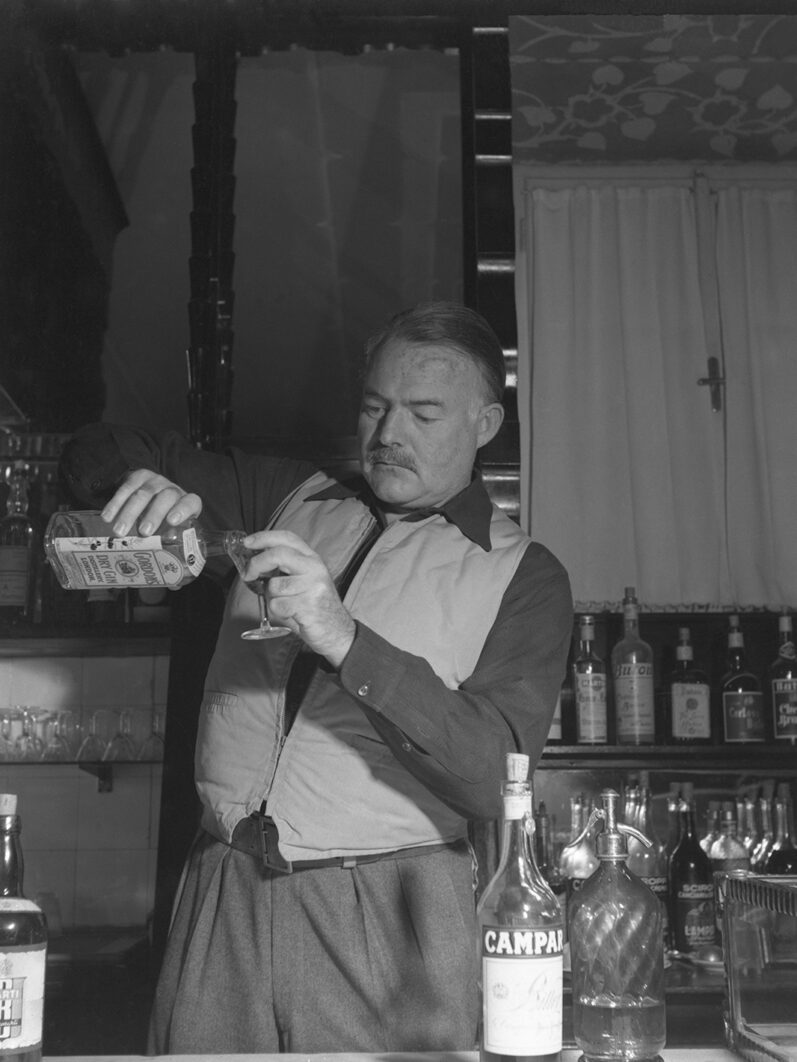
The American Bar in London’s Savoy Hotel is hard to get in to on a Monday at 5pm. This might be the only bar in the capital that is hard to get in to on a Monday at 5pm – bucking a nightlife trend that’s been driven by, in no particular order: puritanical youngsters who don’t drink; an exploded pipeline (2023) somewhere in the North Sea; misadventures in Iran (2026); and, I dunno, George Osborne? Am I contractually obliged to say that?
Never mind. My haggling with the maître d’ (or “hostess” if you’re American and still buy Playboy) for a two-top is welcome: in these dark times, there is still a bit of seedy fun to be had out there. The bar, which opened in 1893, has seen many famous patrons cross its threshold: Winston Churchill, Marilyn Monroe, Silver Spoon. But more than anyone, Ernest Hemingway’s pickled ghost haunts the floor – conspicuous with a Martini in hand, 15 parts gin to one part vermouth. Churchill was a robust drinker, but we may have lost the war had he shared Ernest’s habits.
I am here with the New Statesman’s bluestocking online editor – more of an Austen girl, I suspect. But we are celebrating the 100th anniversary of The Sun Also Rises, Hemingway’s first and greatest novel. (Any views to the contrary will be warmly received by our letters pages, and icily received by me.) I order one Manhattan and a Gin Martini – dry with a twist – for the lady. And then I wonder what Hemingway would think two female colleagues might talk about over a Martini after work: man’s implacable urge to dominate and be dominated by nature didn’t come up.
Much will be said in the coming days about The Sun Also Rises – the cold, cold work that proved Hemingway could carry his sparse prose to novel length. You will hear words like “disillusioned” and “postwar generation”. About how he was a bard of masculinity then just as potently as he is now. Someone, somewhere, will call anti-heroine Brett Ashley “dissolute”. And then, the customary argument: Hemingway could write about men’s feelings towards women, that perfect ancestor to Cormac McCarthy, but could he write women? (Yes, but who cares if not – my two cents).

Considering myself above this route-one textual analysis, I have been thinking instead about how The Sun Also Rises was the best food and drink novel of the 20th century – until you hit John Lanchester’s The Debt to Pleasure in 1996. My condolences to James Joyce, but no one that interested in anatomical function can speak well of lunch, or breakfast. No, in The Sun Also Rises the characters are cruel and bored, but at least they eat and drink with a bit of spirit: sandwiches and Chablis on a train south from Paris; suckling pig with an unrequited romance in Madrid; wine with breakfast at the Hotel Montoya.
None of that at the American Bar in London; nor fried trout freshly fetched from the Irati River, or white wine cooled in a natural spring (one suspects the Savoy to be in possession of industrial refrigerators). We are picking at olives and sipping on pure ethanol – Hemingway might liken it to juice. I look around: geometric carpets, mirrors, black and white photographs of famous people I don’t recognise, patrons of varying degrees of sophistication. Huh, if it weren’t for that woman to my left furiously banging away at her laptop, brandy in hand, maybe I would feel like a feckless expat at a bar in 1920s Paris – maybe I would like to be a feckless expat at a bar in 1920s Paris?
I think I would be good at it, in any case – what with all the moral disorder and sandwiches and Chablis. And I approve of the American Bar too: a place with genuine transporting qualities, that never feels Potemkin or like an adult theme park (Harry’s Bar in Venice shares the same aspirations but falls several kilometres short). No, this is a perfect place to drink a Martini on a Monday at 5pm – everyone else in here has had the same idea. Hemingway approved activity, though I suspect he would be disappointed we didn’t start earlier.
[Further reading: The Ned: a Spoons for finance bros]
Content from our partners



Related
This article appears in the 21 Oct 2026 issue of the New Statesman, Sally Rooney is a writer, not a terrorist
Join the debate
Subscribe here to comment