
It was nice of Emmanuel Macron to let us borrow it – the Bayeux Tapestry, or the tale of how the Normans (with some help from the Bretons and the Picards) invaded and conquered England, a short millennium ago. “Here you go, and don’t forget – it could happen again!”
No hard feelings. It is a shame, however, that it would be hundreds of years until the French became the undisputed kings of the kitchen (a small bust-up in 1789 should have rendered that “presidents of the republic of the kitchen”, but it’s not so catchy). Medieval Normans, like the Anglo-Saxons, survived largely on a diet of leeks, cabbage, turnips and a bit of chicken on a good day. Pottage – grain stew – was commonplace too.
It wouldn’t be until the late 16th century that potatoes entered our culinary lexicon – a historical inflection point that went better for some than others. You can forget about chillis, tomatoes and the pork pad kra pao I ate at Singburi in Shoreditch over the summer, too. All are alien to the imagination of marauding Normans. William the Conqueror probably didn’t even own a toque, much less possess any inclination to make a clafoutis.
I am grateful for the intervening millennium – first William hops over in 1066, then Raymond Blanc and Alain Ducasse a short while later. England – and no thanks to the conqueror – has a great tradition of importing French chefs, techniques, ingredients, sensibilities and manners into its restaurants. For a long while, Gallic-inflected menus were the only way you could eat well in this country… several decades of innovation behind our friends across the Channel. (Everyone say: thank you, Raymond!)

You see, the arrival of the Bayeux Tapestry (pedants will correct me – the Bayeux embroidery) has stirred my inner Francophile; my inner Norman too. It leaves the British Museum next July. Until then, you can call me Fitzredmond. And here is a tip. If you have managed to beat several thousands of your fellow citizens for tickets, you can skip the famous Harold-gets-an-arrow-in-his-eye scene (the nation must maintain some dignity). Instead, head a few paces back, to the night before the Battle of Hastings and watch William, his fellow noblemen and Odo the Bishop (cute name for a dog) feast on fish and meat boiled in a cauldron and what is presumably wine, probably some cider too. I like the tapestry for its narrative ambition and huge scale, and its moments of knowing whimsy. Otherwise – I have to say – it isn’t, on a line level, particularly accomplished.
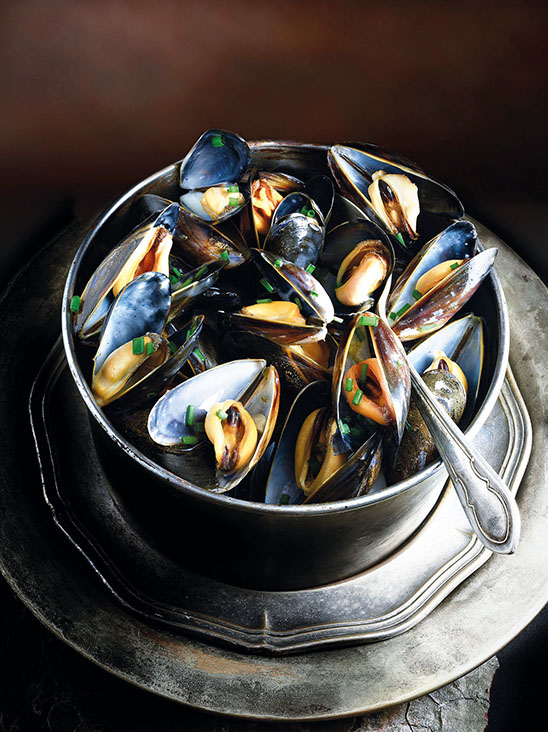
Never mind, I am no churl – or not today, at least. Because I am skipping through London on my way to Blanchette to eat as Normandish as possible (“Garçon! Do you have a cauldron?”) fully in the knowledge that my dinner will be much better than William’s was the night before his big day. At this small French restaurant in Soho we eat bread with Normandy-specified butter, piles of mussels, and a huge piece of steamed white fish. They don’t serve pottage, and I wouldn’t have ordered it if they did. I break with Norman tradition by drinking a Chenin Blanc, from the Loire Valley.
Blanchette would be a good neighbourhood restaurant, and suffers from being in the high-restaurant-density area of Soho. Everything is nice, the staff especially so. Expectations are not particularly high because it doesn’t aspire to much more than that: “nice”. But here is the thing with French food in London: the floor is so high it has become hard to have a bad time. That principle is slowly spreading to the other cuisines (nasty word) of the city. But as ever in all things culinary, France leads the way.
If for some reason – perhaps you are from the moon? – you do not see the appeal of the French restaurant, then bonne chance! London is spoiled with some of the very best (it is harder to get a table at Bouchon Racine than tickets to the Tapestry). But more than that: like William in 1066, the French chef came over here and conquered the kitchen in toto. Yes, even yours.
[Further reading: The vanity fair of 70 Up]
Content from our partners



Related
This article appears in the 16 Sep 2026 issue of the New Statesman, Will AI kill us all?
Join the debate
Subscribe here to comment