
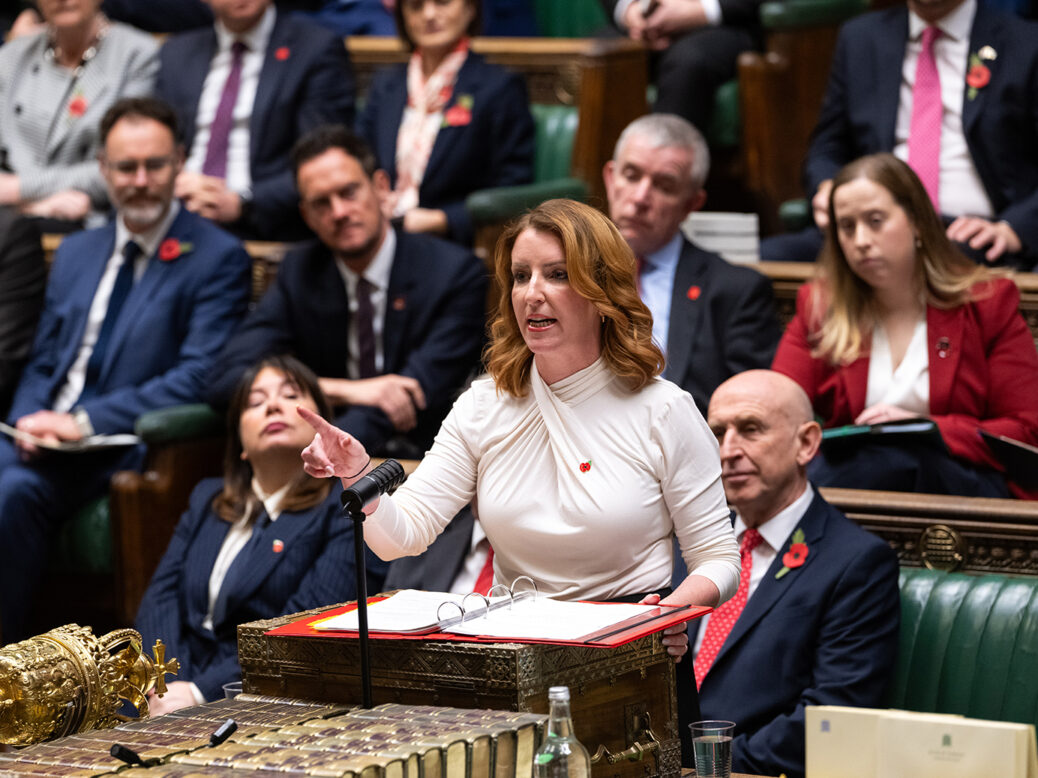
As Louise Haigh waited behind the Speaker’s chair before her first Prime Minister’s Questions she chatted with the Chancellor, John Healey, smiling and laughing in the way people do when they know lots of people are looking at them. At the despatch box, the Welsh Office minister Anna McMorrin had the unenviable pre-PMQs task of trying to answer questions to which almost no one in the rapidly filling house paid any attention, like a teacher trying to set homework after the bell has gone. Haigh looked fresh from the hairdresser’s – the scarlet dye of her pre-government days now a distant memory – and wore a cream silk blouse which didn’t have “I’m the most powerful woman in Westminster” printed on it, but projected that message nonetheless.
Haigh was representing the government at PMQs because the PM is, like the late, great Judith Chalmers, busy pretending that a trip to Antigua is real work. While Andy goes snorkelling with the King (we assume), Haigh is facing her Tory opposite number, the deputy leader Alex Burghart. It’s quite the trajectory for Haigh, who was the first of Starmer’s ministers to resign in November 2024 when it was revealed that she had a spent conviction (in politics, one waits until one is in power before committing fraud; it’s far more lucrative).
Burghart kept things brief, kicking off, without any of the preamble or barb-throwing that characterises Kemi Badenoch’s PMQs performances, by asking simply what the government was projected to spend this year on working-age welfare. A fellow Tory mooed with interest; yes, this was a pointless question – surely the deputy leader of the Conservative Party has access to the Office for Budget Responsibility website? – but it was at least admirably short and to the point. Haigh began her answer with a joke at Burghart’s expense – that as the man whose job it is to correct Badenoch’s mistakes, he must be “the busiest man in Westminster” – but this seemed rather unnecessary, and she didn’t name the figure.
Burghart repeated his question, and did name a figure – £183bn. It’s a figure, but it’s one that is almost certainly wrong. The government’s own figures put the bill for benefits paid to working-age people (most of whom are in work) and their children at £145bn for the current financial year. Haigh might have pointed out that he was simply wrong, by tens of billions of pounds, and perhaps this lack of facility with maths could explain why the benefits bill was so high in the first place. But she stuck, perhaps unwisely, to the lines in her folder.

Haigh seemed as if she’d been briefed more for a clash of personalities with Badenoch than a debate with the smug, Cameronian Burghart. As she raised her voice in righteous indignation against the disaster his party had inflicted upon the country, he gave her an oily smile and repeated the same question – what are you going to do about welfare? – again and again, irritating and persistent as a broken record.
With Burghart effectively declining to ask more than one question, Haigh was led into repeatedly asking questions of him: “perhaps he’d like to explain”, she said, and “perhaps he’d like to take this opportunity to apologise”. It’s not a good look for the government to be asking questions of the opposition; it raises the question of who is in power. Again, Haigh would have been better advised to go off-script; when Burghart joked that Labour was “the only political party in history to have two ten-year plans in ten months”, she could have come back that of the five Tory PMs in the past decade, some weren’t around long enough to need a haircut, let alone a ten-year plan. But Burghart has done PMQs before, and Haigh has not; he was either having more fun, or doing a better job of pretending to be.
Then it was Daisy Cooper’s turn. The Lib Dem deputy asked some questions about American politics – it’s not clear why – and Haigh did a great job of taking these seriously and not saying the obvious (“Why are you going on about the Epstein files, Daisy? Get off the internet for a bit, yeah?”).
The questions moved on to real politics. As two consecutive backbenchers asked questions about bridges in their constituencies, I saw Angela Rayner stifle a yawn. And then Sharon Hodgson, the Labour MP for Washington and Gateshead South, stood and introduced a constituent of hers, a young woman who was sat in the visitors’ gallery with her family; three years ago, she had been given a few months to live, but her condition had been treated by a drug made in the UK and developed with the help of the NHS. Haigh welcomed the young woman to the House and MPs were reminded, however briefly, that beyond the braying and jeering at bad jokes, something much more important is always happening.
[Further reading: Will Andy Burnham’s Ten-Year Plan meet the moment?]
Content from our partners



Related


Join the debate
Subscribe here to comment