
It was a throwaway line, 18 careless words that Rachel Reeves surely could not have predicted would cause such chaos when she delivered her 2025 Budget: “I will also keep the Plan 2 student loan repayments threshold at its 2026/27 level for three years.”
And with that, a policy landmine set by the Conservatives and the Lib Dems back in 2011 which lay dormant throughout five Tory prime ministers exploded on the watch of the new Labour government.
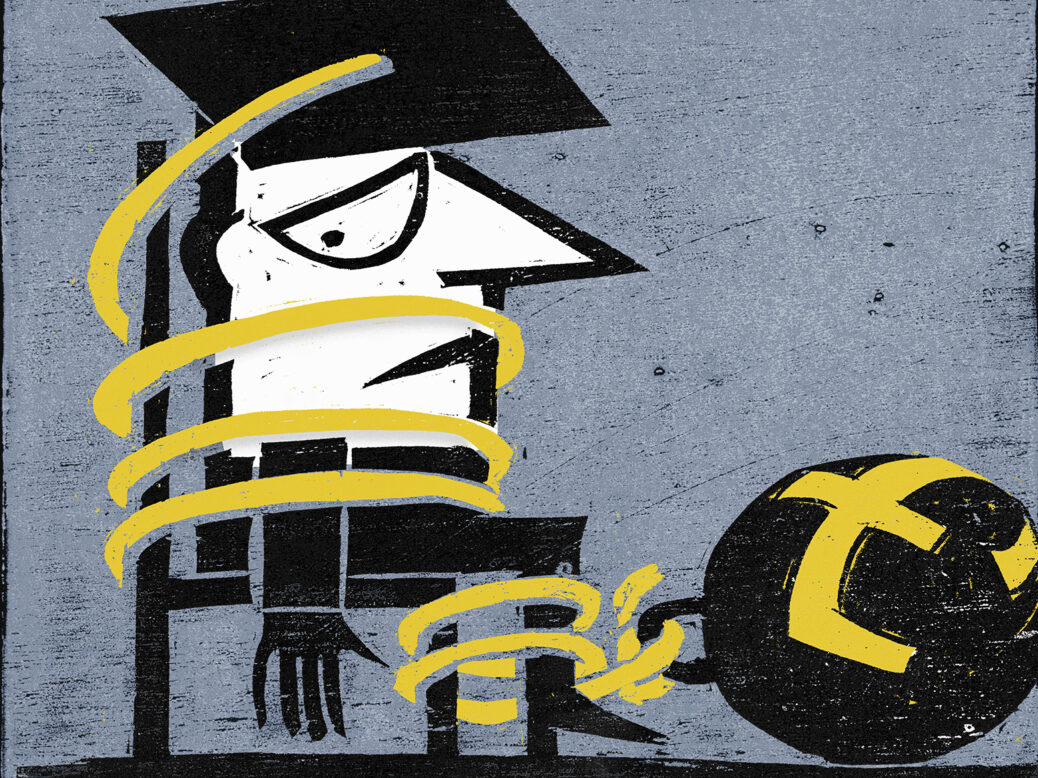
The Plan 2 student loan system, as we have covered extensively, is a mess. The fees, interest rates and repayment structure saddle graduates with decades of debt that amounts to a de facto additional tax of 9 per cent. The system has failed in its stated aim (as elucidated by Vince Cable, then business secretary and one of the architects of the reforms) for the individual to cover 60 per cent of the cost of their university degree and the state 40 per cent; according to analysis shown to the Treasury committee, the individual is now paying as much as 95 per cent.
How did this end up being a problem for Labour? Partly, it was bad luck that the crisis started to dawn on the public more than a decade after the changes were made. Plan 2 graduates began to hit their thirties (in some cases entering parliament) and to realise how punitive the debt they had signed up for as teenagers really was. But Reeves herself is also to blame. By freezing the repayment thresholds, the then chancellor was unilaterally changing the terms of the loan agreements and increasing graduates’ monthly payments – a stealth tax, on top of the fiscal drag faced by all income taxpayers. This is perfectly legal, as loans provided by the government are not bound by the same terms any private sector lender would have to adhere to, but the graduates subjected to this stealth tax were justifiably outraged at being treated as cash cows.

What followed was a much wider conversation about how student loans (don’t) function and what the Chancellor should do about it. The Treasury Committee got involved, canvassing feedback from tens of thousands of young people, and concluded that these loans had essentially been mis-sold in all but name, with teenagers given misleading and sometimes downright inaccurate information about the products they were applying for. The tax burden on young people and its impact on income at a pivotal time in their lives, not to mention the inherent unfairness of a system that students with wealthy parents can simply opt out of, all became hot topics. Meanwhile, various think tanks and interest groups drew up proposals for making the system fairer – all of which came with substantial price tags.
Keir Starmer and Rachel Reeves might not have designed the system (Starmer, in fact, might not even have been an MP). But they’d chosen to bring it up and add insult to injury. Now, the public demand: what were they going to do about it?
The answer, it turned out, was nothing. As the row was blowing up at the start of this year, Starmer’s authority was rapidly disintegrating. But hope remained. Now there is a new Prime Minister and Chancellor on the scene, a pair who talk big about the cost of living crisis and righting past injustices. Surely a generation encouraged to mortgage their hopes and dreams on a dysfunctional loan system that even the politicians championing it failed to understand would merit a mention?
Alas not. When John Healey delivered his “breathing space” Budget on 28 October, he sidestepped the trap Reeves blundered into. Student loans did not get a mention in his speech, and the threshold Reeves had frozen is to remain frozen.
Even the entreaties of the Money Saving Expert himself, pseudo shadow chancellor Martin Lewis, who called the threshold freeze “a fundamental breach on natural justice” and had reversing it as one of his three main pre-Budget asks, failed to move the Treasury. Interestingly, Lewis’s other two big asks – scrapping the standing charge for gas bills and ensuring pensioners who earn a small amount over the state pension won’t face a cliff-edge into paying tax, were both heeded. It’s only the fortunes of young people who were comprehensively ignored. How curious.
Healey would no doubt argue that there are measures for younger voters in the Budget. He might point to the Young Entrepreneurs Allowance, which is designed to “cover a year of living costs for young founders while they turn their ideas into businesses” (although the age criteria for this have not been determined, and it’s unclear how many budding entrepreneurs it would actually help). Or he’d bring up the changes to the Lifetime Isa (another Martin Lewis campaign issue) that remove the penalty and mean young savers will get out at least what they put in if they buy a home over the limit.
On the minimum wage, he’d probably equivocate: 18-to-20-year-olds are getting a 3.9 per cent pay rise that matches the Living Wage increase for holder workers, but won’t see their pay equalise. Considering the difficulties school-leavers are facing getting employers to take them seriously as it is, this compromise makes a certain amount of economic sense, however disappointing it may be.
But still, the failure of the Chancellor in a cost of living budget to even acknowledge one of the main financial burdens weighing on the shoulders of Britain’s aspirational youngsters aged 32 and under is glaring. It’s evidence of a collective Whitehall blind spot, a wilful refusal to recognise the barriers stacking up for one particular cohort on whom the economy is increasingly balanced.
All Treasury secretary Emma Reynolds had to say after the Budget statement was that the system is “under review”. “We inherited a system that is difficult and unfair on young people, but we weren’t able to move on that today,” was her sorrowful contribution, as if the terms of student loans were an uncontrollable adverse weather event, not the result of successive government ministers consciously choosing to screw over students and graduates, including Healey’s immediate predecessor.
Healey is 66. When he went off to university, tuition fees didn’t exist, and local government offered generous maintenance grants. Now, in his first big address to the nation as Chancellor, he doesn’t even think the mess today’s aspirational students are enduring is worth mentioning. It seems not everyone is entitled to breathing space.
[Further reading: The revolution deferred]
Content from our partners



Related


Join the debate
Subscribe here to commentJohn Healey came from a solid middle class family and went to university in 1979 from a private 6th form college with tuition fees paid by the taxpayer. When he was going to Cambridge I was graduating from the University of Bath. I too went to university with the fees paid by the taxpayer I even got a full maintenance grant because I came from a lower working class family and went to a comprehensive school with a brand new 6th form. In those days about 10% of all 18 year olds went to university and about 75% came from middle and upper class families. Lower working class students were a rarity. The Robbins Report of 1963 had predicted that most of the extra places produced by the university expansion of the 1960s woul be taken by the middle class and so they were. The bottle neck for working class kids was at school as I can testify – there was virtually no real guidance as to what you should study or where you should apply. The working class got a raw deal and by the early 1980s deindustrialisation was in full swing so the working class jobs started to evaporate. More university expansion took place in the 1990s but now the students had to pay. Working class people hate the idea of debt. The working class students of today who took up the debt have been shafted again as have their middle class class mates because the debt load has risen steeply to about £50K per graduate plus interest. As for me I am grateful for the education and I needed a PhD to really join the middle class by working for hard nut U.S. corporations but the middle class too is evaporating. Life is a bi**h and you die.
John Healey came from a solid middle class family and went to university in 1979 from a private 6th form college with tuition fees paid by the taxpayer. When he was going to Cambridge I was graduating from the University of Bath. I too went to university with the fees paid by the taxpayer I even got a full maintenance grant because I came from a lower working class family and went to a comprehensive school with a brand new 6th form. In those days about 10% of all 18 year olds went to university and about 75% came from middle and upper class families. Lower working class students were a rarity. The Robbins Report of 1963 had predicted that most of the extra places produced by the university expansion of the 1960s would be taken by the middle class and so they were. The bottle neck for working class kids was at school as I can testify – there was virtually no real guidance as to what you should study or where you should apply. The working class got a raw deal and by the early 1980s deindustrialisation was in full swing so the working class jobs started to evaporate. More university expansion took place in the 1990s but now the students had to pay. Working class people hate the idea of debt. The working class students of today who took up the debt have been shafted again as have their middle class class mates because the debt load has risen steeply to about £50K or more per graduate plus interest. As for me I am grateful for the education and I needed a PhD to really join the middle class by working for hard nut U.S. corporations but the middle class too is evaporating. Life is a bi**h and you die.