
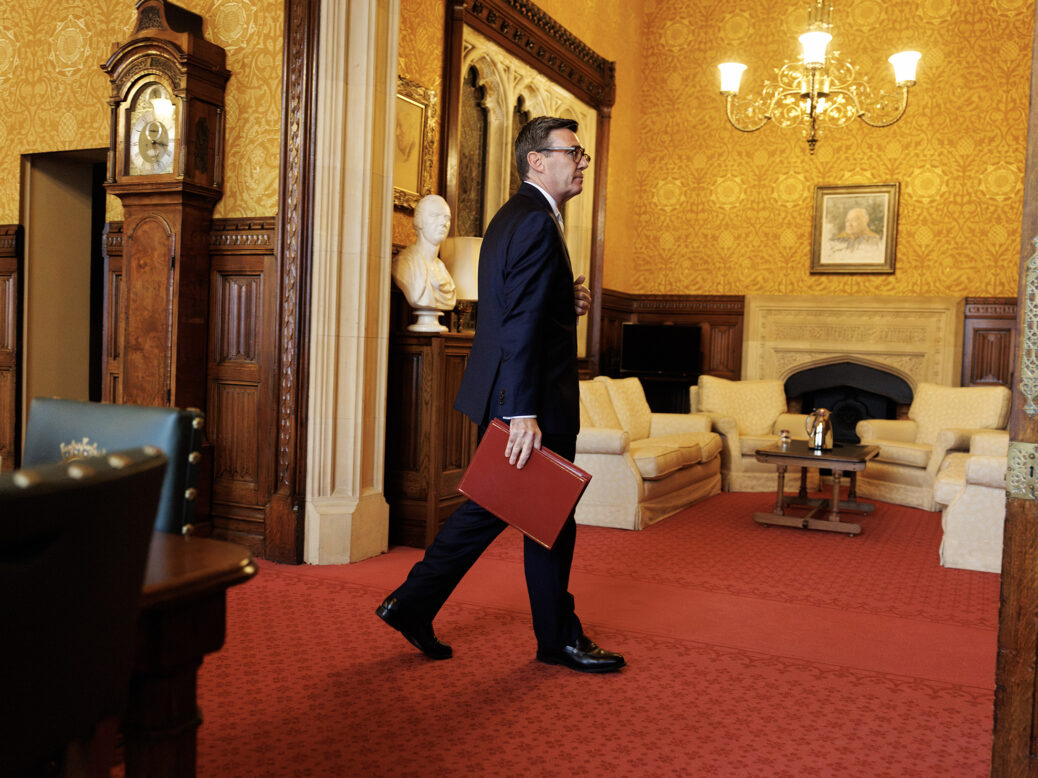
Andy Burnham and his chief of staff James Purnell share rare history at Westminster. Both were cabinet ministers in the days of New Labour, when the UK was a leading member of the EU and secretaries of state could pick up the phone to their opposite numbers on the Continent. With both men back at the top of politics, Britain now has, for the first time in a decade, a No 10 team that has fond memories of dealing with the EU as partners rather than opponents. Perhaps it shouldn’t be so surprising that this Prime Minister thinks Brexit has been a disaster and is comfortable saying so, as he eyes closer ties with the bloc.
When it comes to the government beyond Downing Street, the cabinet leans pro-European. But even so, a number of senior ministers are highly sceptical about Burnham’s decision to open up the issue. One cabinet minister describes it as “a minefield”. Like the country at large, most believe Brexit to have been a mistake yet they flinch at “reopening” the debate. So why is the PM doing it?
Maintaining the status quo over the Tory government’s Brexit settlement is about to be rendered indefensible. In response to Trump’s trade wars and rising competition from China, the EU is ploughing ahead with “Made in Europe”, a “buy European” initiative that threatens further trade barriers between Britain and the bloc.
After introductory pleasantries with European leaders in Kyiv over the summer, Burnham is beginning the major charm offensive he hopes will pay off in November’s European summit. He aims to avoid short-term economic disaster and open up long-term rapprochement.

The Labour Party remains pro-European and regrets the 2016 referendum result. But you might not be able to guess that from its first two post-Brexit years in government. Keir Starmer attempted an EU reset but included firm “red lines” in the 2024 manifesto that ruled out single market access, a customs union and freedom of movement. These self-imposed constraints, intended to neutralise the Brexit issue at the last election, have hobbled attempts to build a new relationship. “In 2024 the red lines seemed cautious. In the world of 2026 clinging on to them seems insane,” said one Labour MP.
The belief was that Labour could quietly repair the damage of Brexit without disavowing the whole project. But Burnham’s tendency to speak his mind and the reality of Britain’s present predicament have shattered this approach. Now it is time to talk about Brexit again.
Before the PM’s intervention, few Labour MPs wanted to talk about the downsides of Brexit. Most were not elected until after the UK left the EU and have comparatively little working knowledge of life in the bloc. And a vocal portion, in historically Leave-voting areas, believe it is not possible to survive as a Labour MP in such places with Brexit-critical views. They have been first to condemn the PM’s European tilt.
This is where Burnham’s political journey becomes important. In his last stint in parliament, he was an MP for a Leave-voting seat while a proud pro-European. In his time away from Westminster, MPs let go of the idea that this was even possible. As one Labour figure says: “A lot of people gave up on fighting for Europe because all the MPs who tried lost in 2019. But Andy wasn’t here for that.”
That 2019 trauma – when Labour under Jeremy Corbyn committed to a second Brexit referendum and won its fewest seats since 1935 – helped shape the conditions from which Starmer’s red lines emerged in 2024, and encouraged relative silence on Europe. That silence has been broken by a leader who was in Manchester when it happened, far from the wreckage. He is giving his party permission to move on and say that Brexit was a mistake and perhaps tempt some pro-European voters to Labour’s fold. A veteran Labour MP says: “The party hasn’t become more Brexit-y. The party has just become fatalistic. Andy is asking everyone to be a bit more optimistic while also being pragmatic.”
It’s part of the broader course correction Burnham has engineered. As he swept to power, he was explicit in identifying Starmerism as an overcompensation from the Corbyn period – leading to an overzealous suppression of internal dissent, an instinctively nauseous response to left-wing ideas and a contempt for some of the party’s core voters. Burnham’s bolder language on Europe is him giving Labour MPs the green light to indulge their instincts.
Burnham has also spotted that his opponents on the Europe question are actually quite weak. In response to each stage of Starmer’s relatively modest EU reset, there were paroxysms of hysteria from Brexiteers. Yet the public did not seem animated by it.
As ever with this PM, we understand the broader picture through his rhetoric: that under Labour, Britain will get closer to Europe. But what might that mean?
The most likely outcome is that the next Labour manifesto will seek consent to negotiate a new relationship with the EU. Intentionally ambiguous, it would throw out Starmer’s red lines but not make an explicit commitment to rejoining, despite that being Burnham’s long-term ambition.
At the next election, Labour could echo the language that got us into the Common Market. The 1970 Conservative manifesto said simply: “Our sole commitment is to negotiate; no more, no less.” Within three years the UK had joined. Could Burnham do something similar?
[Further reading: The Conservative Party is going duck hunting]
Content from our partners



Related

This article appears in the 14 Oct 2026 issue of the New Statesman, Fool Britannia
Join the debate
Subscribe here to comment