
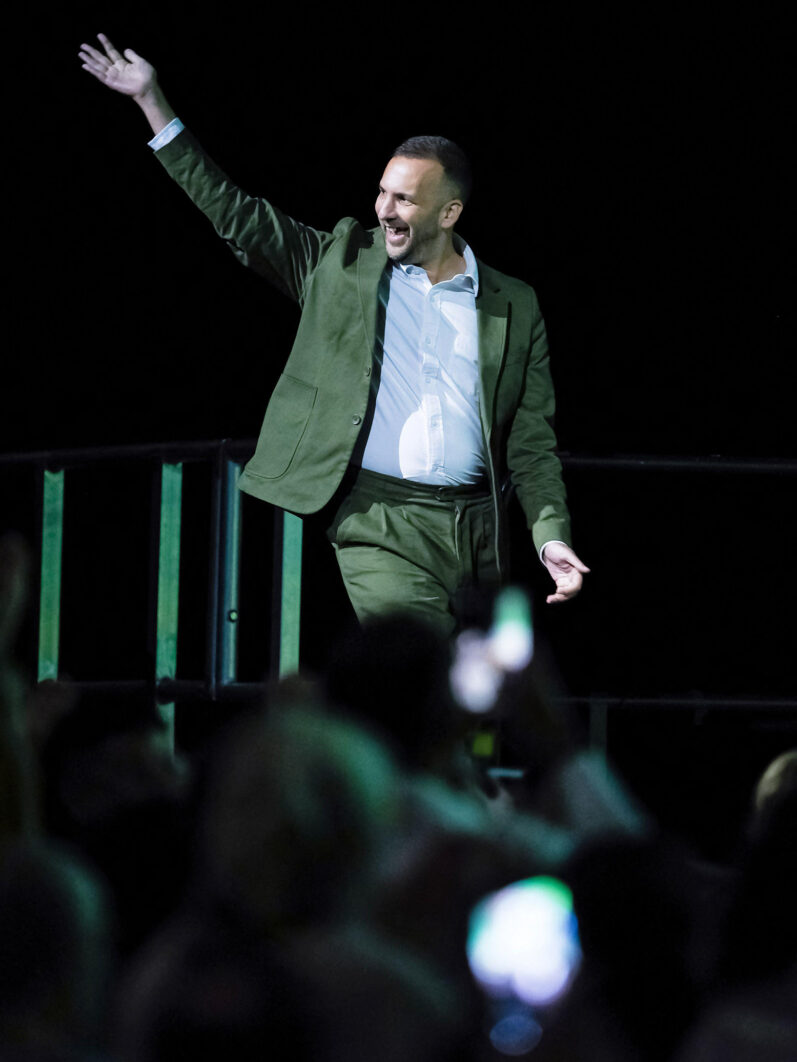
Zack Polanski is not the first leader of the Green Party in England and Wales to lose in Holborn and St Pancras. In 2015, during the so-called Green surge, Natalie Bennett came third in the safe Labour seat with 12.8 per cent of the vote – behind both the future prime minister Keir Starmer and the Conservative Party. Bennett’s defeat prompted questions about whether she should remain leader. But she held the position until the end of her final two-year term, in 2016. As one insider recently mused, “The Green Party doesn’t get rid of its leaders.”
Polanski came second in the Holborn and St Pancras by-election on 8 October. The Greens have been keen to paint this result as a success – the party upped its vote share by 22 points (though it was afforded a boost by the endorsement of the pro-Gaza independent, Andrew Feinstein, who came second to Starmer in the 2024 election).
Despite a turbulent few weeks, Polanski has not stopped since he heard the news of his defeat at 3.03am in Camden Council’s sleek headquarters. “He’s still 100 per cent up for everything,” a source close to him said. “He’s not shown any signs of needing a break.” Even so, the Greens’ national poll ratings are back to single figures. It is unsurprising that internal critics are beginning to urge the party and its leader to change their approach.
Polanski’s own position is protected in part by the Greens’ lack of killer instinct when it comes to removing their leaders. He has been criticised publicly by party grandees such as Caroline Lucas, the party’s former leader and for more than a decade its only MP (Lucas has not called for Polanski to resign but was critical of his decision to miss the “Zionism is racism” vote at conference). But his support among the membership – many of whom joined after he became party leader – remains strong. In order to trigger a leadership election, 10 per cent of those members (currently 23,000) would need to write to Green Party Council in order to recall Polanski. Either that, or the council itself would need to vote to have him removed by a two thirds majority. Both of these scenarios are unlikely. He will be up for re-election anyway in September 2027 because of the party’s term system.

The divergence of opinion among Greens, then, centres on the strategy that the party should adopt, rather than on personalities. There are a broad range of ideas being put forward by internal groups.
One grouping is made up of members who could broadly be described as the “old guard”. It comprises figures such as Lucas and Adrian Ramsay (another former Green leader), who have been around for a long time and believe it should return to prioritising climate and environmental issues, though it should remain vocal about the cost of living.
Lucas, alongside another long-time Green activist, Rupert Read, will publicise a report on Thursday (15 October) which forms a manifesto for some of these issues. The publication, Climate Popularism, has been released by the Climate Majority Project, a non-affiliated think tank. The pair hope its messages will be particularly helpful for the Greens. One of their proposals is a domestic retrofit programme, which the authors argue would oversee large-scale decarbonisation as well as lowering energy bills for communities and ushering in a wave of new jobs.
In the report, Read and Lucas are faintly critical of Polanski’s eco-populist platform. “Populists have injected emotion into British politics,” Read said, “but the main emotion they’ve tended to inject has been anger.” He and Lucas argue that a de-polarised, climate “popularist” message would be more effective. “There is just no way in which we get to have the kind of future we need with polarising politics,” he said, “and the Green Party’s way of doing politics over the last year has tended to be polarising.”
Greens Organise, the left-wing faction that supported the election of Polanski as leader last year, is also assessing after a turbulent few weeks. Until now, it has been associated with newer figures within the party such as Zoe Garbett, who was elected mayor of Hackney in May. But insiders suggest that several people within the group will take a more front-facing approach to politics in the coming months. In a statement following Polanski’s by-election loss, the group said: “The real test for a political organisation is how we deal with failure.” It added: “The Green Party can still become the eco-socialist party we need. Zack is still the leader who can get us there.”
Other allies have similarly renewed their support for Polanski’s eco-populist, “end rip-off Britain” economic platform. Russell Warfield – the author of a new book on Polanski, The Green Socialist, and who also worked on his 2025 leadership campaign – said the party needs to “keep articulating a decisive break from neoliberalism: price caps, rent controls, wealth taxes, major redistribution”. He argued that this could, in future, support the party in winning back “much of the support they’ve lost”.
Other senior figures in the party are making the case for more structural changes. Jamie Driscoll, the former Labour mayor of the North of Tyne, who joined the Green Party last year, believes that it a shadow cabinet to regain prominence. “We don’t have a wave of people out there speaking to a programme,” Driscoll said, “so if you put someone like me on Newsnight, I could defend it. People might come away and think, ‘I might not agree with it, but they obviously know their stuff.’”
Driscoll has his own report coming out, titled Hostage Nation, which he wrote and released before the party’s autumn conference. It argues that the country needs a change of mindset, to break out of the idea that “we can’t afford it” and work out how to source the public sector finance and capacity to deliver broader, and more radical, economic change. The former mayor hopes to use the report to urge his party to “up their game” – and his experience as a former metro mayor furnishes him with the institutional experience to back his ideas up.
Driscoll worked on the report with his long-time adviser, Hugo Fearnley, who has just taken up a new role as Polanski’s head of office. In creating a shadow cabinet, Driscoll argues, senior figures inside the Greens would be given even more legitimacy to go out and argue for the party’s programmes, on issues such as the economy, social affairs or defence. (Any change in structure, of course, would have to be signed off by party members.)
The Green Party is at a crossroads. After the hullabaloo of the by-election and the fallout from the passing of the “Zionism is racism” motion, senior figures are taking a moment to reflect. Work is beginning to get started on how the Green Party’s structures and processes – which were built for when it was much smaller – can be updated to accommodate exponential membership growth. Though what the Greens take from the past few weeks has yet to be decided, one thing is certainly clear to party insiders. They need to know what the party stands for – and fast.
[Further reading: The Green Party has urgent work to do]
Content from our partners



Related

Join the debate
Subscribe here to commentPolanski missed the vote, so guns out for Polanski. But was it cowardly to miss the vote on assisted dying?