
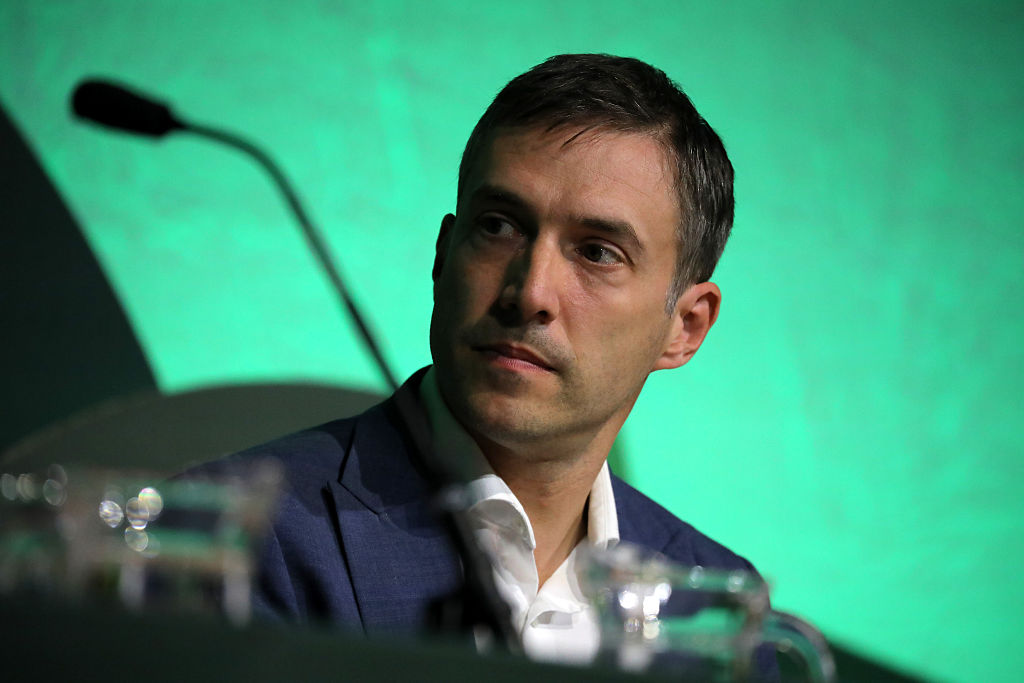
The former leader of the Green Party, Adrian Ramsay, has said he is “deeply upset” that the Greens have adopted a motion that views Zionism as racism. Speaking to the New Statesman shortly after it was voted through by a majority of members at the party’s autumn conference, Ramsay said: “It doesn’t reflect long-standing Green principles, and it doesn’t reflect my own view.”
Ramsay – who is the MP for Waveney Valley and ran against Zack Polanski for leader last year on a joint ticket with fellow Green MP Ellie Chowns – said the motion was “not needed”. He explained: “The Green Party is already one of the strongest forces in parliament calling out war crimes, calling for the UK government to be tougher in standing up for the people of Gaza.” He added: “We have to be really clear and united as a party in our approach to that.”
The motion – which was brought by the non-affiliated group, Greens for Palestine – passed with 1,022 votes for and 813 against. It also calls on the party to back the establishment of a single Palestinian state with democratic rights for all, to demand freedom for Palestinian prisoners, oppose the Palestine Action ban, and affirm Palestinians’ right to resistance.
On Friday (2 October), Ramsay urged members not to vote for the motion. Shortly after it was passed he put out a joint statement with his four fellow MPs, Polanski and the party’s two deputy leaders, Mothin Ali and Rachel Millward, pledging not to tolerate “any form of discrimination or harassment”. Ali was the only member of the leadership team to support the motion publicly.

Ramsay was firmer in his opposition when speaking to the New Statesman. He said he personally intends to continue to uphold the party’s 2024 general election manifesto, which committed the party to supporting a two-state solution, rather than advocate for the policies outlined in the motion. “That’s a long-held Green principle and it really matters because that’s the only way we will be able to get a durable peace in the Middle East,” he said.
The motion has caused deep upset among some members of the Jewish community within the Green Party. The New Statesman is aware of at least one Jewish member who plans to resign their membership now the motion has passed. Ramsay expressed his concern that Jewish Green Party members and the wider Jewish community may be “deeply upset”.
“I’m deeply upset and I’m not Jewish,” he said. “I want them to see that there are so many leading Greens, many elected Greens who are standing by the Greens’ long-held positions and who are resolute in standing shoulder to shoulder with the Jewish and Muslim communities in the UK, who face far too many threats to their communities.”
This motion has sparked a recognition among the party leadership that member-led democracy in the Green Party in its current form is not working. Ramsay agreed. “If you look at the votes that happened today, even the vote with the highest interest in conference today, there were fewer than 1 per cent of party members voting on those motions,” he said.
The Green Party runs on a one-member-one-vote system – anyone can join, then apply for and pay to go to conference, and therefore vote on policy motions. Some in the Greens, including Ramsay, think the party should introduce a delegate system, in which local parties send a certain number of members to conference. “That wasn’t 1 per cent that was representing members across the country, that was a self-selecting 1 per cent,” he said. “We don’t know what the other 228,000 members think on the issues that were discussed today.”
Outside of this debate, Ramsay spent his conference focusing on his own motion, which calls for a new law to require ministers to treat nature decline as seriously as other national security risks. The motion also passed in a vote during the conference. In parliament, Ramsay has been pushing the government to release the full, unredacted text of a report completed by the Joint Intelligence Committee which was due to be released last October but has been delayed. The report is understood to contain a “very stark” warning about the impact of climate change on national security.
Ramsay said the government is “complacent” on this issue, and argued that action gives the Greens a subject on which it can outflank Labour. Climate and nature were absent from Andy Burnham’s speech to the Labour Party Conference last Tuesday (29 September). Ramsay criticised the Prime Minister for this: “After the summer where we’ve had wildfires across the country, we’ve had drought which has caused havoc for our famers… we’ve got to be prepared. The government is just not even on the pitch on those issues.”
On dealing with the so-called Burnham bounce more widely, Ramsay said the Green Party should put environmental policies further up the agenda. “We’ll only be able to achieve what we want to on environmental policy if it’s got widespread public buy-in,” he said, arguing that the party should have a “much stronger focus on core environmental issues”. Ramsay added: “That’s not the only thing we’re focused on but getting it further up the agenda is going to be a big part of our response [to Burnham].”
He also argued that the Greens need to widen their appeal. New research by More in Common shows that, despite drops in Polanski’s personal approval ratings, he is still popular with his base – which tends to be younger, left-wing voters in urban areas. Ramsay thought the party needed to branch out from that core.
“What I would argue and what I’ve always argued,” Ramsay said, “is that the Greens need to have a broad base of support.” At a conference fringe event held by the think tank Compass on Saturday morning (3 October), Ramsay made a similar point, telling attendees that, ahead of the next election, the party needs to decide whether it will focus on “urban areas that would have otherwise been Labour or have a mix of seats where we’re also actually playing a direct role by fighting and winning in seats that would otherwise be Reform”.
For now, Ramsay and his colleagues are headed back to their constituencies or to Holborn and St Pancras to campaign for Polanski. The result of that by-election and the fallout from this consequential weekend in Brighton will determine whether the party needs to reconsider its political strategy going forward. Ramsay is quietly developing ideas for what it could do.
[Further reading: The Green Party’s Zionism reckoning]
Content from our partners



Related
Join the debate
Subscribe here to comment