
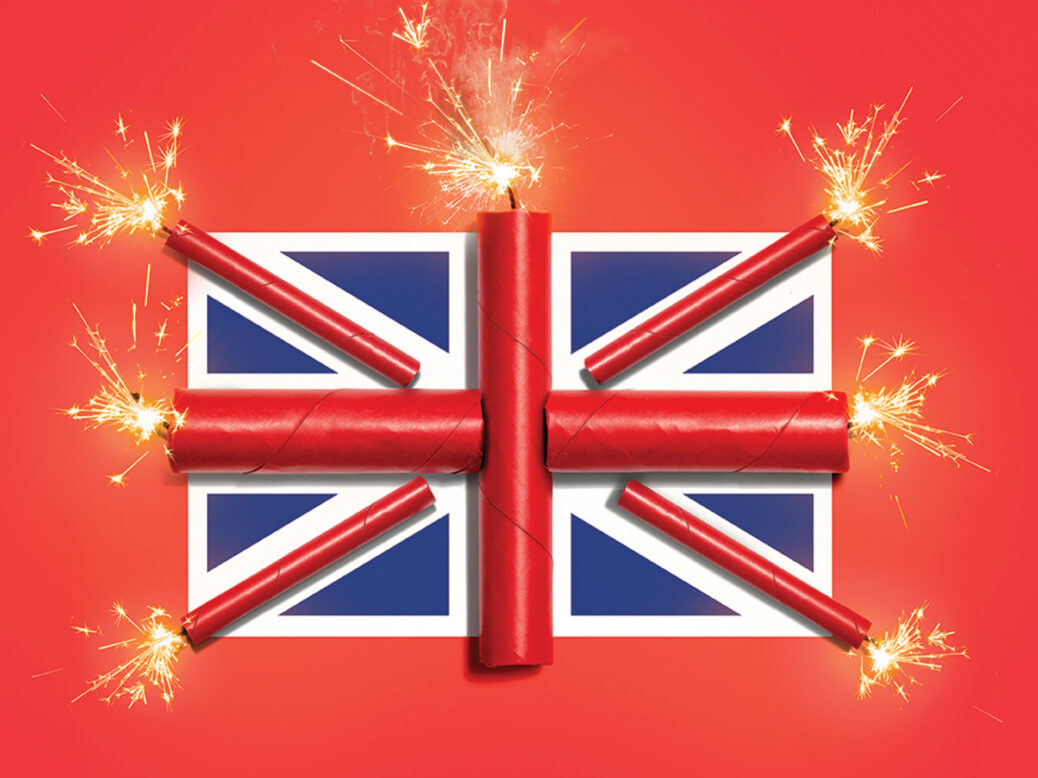
In March 1931 John Maynard Keynes wrote an article in this magazine, then the New Statesman and Nation, entitled “Proposals for a Revenue Tariff” (see the Archive on page 62). The dry headline underplayed the drama of its content.
Keynes enjoyed the sort of fame today’s public intellectuals can only dream of. And for most of his life the celebrity economist had been firmly associated with what we would today call the liberal order. The United Kingdom, then as now, saw itself as the world’s great free-trading nation. Other countries might erect trade barriers in the face of economic crises, but not this one – or so the British liberal establishment liked to tell itself.
But then Keynes changed his mind. The country was in the middle of a fiscal and financial crisis. Trapped in the Gold Standard (which locked the value of sterling at an excruciatingly high level), manufacturers were struggling to compete. As businesses’ profits flagged, tax receipts sagged and the Treasury’s deficit ballooned. Across Europe, the financial sector was careering towards a succession of banking collapses and what eventually became known as the Great Depression. In the face of these mounting problems, said Keynes, there was one clear imperative. “Free-traders may, consistently with their faith, regard a revenue tariff as our iron ration, which can be used once only in emergency,” he wrote. “The emergency has arrived.”
The article, which advocated the imposition of tariffs on a wide range of imports, caused a sensation. Lord Rothermere commissioned Keynes to write a simplified version of the piece for the Daily Mail. Free-traders lined up in these pages to accuse Keynes of having lost his mind. The response in private was no less excoriating, especially among his inner circle, some of whom were also members of his intellectual coterie, the Bloomsbury Group. “Maynard has become a protectionist,” wrote Virginia Woolf. “Which horrified me so that I promptly fainted.”

Except that Woolf was rather missing the point. It wasn’t so much that Keynes was a protectionist; more that he was searching for something – anything – that could help snap Britain out of the economic rut it had found itself in. And, as it happens, the eventual answer was not tariffs but something else. Later that year, in an emergency Budget intended to bring the public finances back into order, the government ordered a wage cut across the public sector. Hearing the news, sailors in the British Atlantic Fleet based at Invergordon mutinied. Questions arose about whether Britain had become ungovernable. Investors ran for the doors. Panicking, the government took the country out of the Gold Standard.
At the time, it looked like a catastrophe. But in hindsight, this was a moment of liberation. Freed from the monetary yoke that had kept sterling so high, manufacturers could finally begin to compete internationally. Britain’s economy had escaped the straitjacket it had constructed for itself. And since the unthinkable – that Britain would abandon the old economic orthodoxy – had already happened, there was no great need for those tariffs Keynes had dangled in this magazine earlier that year. (Not that that stopped politicians imposing some of them in the months that followed.)
Paradigm shifts like this punctuate economic history. Sometimes they are preceded by wars, sometimes by economic and financial crises. Conventional wisdoms and long-held rules are thrown aside. Think of the introduction of the Bretton Woods system in the 1940s, or the collapse of the same system in the 1970s (ending the era of widespread fixed exchange rates), or Britain’s ejection from the Exchange Rate Mechanism in 1992 – an event known as Black Wednesday. In a sense, the striking thing about recent history is that we seem to have gone for a good few decades without a particularly jarring shift. Even Brexit failed to cause a dramatic rethink in the way we run the economy. Indeed, were you to ask most politicians what the UK even has to shift away from, what its economic model actually is, they would probably look at you with blank faces. But, as we’ll get to shortly, Britain does have an economic model – one that is under existential threat, much like the Gold Standard once was.
For a clue as to why, consider the recent roller coaster in government bond markets. On 1 October the yield on 30-year gilts exceeded 6 per cent for the first time since 1998. Fundamental shifts are happening in the global financial system. The UK is not alone in feeling the market’s effects. Yields in the US, Japan and most European countries (France being the extreme example) have lurched higher in recent months.
Such things are not trivial. Bond yields are among the most significant of all forces in financial markets, trickling as they do into nearly every corner of everyday life. Sometimes the impact is quiet but profound, such as when low interest rates – the product, in the words of the former chair of America’s Federal Reserve Ben Bernanke, of an Asian “savings glut” – helped precipitate the Western mortgage boom of the early 2000s, eventually leading to the global financial crisis of 2007-08. Sometimes it is loud and immediate, as Liz Truss can testify.
The fundamental shifts occurring in the financial sector carry profound implications. I have lost count of the number of messages I have received from typically calm traders and economists in which they express an unusual level of disquiet about the bond markets. “It’s getting nasty out there,” one investor messaged the other day. A couple of days later a senior banker pulled me aside to whisper something scary about the yen carry trade – an arcane but popular scheme in which traders borrow at low rates in Japan to invest in assets elsewhere. The result could be the mass dumping of assets around the world as traders attempt to get their books in order. In short, when bond yields yo-yo, lots of unexpected parts of the financial system malfunction.
For all that bond yields are among the most important numbers in the economic universe, the reasons for their movements remain something of a mystery – though nearly everyone in finance has their own pet theory. With that proviso established, here are some of the more plausible explanations. Start with the question marks over whether governments around the world – including but not limited to the US, Japan, the UK and most of Europe – are capable any longer of servicing their debts. Then there’s the worry that maybe central banks will conspire with their political masters to monetise the debt, allowing inflation to run riot and erode what governments owe, to the cost of everyone else.
There is an AI theory, or rather two AI theories: the first claims that higher bond yields reflect expectations for stronger economic growth, which will be fuelled by the AI boom. The second theory posits that breakneck spending on data centres by the hyperscalers (tech giants such as Microsoft, Alphabet and Meta) is soaking up much of the world’s available savings. This means less cash chasing, more investments – which is also a recipe for higher rates.
There are other, slightly more technical explanations. Once upon a time the marginal buyer of government bonds was a pension fund or bank with a long-term stake in the country it was investing in. Today, that marginal buyer is more likely to be a flighty hedge fund that might not have any plans to hold bonds longer than a few days, or even a few hours.
And then there is the impact of inflation. It is hard to cast your eyes around the world right now without seeing the potential for higher prices everywhere you look. The closure of the Strait of Hormuz has significantly raised the cost of moving oil from one part of the world to another. The price to hire a very large crude carrier – vessels that once plied the Strait, which itself carries roughly 20 per cent of the world’s oil supply – has risen to eye-watering levels following a spate of attacks on them in the Gulf.
Diesel prices are at record highs, partly because of what’s happening in Hormuz, and partly because Russia, which was the biggest exporter of diesel to Europe until 2022, has seen so many of its refineries attacked by Ukraine. In the latest bizarre twist to this story, diesel prices could even end up swaying the course of the Ukraine war, as it seems that Donald Trump, who fears that high pump prices could cost the Republicans the Senate in the midterm elections, is back in bed with Vladimir Putin following the US president’s decision to allow Russia to export diesel to America. Or at least for the next few weeks anyway.
My own pet theory is that higher yields also reflect the dawning realisation that the ecosystem of global trade is beginning to rupture. A world that depended, to a large extent, on freedom of navigation of commercial vessels, free passage through maritime chokepoints and just-in-time supply chains, is being replaced by something more hostile, more unpredictable. Barriers to trade are erupting everywhere, be they tariffs, sanctions, exclusive trade blocs or, indeed, wars. And, just as the old world of frictionless trade was distinctly disinflationary, this new era of walls and barriers is inflationary – the sort of long, drawn out inflation that lasts for years, if not decades.
Perhaps the best synthesis of all of the above is to say that, whichever theory you favour, many of the foundations we have come to depend on for the global economy in recent decades are under question. And few countries are as exposed as the UK.
That goes for the politics. Having left the European Union, Britain must now forge its own destiny, deciding its own trade and economic policy in a world that is looking increasingly hostile.
But it also goes for the bond markets themselves. In the years since 2022 – a year in which investors had their faith in British economic policymaking challenged – gilt yields have become an outlier, higher than in any other G7 nation. Tempting as it is to blame everything on Liz Truss, this actually runs far deeper. The rot might have begun with the mini-Budget, but yields climbed higher still when it became clear that Keir Starmer’s government, with its landslide majority, was incapable of implementing the welfare spending cuts it had promised. Some fear, too, that the Bank of England lacks the credibility necessary to keep inflation close to its 2 per cent target. They wonder, as their predecessors did in 1931, whether Britain has become ungovernable all over again.
The other big question mark is the one hanging over the UK’s economic model. We don’t spend all that much time in this country pondering the nature of our economy; it’s just not very, well, British. That Whitehall struggles to put a name to it might lead you to assume that the UK’s economic strategy is more of an anti-strategy, a sort of muddling along, with the odd intervention here and there.
Except that this isn’t quite right, because even a policy of benign neglect is still a policy. In truth, Britain does have an economic strategy, even if it is never put into writing. Perhaps the best way to describe it is as the MoneySavingExpert model.
The country’s guiding principle, from the Thatcher years to the Blair ones and all the way through to Starmer, has mostly been to try to optimise economic policy to make stuff as cheap as possible. Some other countries – most notably China and Germany – have prioritised manufacturers and exporters. In Britain, the government’s focus has long been the consumer – its goal has been to try to reduce costs for households. So utilities were privatised and bills regulated; an entire market was built around encouraging consumers to switch. While other countries deployed industrial strategy to protect national champions and favour particular sectors, Britain’s approach has been monomaniacally focused on consumer prices.
In the MoneySavingExpert economy, where something is made doesn’t really matter too much. What is considered most important is how much the product costs and whether it could be bought cheaper from elsewhere. And in a world where shipping costs were falling, freedom of navigation was a given and you could always presume that something you ordered from the other side of the world would turn up at a click of a button, such a strategy looked rather astute.
Cheap goods meant that for years many households enjoyed unprecedented boosts to their standard of living. That the goods in question invariably came from overseas, accelerating the decline of Britain’s manufacturing sector, was by the by. Cheap deals ruled the roost.
There is much to be said for encouraging consumers to switch utility providers if they can save a few pounds. All power to such a crusade. But it’s questionable whether this is really the most sophisticated principle for how to run a country. More to the point, there is a fundamental problem at the heart of this economic model, which is that, for all those cheap imports, life in Britain is hardly cheap. Consider the cost of housing or childcare or, the most glaring example of all, energy.
While many countries face higher energy costs due to the events in the Middle East and Russia, few have seen quite as big a spike as Britain has. Industrial power costs are comfortably higher than in most developed nations, with domestic costs not far behind. To some extent, this is a function of bad luck and geopolitics. Britain is particularly dependent on natural gas to provide the critical baseload power for its electricity, not to mention much of its domestic heating.
But higher energy costs are also the product of policy. Britain pushed faster and further towards net zero (the goal of diminishing carbon emissions to close to nothing in net terms) than most of its peers. The ambition, held by Labour and Conservative governments, was that the UK should be the global leader in decarbonisation – the flag-bearer for net zero. In one respect, the enterprise was a stunning success – Britain is one of the fastest-decarbonising major economies in the world.
The main catch in – and the cardinal sin of – the make-things-cheap economy is how it affects energy bills. For all that Boris Johnson and Ed Miliband insisted (and as far as I can tell, sincerely believed) that renewables would mean lower costs, the opposite has happened. Unlike solar power, the cost of which fell precipitously as the Chinese mastered the mass production of arrays, wind power has remained comparatively expensive. And so Britain’s ambitious offshore wind programme happened largely thanks to a complex web of subsidies and price guarantees. Those interventions will lock in higher power costs in this country for years.
There is a point – most likely a decade and a half in the future – at which the savings from net zero (less spent on gas and fuels) should outweigh the costs of building all the necessary infrastructure. But for the time being, the policy is expensive – nearly £30bn a year for the next five years, which is the equivalent of an extra 5p on the basic rate of income tax. One of the main reasons net zero is becoming so controversial (and will likely get more controversial) is that the majority of those costs end up on consumer bills.
The other problem is that much of this decarbonisation was achieved through deindustrialisation. In the face of higher energy costs and rising environmental taxes, many manufacturers relocated overseas. Indeed, more than half of Britain’s carbon footprint is now accounted for by imported goods. Paradoxically, the more steel mills and chemicals plants shut down, the better the UK’s environmental credentials, since net zero plans ignore the embedded carbon in our imports and focus solely on what is puffed out of domestic flues and chimneys.
Energy costs are only one dimension in the story of Britain’s deindustrialisation. Another critical element is that it has become increasingly difficult to compete with low-cost imports, mostly from China. Where once these imports were primarily relatively simple products, from clothes to toys, today China has a commanding lead in the production of many of the critical goods needed for the energy transition, from batteries and electric motors to transformers and solar panels.
This is hardly a UK-specific story. In much the same way as the West had to contend with a “China shock” – economic disturbance caused by surges of the country’s manufacturing exports into global markets – in the early decades of this century, it is now bracing for a “China shock 2.0”, as its most prized manufacturing sectors, most notably the motor industry, have come under assault. One common misconception is that this is mostly a story about electric cars, in which China has a nearly unassailable lead. In practice, however, the threat is far more existential, since China is also increasingly proficient at both making conventional and hybrid cars and making the components and parts that go inside them. Few European or American cars could be made without parts from Asia. But not vice versa
This is, in other words, a do-or-die moment for the Western car industry, all of which explains why nearly every G7 nation has imposed special tariffs on Chinese electric vehicles. There is a logic to this sort of protectionism, since you could make the case that with all its subsidies and preferential arrangements, China is hardly competing on a level playing field. All the same, if it smacks of desperation, that betrays the panic throughout Europe – that the centrepiece of its advanced manufacturing sector is about to be obliterated.
In spite of this, the UK has, thus far, opted not to impose special tariffs on Chinese cars. This is entirely consistent with the MoneySavingExpert model, which prioritises cheap products over industrial strategy. And you can see the consequences today. Nearly a quarter of new cars sold last month were Chinese brands, with the biggest-selling car in the country the Jaecoo 7, a cheap and cheerful Chinese SUV some have nicknamed the “Temu Range Rover”. Even those figures understate it, because some seemingly Western models (including some Teslas and Volvos) are, in fact, made in China.
Whether these cars carry on flowing freely into this country is an open question. The European Union has just hatched a deal with China to limit the number of Chinese hybrids coming into its countries, and is now putting Britain under pressure to put its own barriers up. European officials ask whether Britain really wants to become the continent’s main entryway for cheap Chinese cars and automotive parts. To which the answer is: no one really knows. Then again, cars are hardly the only example. Europe and America have both closed a loophole allowing Chinese fast-fashion brands like Shein and Temu to send cheap clothes and trinkets into their countries duty-free. While Britain says it plans to abolish this obscure tax rule, known as de minimis, it seems to be in no rush. So the flood of cheap goods into Britain has accelerated. It all raises the question: does the new government want to carry on with the country’s economic model or will it do something different?
Andy Burnham tells us he intends to reindustrialise the UK. Then, sometimes in the same paragraph, he describes his regime as a cost-of-living government. Well, which is it to be? The net result of making more stuff domestically rather than buying it in cheaply from overseas will be to push up prices. He will have to choose one route or the other. It is hardly the only such dilemma. Does Britain lean towards Europe or America? Do we align economically with China, and favour cheap stuff over national security?
All of which is to say, Burnham and his fellow politicians face some stark choices in the coming years. Economics is only the start of it. The entire services sector is also facing a breakneck disruption in the form of AI. Even if you don’t subscribe to the notion that the machines are about to make humanity extinct, at the very least this modern-day Industrial Revolution will have far-reaching consequences for work and the distribution of profits. And Britain’s part in this revolution hinges in large part on whether it can find a way to bring energy costs down, given the power-hungry nature of AI computing.
And yet there is a jarring contrast between the scale of these challenges and the smallness of our political debate. Much of the newspaper coverage in the build-up to this government’s first Budget has fixated on the question of how much headroom John Healey will have against one of his fiscal rules, an oddly parochial topic given the precarity of the financial system.
A far better question is whether Britain’s economic model is fit for purpose in the world of the late 2020s. The MoneySavingExpert strategy of choosing the product from wherever it could be sourced most cheaply might have made sense in a world of just-in-time supply chains, where inventories were derided and those who kept stockpiles of food and fuel dismissed as crazies. But how about in a world where geography is reasserting itself, where maritime chokepoints are being shuttered and where bond yields are signalling danger? Might it be that, all of a sudden, stockpiles of everything from diesel to food – “iron rations” as Keynes might have called them – are relevant all over again? Perhaps it is time to reconsider an economic model that precipitated the hollowing out of the country’s industrial heartlands, all in the pursuit of cheaper stuff.
That this moment feels like a crossroads for Britain – more perhaps than for most other countries – is because it isn’t just about tremors in financial markets. It’s a challenge to the very way government has run the economy for decades. In 1931, Keynes attempted in this magazine to shock Britain out of its economic orthodoxy. In the event, it took a naval mutiny to force its leaders into a change of course. They realised, eventually, that economic models are not inevitable, they are not laws of nature. They are ours to change.
[Further reading: The suspicious relationship]
Content from our partners


Related



This article appears in the 14 Oct 2026 issue of the New Statesman, Fool Britannia
Join the debate
Subscribe here to commentIn some ways, the most significant phrases in this article are “he was searching for something – anything…”, “my pet theory”, and “no-one really knows”. No one knows, because economics is not a science, whatever it claims. This is encapsulated in the old joke that economic forecasting was devised to make astrology look respectable.
Economics tries to be rational, but it cannot be, because all forecasting comes with the proviso “other things being equal”, and they never are. An economic forecast can be made in good faith, but any unexpected event – a war, a bad season for crops, an earthquake, a flood, etc, can throw all the predictions out of the window. We can influence the direction of travel to some extent, but no more than that. As the physicist Niels Bohr reputedly said “prediction is very difficult, especially about the future”. On top of that, as a psychologist demonstrated, human decision-making is largely driven by emotions, not rationality, and this includes financial decision-making. Overturning the Bernoulli rationalist model of economic decision-making (which had held sway, despite its inherent implausibility, for 250 years) won him the Nobel Prize for Economics.
The Thatcherite model of deregulation, and privatisation of public services, was supposed to spread wealth about the population. It didn’t. Because companies chased profits (surprise!) instead of doing the task they were contracted to undertake, we have collapsing public services, a water shortage (exacerbated by, but not caused by, climate change), and huge economic inequality. All of these can be changed. The other outcome was that wealth gravitated away from poorer people to those who already had plenty. The rich have become incomparably richer, but the rest have not. The Tory and Reform “solutions” appear to be more of the same, and worse. We desperately need to reverse Thatcherism, and in this Burnham is correct. But this will mean reversing the tendency of deregulation to create great inequality. That may require the rich to pay more tax (please, spare me the whingeing rhetoric about how the millionaires will all leave – good riddance, if they won’t pay their share). Some, like the Patriotic Millionaires, have signalled their willingness to do so. But tax isn’t the only way – raising the minimum wage, for example, would do a lot to help the poorest. It would also cut the welfare bill, much of which goes to the underpaid employed. Rearranging the tax system, as advocated by Will Dunn in this journal, by abolishing National Insurance and raising income tax to make up for it, would naturally make the better off pay more, but need not tax the poor. It would also, incidentally, mean some more tax being paid by those who currently don’t pay National Insurance (including better off pensioners like me). Bring it on – we have children and grandchildren who need a future more than we need another holiday.
However it is done, it must be done. Otherwise, a naval mutiny may be the least of our problems.
No “stark choices”
The sad dilemma is that Burnham (like Macron, Merz, Zelensky and most of the West’s leaders) have no mandate except from their corporate, other governments and NGO donors. Delaying elections may be sufficient for control, but tragic for social or economic progress. Who is going to sacrifice in the short term, or longer, for well healed bureaucrats, most of whom accumulated their wealth from government?
I truly sympathized this past year with the Council member in Denver who, upon having to vote on cutting expenses (and programs), claimed, “I never chose this.”
Making ‘everything’ cheap, except education, healthcare, housing and energy, plus getting rid of well paid jobs and thus forcing people into debt and a benefit culture just about sums up the neoliberal UK. Most people are so busy trying to make ends meet they have no time for politics and working out who did what when or how this new political party can make things better if only given a chance. In the end a majority rushes to simple solutions like leaving the EU. Now we talk of going back into the EU. People will vote against their own interests if they are promised by clever politicians that it will be good for them. I have seen it time and time again and it could be repeated in Germany and France but perhaps not in the UK. The far right in power in most of the EU by the end of 2027 is not an outlandish prospect but then again those energy costs will come down. Russia does not need an army to achieve its goals. Remind me how you run an AI economy if you have not got lots of cheap energy and access to 17 rare earth metals? The ‘digging stuff out of the ground economy’ has a long way to go whatever we might think.