
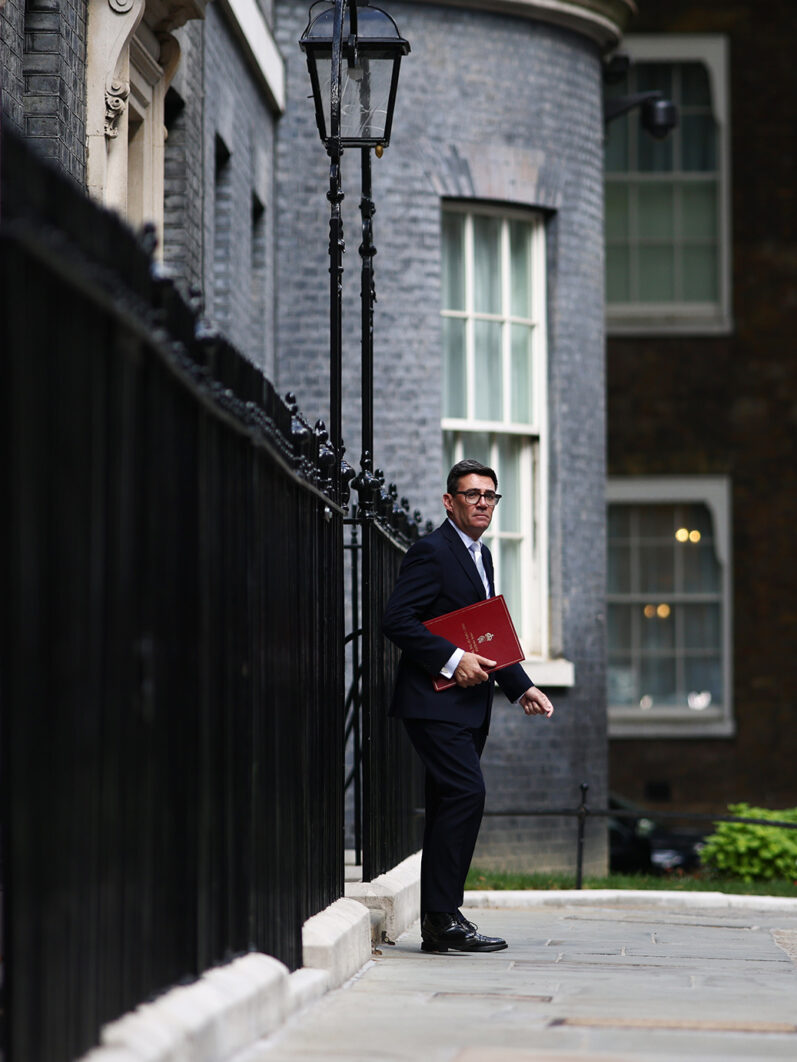
Every few weeks, I am surveyed for my opinions – not as a journalist, but as a human – by a polling firm. Five years ago, our household was chosen by whatever magical selection process these companies concoct to be part of a polling panel, answering questions about everything from pension literacy to the state of our neighbourhood to how we feel on an emotional scale about heat pumps.
I sometimes wonder how to answer. Should I tick “yes” that I’ve heard of political buzz terms such as “levelling up” or “net zero”? Would someone of my demographic have come across them if it hadn’t been for having a job like mine? And am I being misleading about my media habits if I tick that I read every newspaper, multiple times a month, even if it’s only for work?
For someone who reports on politics and society – and often on the public opinion shaping them – it is a fascinating process. During the pandemic, in particular, I remember discovering a great deal about my own biases. I thought, for example, given the authoritarian bent of the public at that time, that I would be an anomaly in my opposition to “vaccine passports”. It turned out, though, that my views were largely in line with those of my age group. And more than half of my fellow respondents were afraid, like me, that such a plan could lead to a more “unequal society” – something I’d assumed, when filling in the survey, would be less of a problem for most than the threat of catching Covid.
No 10 began receiving almost daily polling data on public attitudes at that time. One high-profile “cronyism” scandal back then was over a six-figure deal awarded without tender or formal contract to Public First to test government messaging and public opinion during the lockdown. Ordinary members of the public were invited to dial in to ask questions during live televised press conferences.

Much is written of the focus-group obsession of New Labour, but it was during the pandemic that public opinion truly became the golden thread of policymaking. In a way, it had to be – the government needed a compliant populus to make its laws work. But it also had the effect of embedding snap opinion polling and sentiment analysis in every whisper of political activity. An irony, given the partygate scandal that soon followed could have been laboratory-designed to fracture public trust.
It still feels as if every announcement and proposal is viewed through the lens of popular opinion. If think tanks or pressure groups want to promote their causes these days, their arguments often foreground bespoke polling results. Did you know, for example, that Brits want precisely “61 per cent” of the country’s land protected for nature? Or that 58 per cent of the UK population supports changing the law to make it easier to research magic mushrooms? Policy works in the same way. The government has lifted the Brexit taboo, yes, because Andy Burnham and most of the Labour Party believe in a closer relationship with the EU – but a marked shift in public attitudes towards the Europe question gave it cover to move. And Kemi Badenoch’s Tories promote their plan to cut inheritance tax with the argument that it’s “Britain’s most-hated tax”.
Too often, bizarre proposals have clearly been workshopped to appeal to some imagined voter archetype. Memorably, Nigel Farage’s promise to bring back coalmining ahead of the Senedd election – as if the Welsh were itching to pollute their lungs and die young, as their grandfathers did – fell flat and led to an eventual U-turn.
This is what I have described in the past as the “Goggleboxing” of British politics, in which everything is seen through the eyes of an artificially curated audience, whose verdict is the great prize. The Channel 4 show (in which we watch people on telly watching telly) has become such an influential national focus group that GB News has bothered to call it “woke” and “political propaganda”. On 23 October, Burnham became the first Prime Minister to appear on it, watching Countdown with his pal and Liverpool mayor Steve Rotheram.
But trying to read the minds of Everyman and Everywoman can override a politician’s moral instincts. Labour’s often squeamish response to anti-migrant street thuggery is an example. In a climate of heightened immigration-scepticism, it can feel as if the party has misread widespread unease at border chaos as widespread racism. Under Keir Starmer, the cabinet’s original line after last year’s Unite the Kingdom marches – which featured calls for violence, injured police officers and the racist chant “let’s make England Abdul-free” – was meekly to defend free protest rather than condemn bigotry.
Let’s look back to a pre-focus group age. After Enoch Powell’s “Rivers of blood” speech in 1968, Harold Wilson told a rally in Birmingham: “I am not prepared to stand aside and see this country engulfed by racial conflict… This country must be clear where it stands.” He said he was not “prepared to be a neutral”. This ran counter to public support for Powell at the time, which was at 74 per cent.
The hypothetical “man on the Clapham omnibus” has been a feature of British public life since the Victorian age, at least in the English law courts. And politicians have long fretted about their popular appeal. But lately I’d say that Gogglebox-ification has gone too far – and as a polling participant, my opinion counts.
[Further reading: Inside Labour’s union row over immigration reforms]
Content from our partners



Related
This article appears in the 28 Oct 2026 issue of the New Statesman, Bin the Budget
Join the debate
Subscribe here to comment