
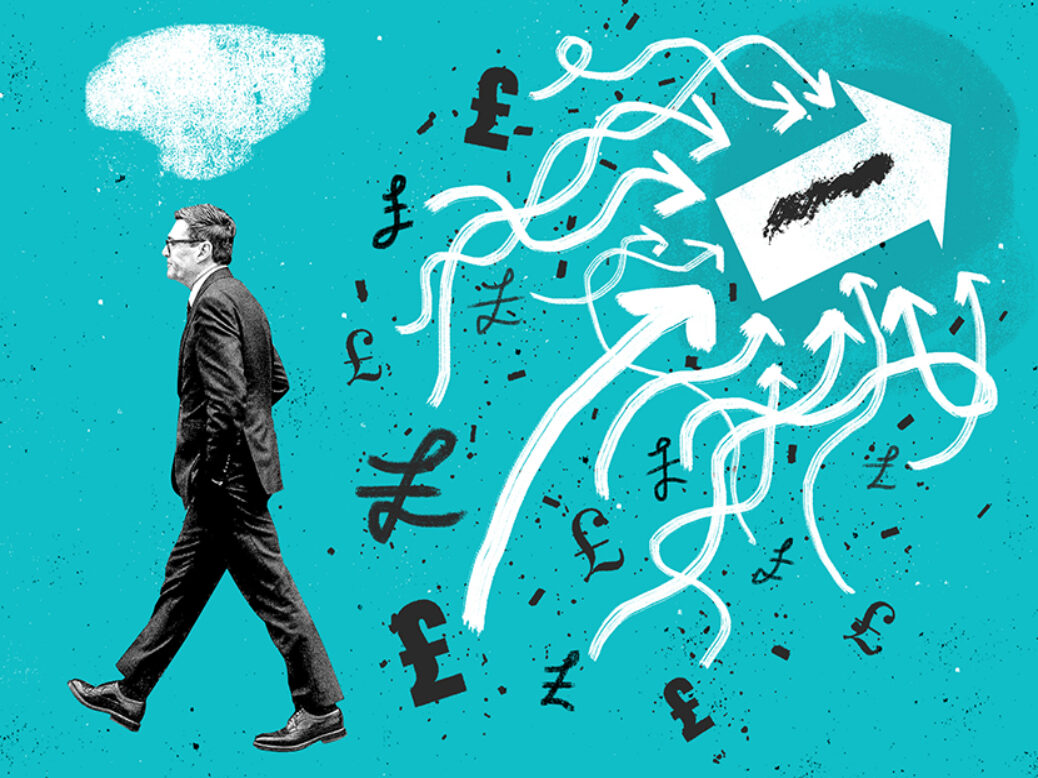
Andy Burnham’s Labour has generally been a calmer place since he took over. But over the weekend, a wave of panic rippled through his parliamentary party. In the Labour MPs’ WhatsApp chat, one backbencher shared the news that the crypto billionaire Ben Delo had donated £36 million to Reform UK. “Terrifying,” one Labour MP responded. “This money just fundamentally alters our chances of stopping Reform,” said another. “It’s just impossible to compete,” agreed a third. Then the second £36m donation came in.
As Labour MPs got their heads around these staggering sums of money – record-breaking, and of an order of magnitude not seen before in British politics – their discussion quickly turned to the need to introduce a donations cap. “Aren’t we already capping individual donations?” one Starmerite former cabinet minister asked innocently. No, we aren’t, a colleague explained: only on overseas donations.
This was exactly the conversation Burnham has been trying to avoid all summer. While his government is appalled by these Reform donations, and expects that they may need to be returned, the wider conversation about capping domestic donations is a much more uncomfortable one than he or his cabinet colleagues would ever admit publicly. Even in the face of staggering sums from billionaires, Labour high command is still anxious about taking action on political donations that ends up limiting the ability of trade unions to contribute to the party.
Stella Creasy, the Labour MP for Walthamstow, discovered this recently, when she made it clear she would seek to amend a bill going through parliament – the Representation of the People Bill – with a cap of £100,000 on domestic political donations. “Capping donations at £100,000 from any single individual in a calendar year would put a stop to the idea any millionaire’s voice matters more than someone else’s,” Creasy said, “and protect those who want to support causes they care about on all sides.” For Creasy and like-minded MPs, it’s not about whether money is from overseas or within the UK – big money in

Yet she was warned privately not to go there. “You’re on a suicide mission,” she was told, because every national conversation about political funding has always ended up focusing on the role of trade unions, placing a large chunk of the Labour party’s funding at risk, not to mention deeper questions around the party’s identity.
“It’s really important to be careful of unintended consequences,” one Labour insider said. “Unions aren’t “funders” of the Labour Party, they are part of the Labour Party. We can’t risk a tit-for-tat that removes union funding from politics altogether.” Another trade unionist described Creasy as a “rogue agent”.
Creasy was undeterred, and threatened to push her amendment to a vote when parliament returned in September. She decided not to force a vote in the end, but only after a debate in the House of Commons on the issue, meaning the House of Lords could carry on the baton.
The government said publicly that it wanted the Bill to focus on votes for 16 year-olds and cracking down on foreign interference in elections. Adding other, more controversial, elements to the bill risked slowing down its passage through parliament by causing “ping-pong” with the Lords, went the logic. Better, they said, to leave donations caps for another time. Behind the scenes, Labour MPs were warned that if they backed Creasy’s amendment they could put future trade union funding for themselves in jeopardy,
“This bill isn’t the sum total of our ambition on electoral reform,” a government insider said. “We will continue to work at pace on this.” Louise Haigh, the first secretary of state, and Angela Rayner, the cabinet minister with responsibility for elections, wrote to the Electoral Commission to ask it to review campaign spending limits, and they established a taskforce to look at wider issues around campaign finance.
After narrowly avoiding a vote – and potential rebellion – on the issue in Burnham’s first week as prime minister with parliament sitting, the issue has come roaring back with a vengeance with these two mega-donations to Reform. “Stella is looking pretty prescient now,” one initially sceptical colleague remarked. Now a growing number of Labour MPs, working with the House of Lords, want to push the government to go further.
But inside government, concern about how to act without impacting on trade union donations remains. “If we do a massive hard donations cap now, when we lose, which we will at some point, they will absolutely gut union funding,” one Labour insider warns. “Union funding is a key stabiliser: when we are still far from electability it is still there, keeping us afloat. In good times there are big conferences and big donors – but they aren’t there in the same way in bad times.”
“Lou gets it. Andy gets it,” one trade unionist says, confident that the government – which has a much improved relationship with unions compared with the last – will not take any action on political donations that jeopardises the party’s historic links with organised labour and the unions. Burnham’s cabinet and advisory ranks are now full of people with close union ties, such as Haigh, Rayner and Anneliese Midgley, the new chief whip who previously worked for the TUC and Unite.
If all this discussion about trade union funding seems rather myopic in the face of politics-altering sums from crypto billionaires, plenty of Labour MPs would agree with you. “I worry the trade unions really don’t understand what’s going on out there in the real world,” one Labour backbencher says. In the meantime, the government has not made its mind up as to whether, or how, to cap political donations, or how to do it while allowing trade unions to continue to fund the Labour party generously. Despite their promise to act “at pace”, Louise Haigh and Angela Rayner’s taskforce on political donations and risks to democracy has yet to actually meet. Florence Eshalomi, the relevant government minister, has simply promised that the taskforce will “work at pace to find a solution without unintended consequences.”
The Labour machine, meanwhile, has responded to the big donations news by reaching out to its own donors to secure money of its own. While no one expects donations on the scale that Reform has received, there is a sense, however well-founded or otherwise, that this is an arms war they can compete in, even if they cannot win. An email to Labour members and supporters asking for donations after the Reform donations has also secured an influx of money into the party.
Yet Labour backbenchers remain anxious. They think they know how this story ends, one way or another. “There will be a cap on political donations,” one predicts. They say the only question now is whether, in a few months’ time, it looks like Burnham’s idea, or if he is dragged there kicking and screaming.
One thing is certain: Burnham may have spent the summer trying not to talk about the thorny question of political donations, but now he has no choice.
[Further reading: Reform has peaked]
Content from our partners



Related
This article appears in the 16 Sep 2026 issue of the New Statesman, Will AI kill us all?
Join the debate
Subscribe here to commentI feel that the nature of the unions affiliation to Labour is fundamentally different to that of individual donors, who seem to be expecting a quid-pro-quo relationship to Reform.