
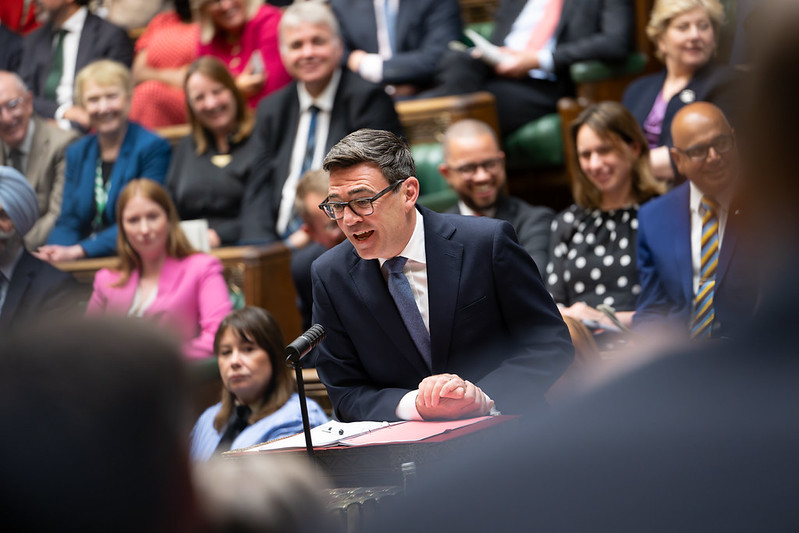
Today’s Prime Minister’s Questions (9 September) was only Andy Burnham’s second in the job, and was the final session before MPs head off on conference recess next Tuesday (15 September). Here’s what we learned.
Kemi Badenoch continued on a theme she has long used to pincer Labour PMs – first Keir Starmer, and now Andy Burnham. Repeating a line she used last week, Badenoch pointed out that Burnham’s new chancellor, John Healey, resigned in protest at the Defence Investment Plan which he felt was not being properly funded. Badenoch even used language similar to that used by Healey in his resignation letter. “Is the Prime Minister unable or is he just unwilling to get spending on defence to 3.5 per cent of GDP by 2035?” she asked.
The Chancellor was watching proceedings behind the line, rather than from the frontbench – a spot he has often occupied, even as a backbencher. (Rachel Reeves, in comparison, would often enter the commons for PMQs alongside Starmer). Burnham repeated his own rebuttal, pointing out that the reason he hired Healey was his commitment to increasing spending on defence (“I appointed this Chancellor because of his strong commitment to the defence of this nation”). But he bristled when Badenoch brought up the Conservatives’ own plan for increasing spending on defence.
“I looked at it,” Burnham said, “I don’t think that taking £4bn out of housing benefit is going to get the right consensus around this issue. That would create levels of homelessness… that we wouldn’t have seen before.” In giving this answer Burnham gave a hint of his priorities. He will increase spending on defence, but not if it affects the UK’s social security.

Ed Miliband’s announcement yesterday that the government will sanction illegal Israeli settlements in the occupied West Bank received little airtime during the session. Burnham was flanked on the front benches by Miliband, who likely has not sat that prominently during a session of PMQs since his own time as leader of the Labour Party (albeit on the opposite side of the Commons). Badenoch chose not to grill the Prime Minister on the government’s decision. He instead brought the issue to the floor.
After Badenoch accused Burnham of being “continuity Keir” after “failing to cut welfare”, the Prime Minister responded with a tacit dig at his predecessor. “Words from any politician about a two-state solution will only be words if they are not backed with action,” he said. “Leadership is about taking action.” In typical Burnham fashion he continued, “Britain has to stand for something,” he said. “We will always stand with the underdog. That is leadership on the world stage.”
Ed Davey – the leader of the Liberal Democrats – who in the final days of Starmer’s premiership would often exchange jokes with the outgoing PM – was also critical of Starmer. He thanked Burnham for his action in introducing sanctions, before adding: “It’s something Keir Starmer should have done a long time ago.”
The only criticism of the government’s plans came from the Tory MP Bernard Jenkin. He used the final question of the session to accuse the government of advancing “on a diplomatic dispute with Israel” before asking what advice he and Miliband had received before enacting the sanctions.
“We have given the most careful consideration to all of the issues involved, indeed all of the risks,” Burnham said. But he added gravely that the government is acting to prevent the collapse of the two-state solution. “It is dying before our eyes,” Burnham said. “That requires us to have the confidence to act.”
[Further reading: Ed Miliband is remaking Britain’s foreign policy]
Content from our partners



Related
Join the debate
Subscribe here to comment