
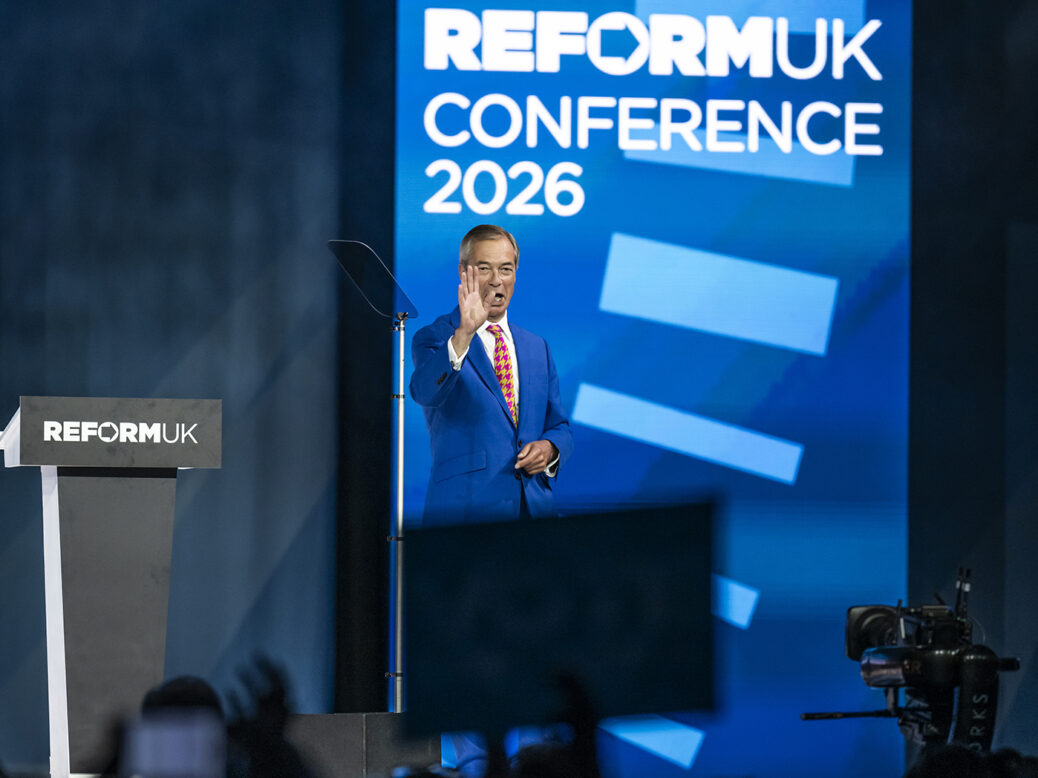
Last night, Channel 4 aired a documentary in which senior Reform officials appeared to welcome donations that would be illegal under the UK’s political finance law. The investigation by undercover journalists Verbatim seemed to show that polls commissioned for Reform were paid for by a US firm. It also showed a meeting with Nigel Farage in which the Reform leader met with, and appeared to welcome the idea of a donation from, someone posing as a foreign donor. Farage has said that his party “has broken no laws” and “has not taken any dodgy money or anything like that”. Reform has said the investigation is “a hoax perpetuated by foreign-funded climate-change activists”. However, electoral donation experts consulted by the New Statesman say the footage could show breaches of the Political Parties, Elections and Referendums Act 2000 (the “PPERA”). Offences under this act can incur a fine or a prison sentence.
Foreign nationals and overseas registered companies are “impermissible donors” under the PPERA; they are not allowed to donate to British politicians or political parties, directly or indirectly. The documentary appears to show Reform officials Dan Jukes and James Orr arranging for polls to be paid for by an American company, which Orr describes in the secretly recorded footage as “technically… a donation in kind”. Later, Nigel Farage and his officials are shown attending a meeting in which they appear to discuss a planned donation in which an American businessman would be the original source of the money.
Section 61(1) of the PPERA states that, “A person commits an offence if he (a) knowingly enters into, or (b) knowingly does any act in furtherance of, any arrangement which facilitates or is likely to facilitate, whether by means of any concealment or disguise or otherwise, the making of donations to a registered party by any person or body other than a permissible donor.”
One of the key words here is “knowingly”. The undercover film seems to show the Reform policy chief James Orr arranging for a US company to pay the pollsters, JL Partners, for a series of polls which Reform UK went on to distribute to newspapers. Orr is recorded as saying to the undercover reporter that he was not going to tell anyone about the arrangement and claiming that “the Electoral Commission… are completely useless. They’re just so dumb and ineffective” and “the reality is we could easily get away with it”. Dan Jukes is shown referring to the undercover reporter as a “key donor for an off-the-book project”.

The key phrase with regards to the meeting with Farage and the conversation about a possible donation in which a foreign national would be the real source of the money is “likely to facilitate”. Farage and Reform are right to say that they have not received this donation, but under the PPERA, taking action to facilitate an impermissible donation is potentially illegal.
Breaking electoral law can be an “either way” offence. This means that, depending on how serious the offence is, it can be treated as a summary offence and tried in a magistrates’ court, or – if more serious – it could be tried in the Crown Court as an indictable offence. Under schedule 20 of the PPERA, the penalties differ depending on where it is heard. A summary conviction for breaking Section 61(1) of the PPERA carries a maximum penalty of six months in prison (or a fine). If heard in the Crown Court as an indictable offence, it carries a maximum sentence of one year in prison (or a fine).
A further breach of electoral law could potentially apply. Section 56(2)(a) of the PPERA requires parties to return impermissible donations within 30 days of their receipt. If the party was found to have failed to have returned an impermissible donation, and not to have taken all reasonable steps to check that the donor was permissible, “the party and the treasurer of the party are each guilty of an offence” and might face a civil penalty, which could include a fine of up to £20,000, applied by the Electoral Commission. A criminal offence carrying a penalty of six months to a year in prison (depending on whether it was considered indictable) is also theoretically possible, but very unlikely.
This is based on the evidence provided in the Channel 4 documentary, which Reform has described as “entrapment”. In the case of Farage, it seems possible he could deny that he “knowingly” joined a meeting to agree an impermissible donation and that he was not fully aware of what was being discussed. Orr and Jukes appear to have a clearer sense of what they were doing.
The case has reportedly been referred to the police, although BBC News has also reported that an investigation is not currently under way. Organisations such as Spotlight on Corruption say the resources available to the Electoral Commission are insufficient (Australia spends 23 times as much, per capita, regulating political finance) and that the penalties for breaches do little to enforce the law. A report released by Spotlight on Corruption this year revealed that since 2010, the electoral fraud unit at the Met police has not opened a single criminal investigation from a referral for either of the two main political finance offences. No one has yet served any time in prison for breaking electoral law.
[Further reading: Who will win the Holborn & St Pancras by-election?]
Content from our partners


Related

Join the debate
Subscribe here to comment