
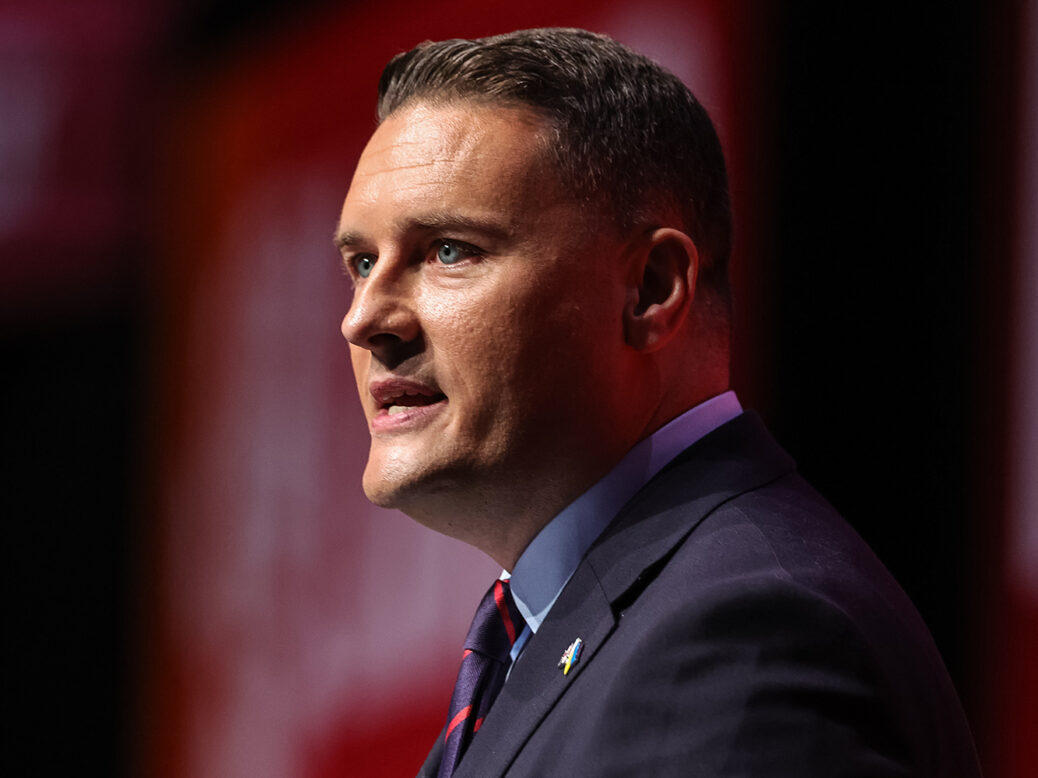
Wes Streeting is a man liberated. This is the first Labour conference in a number of years when he has not been touted by journalists as a potential leadership contender.
In the fast-moving events of this spring, he withdrew his putative leadership bid in order to back Andy Burnham and told a fringe event at Labour conference yesterday: “I am, for the first time since I was probably about 15 years old, not running to be leader of the Labour Party, and it’s quite a liberating position to be in.”
So the leader-ship has sailed, for now. But even Streeting’s critics and factional enemies concede he has formidable energy and lives for politics, so what is he up to instead in his new job as Defence Secretary? Streeting was able to elaborate in his address to party conference on Monday.
In many ways it was a conventional Streeting speech, and I have watched quite a few. As usual, he drew on the heartstrings of the party faithful, harking back to the post-war Attlee government which created the NHS. In a smooth attempt to link his old job as Health Secretary with his new one as Defence Secretary, he said: “That Labour government built another great institution too: NATO… One built security at home, the other built security with our allies abroad.”

There was a cutting attack on the terrible Tories: “If Kemi Badenoch wants to go toe to toe with Labour on defence, we will wipe the floor with the Tories so comprehensively they will see their abysmal record reflected back at them.” As well as a classic Streeting triangulation on the thorny issue of defence spending. He presented the arguments of “our critics on the right”, who advocate cutting welfare to increase defence spending, and said they “need to understand that you don’t make your country stronger by making our people poorer”.
Then it was the turn of “our critics on the left” who, he said, prefer spending on public services to spending on defence. To them, he said, there is no point having public services if they cannot be defended.
Standing between them, Streeting once again presented himself as the moderate friend of common sense. In these moments he demonstrates the influence of Tony Blair, one of his political heroes.
And then the speech moved into altogether more interesting territory as Streeting, the standard-bearer of Blairism in his party, started to flirt with a very different tradition.
He spoke of buying British, reindustrialising the country and making British jobs for British workers in the defence sector a priority. Suddenly, Streeting seemed to be speaking the language of Blue Labour rather than Blairism with its willingness to embrace globalisation and face the future of a post-industrial Britain.
“The Ministry of Defence I lead will be at the heart of our Prime Minister’s mission to reindustrialise Britain,” he said, “because there is neither an economic nor a moral justification for Britain’s defence sector hiring thousands of workers from abroad, when we have one million young people out of work here at home.”
Echoing the words of the Prime Minister, he said: “That is what growth in every postcode means in practice: backing Britain by buying British.” As a concrete example of this, he announced that foreign companies would be blocked from submitting tenders for a new multi-billion-pound project to build floating docks for British nuclear submarines.
Here it was clear that Streeting really has given up his ambitions for the time being. He has gone from being Andy Burnham’s principal rival to being his point man on one of the thorniest issues of the day.
[Further reading: Why Andy Burnham should go to bed with a Trollope]
Content from our partners



Related



Join the debate
Subscribe here to comment