
“I believe,” intones the speaker at the Christian Fellowship for Reform, “that Jesus Christ is the ultimate Reformer.” The Reform Party Conference delegates are still arriving. Long queues of them have formed in the mouth of the Birmingham NEC, filing slowly past a Wetherspoons in which men in turquoise ties were ordering pints at 9am. But the most zealous of the party faithful have already begun to preach. They are gathered, one of the speakers says, in “solemn circumstances”, and he raises his eyes to the huge picture of Ann Widdecombe that covers a nearby wall. In front of the wall is a table on which books of remembrance have been placed. Reform members queue up to write their condolences of Widdecombe’s recent passing in the books. Many are in tears as they do so.
The discussion being held by the Christian Fellowship for Reform was Widdecombe’s idea. She wanted them to discuss free speech, which she saw as integral to her faith. Jesus, one speaker says, was a “free-speech martyr” – and thus, it is implied, a forerunner to Widdecombe. For these people, free speech means the right to follow a woman right up to the door of an abortion clinic, praying and warning of God’s wrath. It means the right to tell other people if they can get married or have children. It means resisting governments that want to make it “illegal to be annoying”. And here they are, as annoyed as they like, saying whatever they want.
There is no risk of their free speech being impinged at the Reform Party Conference, because it is not a party conference. It is a rally. At no point do attendees confer about the party’s ideals or its policies. Journalists who have exposed concerns about the party’s finances have been excluded (free speech apparently is not a universal right). On huge screens across the NEC, the party’s propaganda channel, GB News, blares agreement. “Oh, it’s brilliant, isn’t it,” says a young GB News anchor as he leads a camera across the floor, asking attendees to agree with him. They all do.
No one mentions the investigation broadcast by Channel 4 the previous night (Thursday 3 September). Secretly filmed footage showed James Orr and Dan Jukes – then the party’s policy chief and senior official, respectively – appearing to solicit and welcome illegal donations from overseas. Farage was shown attending a meeting in which it is suggested a foreign donor would pass money to Reform through a UK-based family member. The conference attendees don’t care. They don’t care that Farage is being investigated for failing to declare a £5m donation from a British cryptocurrency billionaire who lives under another name in Thailand. They don’t care that the former leader of Reform in Wales is currently in prison for taking pro-Russian bribes. A man who has been a Reform member for six months tells me he saw a clip about the documentary on social media, but decided not to watch it. A woman in her fifties tells me all politicians are “pigs in the same trough”. She demands to know where Angela Rayner got the money to buy a nice flat in Hove. “I’ve had better jobs than her,” she says of the former deputy prime minister.

In the main hall, as attendees wait for the show to begin, a woman in her late sixties is looking at Facebook on her phone, scowling. She hasn’t watched the Channel 4 documentary either, but she’s watched a reaction video dismissing it as a hoax. The main show is running late. There’s a sense that something unplanned is happening behind the scenes. Is Nigel talking to his lawyer? On the giant screens is Jeremy Kyle, whose eponymous show was once described by a judge as a “human form of bear-baiting”. Kyle tells the crowd that the delay is because the conference is just so popular, and it’ll all get going in five to ten minutes. He keeps doing this every five to ten minutes, for an hour.
The air becomes thick with breath: coffee; wafts of beer; cloying, floral perfume; damp shirts; and, above all, what Japanese call kareishu: “the smell of increasing age” (persimmon soap is a popular remedy). A great guff of kareishu rolls forward as the Reform delegates rise to their feet to welcome Farage to the stage to begin the tribute to Widdecombe, the fallen hero, the Lenin to his Stalin. He calls her “the best-known female politician in Britain since Margaret Thatcher”, which will be news to the two women who have been prime minister since then. “May God bless her soul,” he says. He introduces Reform MP Andrew Rosindell, who delivers a lengthy speech about how Widdecombe stood up for Britain’s “Christian foundations” and “all God’s creatures”.
In the hours that follow, speaker after speaker plods through the same litany: the boats, gender ideology, net zero, grooming gangs, Sharia courts. Britain is broken, they say, over and over again. They don’t offer policy ideas, and this crowd doesn’t want them. They want to be told that Britain has changed for the worse, and that it’s someone else’s fault. And they want Nigel.
But they will have to wait, again. After Richard Tice speaks – “let’s enjoy it,” he says of the climate crisis – Farage is supposed to start speaking, but again something seems to be happening in the background. Some noodling guitar music starts playing, too loud to allow conversation or coherent thought. Ten thousand people are sat in a musical holding loop, like we’re all trying to get through to the same podiatrist. It stops – a breathless moment of anticipation – and then starts again. This goes on for 30 minutes, 40. And then it changes to the choppy opening chords of “Mr Blue Sky” by the Electric Light Orchestra. People are on their feet, singing. This is followed by “Sweet Caroline” and “Dancing Queen”, cruise-ship hits for people who haven’t wanted to listen to anything new for decades. They raise their placards and sing towards the empty stage.
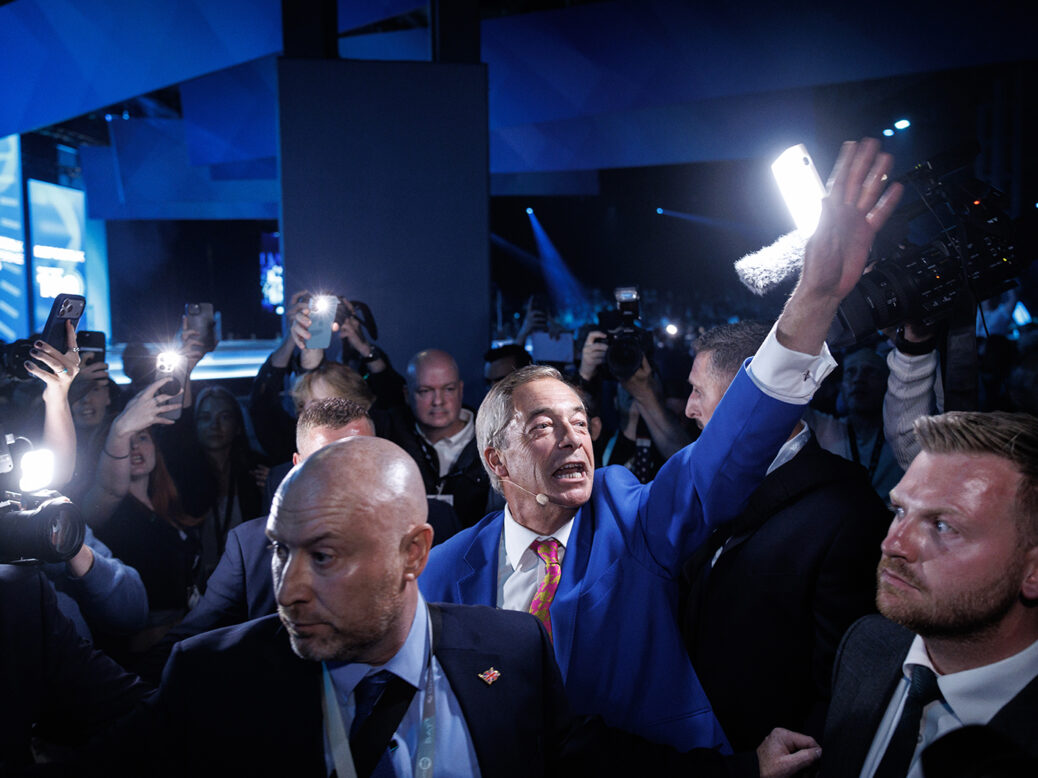
Finally, as “Come On Eileen” plays, the crowd becomes aware that Nigel is in their midst. Ringed by heavies and TV cameras, he makes his way slowly through them. There is yet another awkward wait and then finally, an hour and a half late, he is on stage. Smoke jets from the floor around him. Fireworks blaze. The music reaches a deafening intensity. This is a spectacle designed to create evangelical fervour.
He’s a dull speaker. He can’t do powerful oration or humour, but what he shares with his crowd is a sense of vindictive glee that things are still, somehow, going his way. The reporters asking questions about his finances are “foreign-funded hard-left activists”. The £5m gift was necessary to defend him against the forces of evil. And he will have his revenge: he will declare an emergency, force MPs to work six days a week. He will stuff the Lords with Reform peers, or remake it. He will lay waste to the civil service.
A protester begins to shout, and is rushed from the doors to screams of, “Out, out, out!” A few minutes later another rises, then another. In the harsh lights of the video cameras I see the faces of men and women well past retirement age, bellowing with savage joy. They claw at the young climate protesters, pulling at their hair. Their eyes are wide, like Saturn in Goya’s horrifying painting, the mad giant devouring its children. “Boring, boring,” yells Farage from the stage, but he’s wrong: this is what the crowd came for, the violent ecstasy of hatred. It’s the most fun they’ve had all year.
[Further reading: Zack Polanski faces a fight in Holborn and St Pancras]
Content from our partners



Related
This article appears in the 10 Sep 2026 issue of the New Statesman, The World According To Ed
Join the debate
Subscribe here to comment