
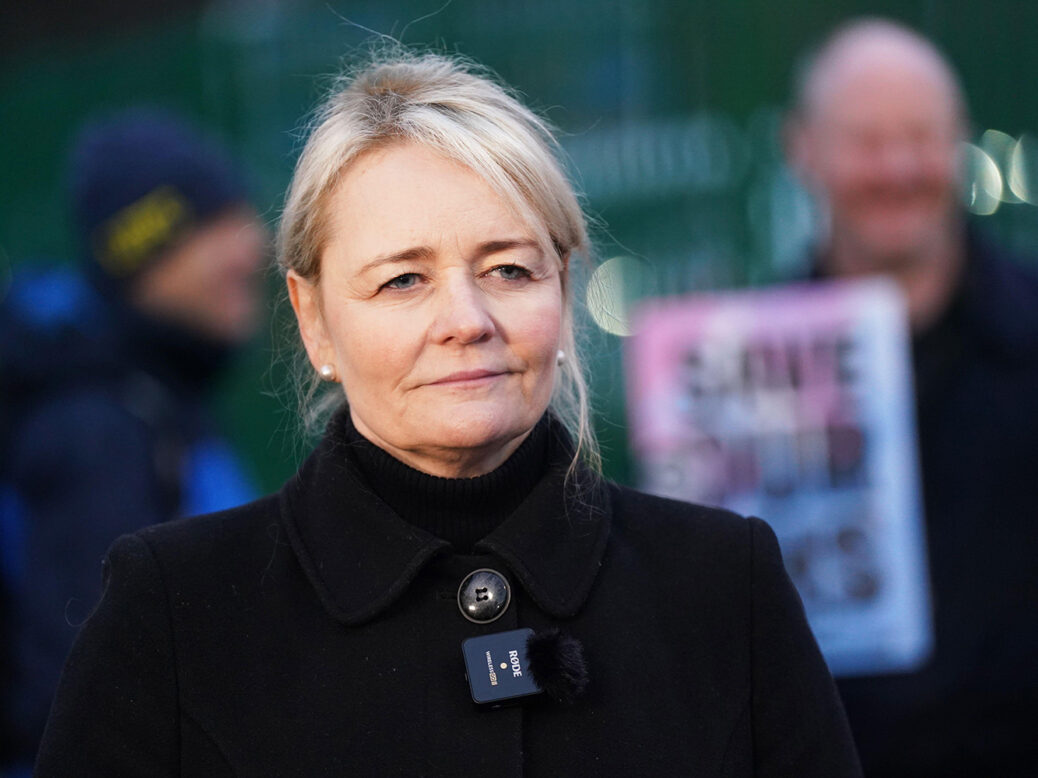
Andy Burnham must reduce the tax burden on working-class people in the upcoming budget or they “will turn their back on politics for good” , the general secretary of one of the biggest Labour-affiliated unions has warned.
Sharon Graham, the general secretary of Unite the union, has called on Burnham to un-freeze income tax thresholds at the upcoming budget, saying that democracy is at threat without a major intervention to improve living standards.
Writing for the New Statesman, she said: “There is now the very real danger that a clear majority of working-class voters will turn their back on politics for good. If they do, who knows what will then follow. But it will likely be far worse than anything Farage can dream up.
“No matter what the bond markets might expect, the working-class are not going to keep paying. At least not without serious consequences for us all.”

Unite is proposing a motion at Labour Party conference to compel the government to lift the freeze on the personal allowance and the point at which taxpayers begin paying the higher rate of income tax in the budget in October, to be funded by the introduction of a wealth tax. The union is also calling for an immediate cut in household and industrial energy bills paid for by the profits of the big energy firms, as well as a windfall tax on banks.
Budget speculation is likely to hang over Burnham’s first party conference as prime minister, as anxiety grows inside his government that he will struggle to match his rhetoric about delivering “the biggest change in 40 years” with the difficult economic reality. Government borrowing costs have soared in recent weeks, and Chancellor John Healey has found himself facing the difficult choice of either raising taxes or cutting spending.
This Unite intervention – with more budget-focused interventions from other unions expected – illustrates the pressure on Burnham and Healey from both sides. While Healey has been at pains to reassure markets that he will “control public spending”, parts of the left are calling on Burnham to be more radical. Graham has said her policies would “mean a new settlement with the bond markets.” If they risk driving up borrowing costs further, this may not be a recommendation Healey is minded to accept.
If Labour doesn’t grasp the moment for change, Farage is the least of our problems
By Sharon Graham
It’s Labour Party conference and inevitably the talk is of budgets and the bond markets. Will there be any meat on Healey’s fiscal bone? And if so, what will the traders say? According to the doom-mongers, any real change will be the end of days.
I not only disagree, but think it’s time to consider the costs of doing nothing. Of keeping to the status quo. Costs that will far outweigh the impact of any YouGov poll or even a slight uptick in the price of our bonds.
One based in the real economy. It’s a hard reality that had wages grown as they were before 2008, the average worker would be making over £10,000 a year more than they do now. That is a lot of money in most people’s books. And behind that figure lies a lot of pain.
When you look at that fact, you can’t see past certain associated truths. Whether that be the economic crash that doubled the public debt and set the stage for stagnation or the political turmoil that has gone hand in hand with it ever since. That one led to another seems undeniable.
It’s also increasingly difficult to argue that the seeds of 2008 were not sown in the decades prior. Specifically, through the free-market consensus that delivered mass liberalisation and the wilful disposal of political agency over our economy by Governments of all parties.
That consensus, shaken by the crash, had already emasculated working-class communities. Manufacturing had already been hammered; millions of jobs lost. The post-2008 wage stagnation followed and was then amped up by the post Covid price hikes. At the same time austerity has hollowed out many of our public services. It should not be a surprise that faith in the system itself has been shaken in many of our communities.
But rather than act as a spur for real change, the system crisis has become a straitjacket for timid politicians and given birth to an increasingly narrow, poisonous politics. One where the wrong people, the working-class, always seem to pay for crises they did not create. Where workers are actively pitted against pensioners and the disabled. And where even the right to protest or trial by jury, are under seemingly endless, relentless attack. The very fabric of our society is being torn, not transformed.
There is now the very real danger that a clear majority of working-class voters will turn their back on politics for good. If they do, who knows what will then follow. But it will likely be far worse than anything Farage can dream up.
Make no mistake, we face a working-class emergency, and it requires a solution that delivers for the working-class, not business as usual. And it certainly does not require another Government hand in their pocket. No matter what the bond markets might expect, the working-class are not going to keep paying. At least not without serious consequences for us all.
But all is not yet lost. Time is short but the stage is set. This must now be a Labour moment. An opportunity to put the people they were created to represent, back to the front of the political queue.
To live up to the billing they are going to have to do a lot more than tinker. They are going to have to deliver real change in the immediate and long term.
Political hands will have to reach for the economic wheel again. To repurpose a New Labour phrase, this Government will have to become “intensely relaxed” about public intervention, control and ownership. And it will have to be unafraid to use its power to buy British.
It must also ensure that ordinary people feel that they are getting a fair shake. That should start with axing the Tory stealth taxes.
How can it be right that at the same time as wealth taxes on the top 1 per cent are routinely dismissed as unworkable, that 1 in 4 of us will end up paying 40 per cent tax by the end of the decade, compared to just 1 in 10 in 2019? The wrong people are about to be told to pay again. Nurses, midwives, teachers, crane drivers, paramedics, biomedical scientists, engineers, energy plant machinists: workers it was never intended to hit.
Next year pensioners receiving the full state pension could be dragged over the 20 per cent threshold. A million may pay more as a result. And 690,000 people claiming Universal Credit will have to pay tax because of the threshold freeze being extended to 2031.
It’s ridiculous and points to the fact that we are not in it all together. That balance must be restored. For sure it will mean a new settlement with the bond markets. Long term political thinking in return for less jumpy trading desks.
Above all, if we are to rescue that which binds us all to this democracy, then Labour must show that the best days of the working class are ahead of them, not firmly in the rear-view mirror. If they fail to act, if they are cowed by hot talk of Truss, then in time we will all pay a much higher price than the latest bond yield.
Sharon Graham is general secretary of Unite
[Further reading: Everyone is blaming John Healey for the stink in the room]
Content from our partners



Related
Join the debate
Subscribe here to commentto be honest…there is so much that needs to be done in order to bring living standards up to european levels….and so little money available to do it. Further government borrowing. will just push up interest rates and cutting taxes will mean Burnhams measures will not be financed….increasing taxes on the wealthy is the only way forward yet they make up just 5 % of the population….so the overall sums are relatively small