
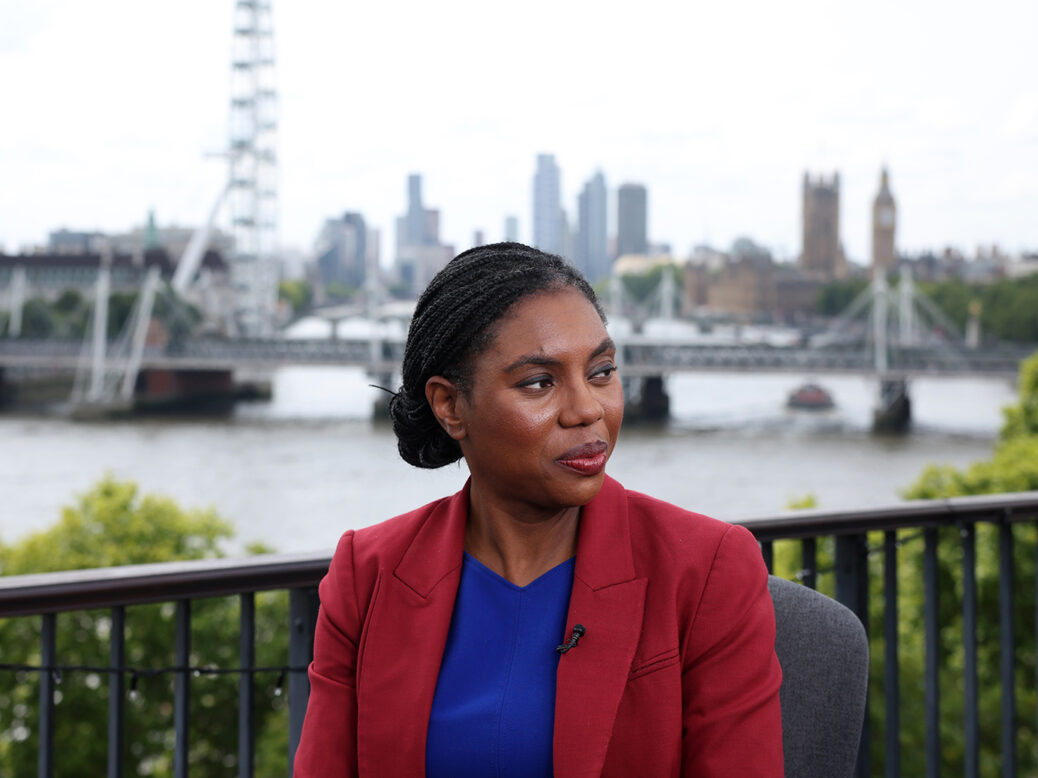
On Thursday, Kemi Badenoch managed to grab the coveted 8:10am interview slot on the Today programme, usually reserved for government ministers, and proceeded to have a testy exchange with Emma Barnett in a range of areas.
Despite the talk of a “Kemi Bounce” – her personal approval rating is good, though lower than the Prime Minister’s, and she has been praised for effective House of Commons performances – the Tory leader’s appearance in the flagship slot exposed a few of the weaknesses she is still struggling with.
Most obviously, there is that characteristic combativeness that can be striking on the floor of the Commons but frankly unlistenable in broadcast interviews. But more importantly, Badenoch repeated some mistakes that are becoming common as she tries to rescue her party from the doldrums.
First, she struggled to defend her party’s record in government. When challenged on low defence spending by the Conservative-led governments of 2010-2024, Badenoch repeated her familiar argument that she was only there for seven years and that the party was under new leadership. But the public doesn’t seem to buy it. The party’s poor record, which stems particularly from the Liz Truss interregnum and the poor state of the NHS after the Covid-19 pandemic, remains stubbornly salient in the public consciousness. It is perhaps admirable that she feels unable to disavow her old colleagues (consider that Liz Truss is still, as far as we know, a Tory party member and compare it to the fate of Jeremy Corbyn under Keir Starmer’s Labour leadership). But that record is a drag on the party and one of the main reasons it is struggling to poll above the 20 per cent.

Secondly, Badenoch got into a pickle on foreign affairs, which is becoming an area of weakness for her. When questioned by Barnett about the government’s new sanctions on illegal Israeli settlements, she made the implausible allegation that the timing of the decision had been influenced by the impending by-election in Holborn and St Pancras, where a Green challenge could deprive Labour of one of its safer seats.
This is an eccentric improvisation on one of the more common accusations made about Labour’s stance on Israel – that the party has started taking a harder line in order to win back parts of its own voter coalition that deserted to the Greens under Keir Starmer. This is certainly arguable. But Badenoch is going further and suggesting that the timing of the sanctions was intended to coincide favourably with the by-election (her spokesperson said the same when addressing journalists on Wednesday). This is far less arguable. If the point even needs to be made, the timing of the sanctions – an international effort coordinated by multiple countries – was triggered by the Israeli government’s decision in late August to open tenders for settlements in the E1 area of the West Bank. It seems the prep work for the sanctions began in the Foreign Office before Starmer even announced his intentions. Nevertheless David Mencer, a spokesperson for the Israeli government, has now repeated this when talking to GB News, perhaps after believing the Conservative bluster on the subject (on Thursday morning his comments could be found on the front page of the Daily Telegraph).
It is the second time this year that Badenoch has argued, flimsily, that the government’s Middle East policy is determined by domestic political considerations alone, specifically the outcome of by-elections. In early March, as the Gorton and Denton by-election result came in and the government ruled out unlimited American use of British bases for strikes at the beginning of the Iran War, Badenoch said the two were linked. This “by-election brain” suggests she is unable to see the bigger picture beyond domestic politics.
She has just appointed a new shadow foreign secretary, Tom Tugendhat, who is experienced in this area and may be able to do a lot of leg work. Badenoch’s supporters insist her experience as International Trade Secretary under the last Conservative government is proof of her foreign policy chops. In this way she is equally matched with Andy Burnham, who lacks experience on the world stage. He will have to learn quickly. Will she?
[Further reading: Nigel Farage is not a Nazi]
Content from our partners



Related
Join the debate
Subscribe here to commentUnfortunately, ‘the timing of the sanctions was intended to coincide favourably with the by-election’ is not that implausible. Opening a tender means a beginning of a long process, far longer than the seven weeks remaining until the elections in Israel in late October. It could easily have been postponed until then, and it is very unlikely that the government did not know that. What could not have been postponed, however, was the Holborn and St Pancras by-election — hence the inference.
It is also curious how much emphasis Mr Burnham is placing upon this policy as evidence of leadership; he is clearly very keen to have it noticed, and the broader message amplified. To Labour, this is no run of the mill foreign policy matter.
Badenoch’s combativeness will be seen as a positive or negative, depending on the listener’s predilictions, but the positions she took were perfectly reasonable. That Labour are trying to secure votes leaking to the Greens is obvious, however much they deny it. Conservative redord in office will be less impactful as we move towards the next election with Labour judged by their record in office and the electorate presented with a clear choice. The Conservatives are no more defined by Liz Truss than Labour is by Jeremy Corbyn.